 Oxify
OxifySlide Cart vs Mini Cart: Which Converts Better? (+ Minicart Reviews & Mini Cart Apps, October 2026)
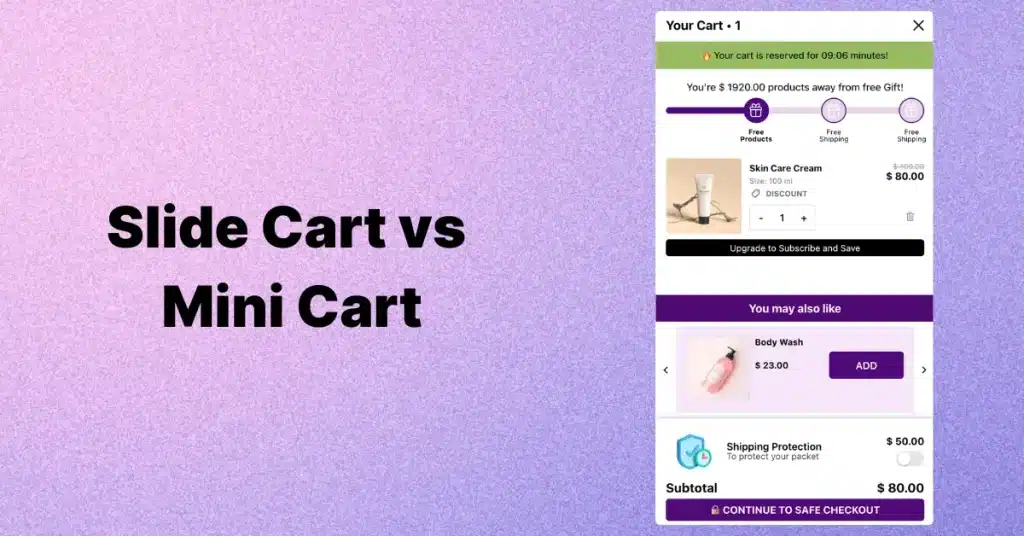
Quick Answer: Slide Cart vs Mini Cart
In ecommerce, a slide cart (cart drawer) is a full-height panel that slides in from the side and stays open; a mini cart is a small dropdown under the header cart icon. For most multi-product stores, the slide cart wins: it fits free shipping bars, upsells and free gifts, and works far better on phones. Mini carts suit single-product stores.
Minicart reviews: Minicart (minicart.com) is not a cart type. It is an AI-run store platform operated by Neurox, Inc., with a free plan and per-sale card fees. As of October 11, 2026 we found no Trustpilot profile and few independent customer reviews, so treat it as a real but young platform. See what we found.
The evidence: There is no independent, published head-to-head A/B test of slide carts vs mini carts, so be wary of precise "17% lift" style claims (we removed our own). What is documented: a slide cart gives you room for the features that do move AOV (free shipping bars, recommendations, free gifts), and on one of our merchants the drawer is the single biggest upsell placement, 57% of app-attributed revenue in our Replenhair case study. The mobile gap is largest because dropdown mini carts are cramped on phones and often fall back to a page redirect.
Bottom line: For most ecommerce stores focused on growth, a slide cart is the better choice. Mini carts still work well for single-product stores with simple checkout flows. Read the full comparison below.
Seven out of ten people who add something to their online shopping cart never buy it.
That is not a guess. It is the average cart abandonment rate across 50 different studies, as documented by the Baymard Institute. The number: 70.22%. It runs higher on mobile, where screens are small and every extra page load costs you.
Let that sink in. If your store gets 1,000 add-to-cart actions this month, roughly 700 of those shoppers will walk away without paying. On mobile, it is usually worse.
Now here is what most store owners miss. A big chunk of those abandonments happen because the cart experience itself creates friction. The shopper wanted to buy. The cart got in the way. Maybe it was slow. Maybe it did not show enough information. Maybe it kicked them to a separate page and they got distracted.
This is why the debate between slide cart and mini cart matters so much. These two cart types look similar at first glance. Both let shoppers peek at their cart without leaving the page. But the way they function, the features they support, and the results they produce are completely different.
This guide gives you everything: the data, the psychology, the case studies, and the exact steps to pick the right cart for your store. Whether you sell beauty products on Shopify or industrial supplies on Magento, this will help you make a smarter decision.
First: Understand All Four Ecommerce Cart Types
Before we dive into the slide cart vs mini cart comparison, you need to know there are actually four main cart types used in ecommerce today. Most articles only cover two. We will cover all four so you have the full picture.
| Cart Type | How It Looks | Best For | Biggest Weakness |
| Slide Cart (Cart Drawer) | Full-height panel from the side | Upselling, mobile, growing stores | Slightly heavier to load |
| Mini Cart (Dropdown) | Small dropdown from header icon | Simple stores, single products | No room for revenue features |
| Full Cart Page | Separate dedicated URL/page | Complex orders, B2B, high-ticket | Interrupts browsing flow completely |
| Modal Cart (Popup) | Center-screen popup overlay | Quick confirmation + one upsell | Can feel intrusive, blocks content |
Shopify agency Ethercycle (whose founder Kurt Elster hosts The Unofficial Shopify Podcast) argues that a full cart page wins for pure conversion rate because it creates a clear action step. They have a point for certain stores. But that argument was published in 2020, before mobile became the majority of ecommerce traffic on most stores and before modern slide carts offered upsells, free gifts, and shipping bars.
The reality in 2026: for most standard ecommerce stores selling multi-item or accessory-friendly catalogs, the slide cart generates more revenue than any other cart type. But the highest-performing stores often use a hybrid, a slide cart for quick interactions and a full cart page accessible via the cart icon for detailed reviews. We will get to that later.
For now, let us focus on the two options that matter most for the majority of stores: the slide cart and the mini cart.
What Is a Mini Cart in Ecommerce?
A mini cart is a compact dropdown or popover that summarizes cart contents when a shopper clicks or hovers over the cart icon in a site's header. It shows product thumbnails, quantities, and the subtotal, then closes when the shopper clicks away — a quick peek at the cart without leaving the page.
In ecommerce, the mini cart's job is speed: instant confirmation that an item was added, with minimal interruption to browsing.
What you typically see inside a mini cart:
- A small thumbnail image of each product
- Product name and variant (size, color, etc.)
- Quantity of each item
- Price per item and the subtotal
- A button to view the full cart page or go to checkout
When you click somewhere else on the page, the mini cart closes. It is designed to be fast, lightweight, and unobtrusive.
The mini cart user flow:
- Shopper clicks Add to Cart on a product page
- The cart icon updates with a small badge showing the item count
- Shopper clicks or hovers over the cart icon
- A compact dropdown appears with cart contents
- Shopper either clicks through to checkout or closes the dropdown to keep browsing
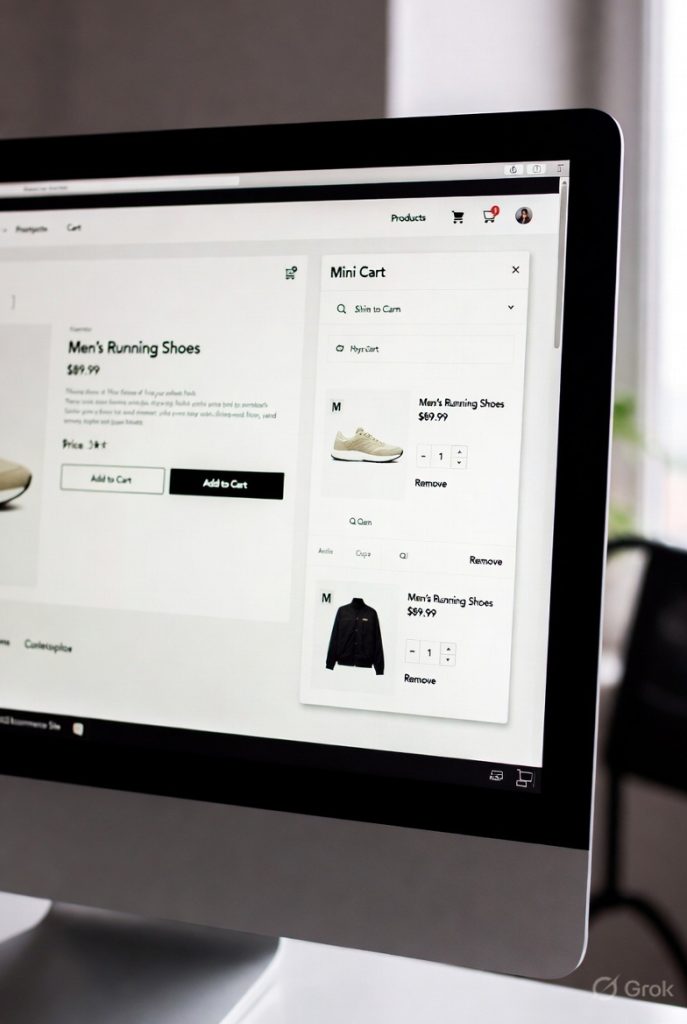
Three types of mini carts you will see in the wild:
Dropdown mini cart. A vertical list that drops straight down from the cart icon. Most common on desktop. Clean and simple. Very limited in space. Brands like Nike have used this style with thumbnails and a PayPal quick-pay button.
Hover preview. A tooltip-style popup that appears when you move your mouse over the cart icon. Even smaller than a dropdown. Only works on desktop because phones do not support hover interactions.
Compact slide-out. A hybrid mini cart that slides in slightly from the side but stays small. Offers a bit more room than a pure dropdown but far less than a full slide cart drawer.
Where Mini Carts Actually Work Well
Mini carts are not bad. They do have a place. Here is when they make sense:
Single-product brands. If you sell one product (like a unique gadget or a single supplement), your shoppers do not need upsells. They add one item and go to checkout. A mini cart handles this flow perfectly.
Simple, fast checkout journeys. Stores where the average order is one or two low-cost items benefit from a simple dropdown. No frills, no distractions.
Stores hyper-focused on page speed. Mini carts require fewer scripts, fewer DOM elements, and less CSS. If your entire strategy is built around having the fastest possible page load, a mini cart keeps the overhead minimal.
New stores just getting started. If you have under 100 visitors per day and are still testing products, a mini cart is a fine starting point. Upgrade when the data tells you to.
Impulse-buy stores with single SKUs. Some stores sell quick impulse purchases like stickers, novelty items, or digital products. One click, one item, done. No need for upselling infrastructure.
The Limitations of Mini Carts (What They Cost You)
1. No Room for Upsells or Cross-Sells
This is the biggest revenue problem. A tiny dropdown cannot fit product recommendations, frequently bought together bundles, or complementary item suggestions. These are the features that raise average order value. If your cart cannot show them, you are leaving that money on the table every single time a shopper opens the cart.
2. No Space for Free Shipping Bars
A free shipping progress bar (the kind that says "Spend $15 more for free shipping!") is one of the most effective revenue tools in ecommerce. It works because 40% of shoppers abandon their cart specifically because extra costs like shipping, taxes, and fees are too high (Baymard Institute, 2026). A mini cart rarely has enough room to display this bar clearly. And when it is cramped or hidden, it does not work.
3. Poor Mobile Experience
This is critical. On most stores, the majority of traffic now arrives on mobile devices. Dropdown mini carts feel cramped on phone screens. Scrolling inside a small dropdown is awkward. Buttons are tiny and hard to tap. Many stores end up redirecting mobile users to a full cart page instead, which adds an extra click, an extra page load, and more chances for abandonment.
4. Disappears Too Easily
Mini carts close the moment you click outside them. That means the shopper loses visual contact with their cart contents. This is not just a design inconvenience. It is a psychology issue. When items are out of sight, they are out of mind. The shopper is less likely to feel ownership over those products, which reduces their motivation to buy.
5. No Room for Trust Signals
Trust badges, return policy reminders, security icons, and discount code fields all help close the sale. Mini carts do not have space for any of them. Shoppers have to wait until the checkout page to see these elements, and by then, many have already left.
6. Cannot Support Subscriptions or Gift Options
Modern ecommerce strategies include subscribe-and-save toggles, gift wrapping options, and order notes. These are impossible to fit inside a mini cart dropdown. Brands like Kettle & Fire and Vineyard Vines have moved to larger cart interfaces specifically to support these features.
Mini Cart UX Best Practices
If a mini cart does fit your store, execution decides whether it helps or hurts. Mini cart UX is where most implementations fail, especially on mobile. Follow these eight rules:
1. Never rely on hover, especially on mobile. Phones have no hover state. If your mini cart only opens on mouse-over, your phone visitors (the majority on most stores) can never see it. Always support tap or click to open.
2. Use 44px minimum tap targets. Quantity steppers, remove buttons, and the checkout link all need touch areas of at least 44x44 pixels. Tiny "x" icons cause mis-taps and accidental item removals.
3. Keep the subtotal and checkout link always visible. A shopper should never have to scroll inside a small dropdown to find out what they are paying or how to pay. Pin both to the bottom of the mini cart.
4. Update the cart badge instantly. When an item is added, the header cart count should change immediately with no page refresh. A delayed badge makes shoppers doubt the add worked, so they click again and end up with duplicates.
5. Do not auto-close too fast. If your mini cart flashes open after add-to-cart, keep it visible for at least four seconds or until the shopper interacts. A cart that vanishes after one second feels broken.
6. Support keyboard and screen reader users. The mini cart needs a focusable trigger, Escape-to-close, logical tab order, and aria-live announcements when contents change. This is an accessibility requirement and a UX baseline.
7. Show variant-accurate thumbnails. Blue shirt in the cart? Show a blue shirt, not a generic product image. Wrong thumbnails create "did I pick the right one?" doubt and send shoppers back to the product page.
8. Always provide a path to the full cart page. A mini cart is a preview, not a replacement. Shoppers who want to review details or edit a complex order need a one-click route to the full cart.
Notice something? These rules essentially describe what a slide cart already does by default. That is the pattern worth internalizing: most mini cart UX fixes push the mini cart toward behaving like a cart drawer.
What Is a Slide Cart (Slide-Out Cart or Cart Drawer)?
A slide cart (also called a cart drawer, side cart, slider cart, or slide-out cart) is a full-height panel that slides in from the edge of the screen when a shopper adds a product to their cart or clicks the cart icon. Unlike a mini cart, it stays open until dismissed and has room for upsells, shipping bars, and a checkout button.
Think of it as a mini store inside your cart. You can see your items, change quantities, browse product recommendations, track your free shipping progress, and tap the checkout button. All without leaving the page you are on.
The slide cart user flow:
- Shopper clicks Add to Cart
- A full-height panel slides in from the right side of the screen
- The panel shows all cart items, images, prices, subtotal, and extra features
- Shopper can edit quantities, remove items, add suggested products, or apply discounts
- Shopper either closes the drawer to keep shopping or clicks the checkout button
The critical difference from a mini cart: a slide cart stays open until the shopper actively closes it. It takes up more space, which means it can hold far more features. And on mobile, it becomes a full-screen panel that feels natural to scroll and interact with, no pinching or squinting required.
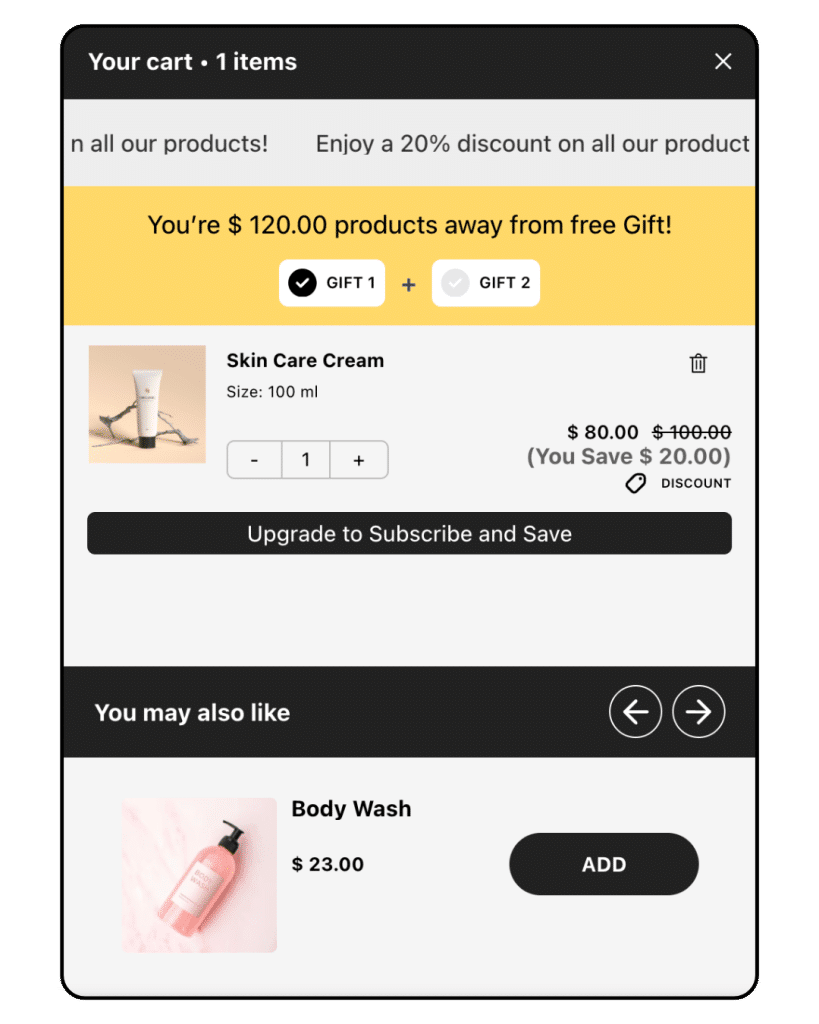
What makes slide carts powerful:
Persistence. Stays visible until dismissed. No auto-close on hover-out. The shopper maintains visual contact with their purchase.
Room for upsells and cross-sells. Product recommendations, complementary items, and bundles fit naturally inside the drawer. This is the single biggest revenue driver.
Free shipping progress bars. A clear visual bar showing how close the shopper is to free shipping. Proven to lift AOV.
Reward thresholds and free gifts. "Spend $50, unlock a free gift" with real-time progress tracking inside the cart.
Discount code support. Shoppers can apply codes directly in the drawer, building confidence before checkout.
Cart announcements. Banners for limited-time offers, seasonal sales, or promotional messages.
Subscription toggles. Subscribe-and-save options for consumable products.
Mobile-first design. On phones, the drawer becomes a full-height panel optimized for touch.
Real Brand Examples Using Slide Carts
These are public examples of brands described as running a slide cart or a vendor's cart drawer. We have not tested or re-checked their carts, and a brand using one is not evidence that it converts better:
Kettle & Fire. Their slide cart includes subscription prompts and product recommendations. Built on Shopify Plus with Rebuy for dynamic suggestions. The cart actively drives recurring revenue.
Allbirds. Uses a clean, minimal slide-out cart that matches their eco-friendly brand. Includes eco messaging inside the drawer.
Every Man Jack. Replaced a custom agency-built slide-out cart with Rebuy's Smart Cart and its AI-powered recommendations. Reported a 10.68% AOV boost and avoided 4+ months of agency development work.
Shoptimizer (WooCommerce theme). Features a slide cart with free shipping indicators and one-click add buttons for upsell products.
They show that slide carts are used across niches, price points and platforms. They do not show that a slide cart beats a mini cart.
Slide Cart vs Mini Cart: Complete Feature Comparison
Here is the most detailed side-by-side comparison you will find anywhere. We compared 14 features, not just the basic 5 or 6 that other articles cover.
| Feature | Slide Cart (Cart Drawer) | Mini Cart (Dropdown) |
| Display type | Full-height side panel | Small dropdown or tooltip |
| Screen space | Large (30-40% of screen) | Small (15-20% of screen) |
| Persistence | Stays until actively dismissed | Closes on click-away or hover-out |
| Mobile experience | Excellent (full-screen panel) | Cramped; often forces redirect |
| Upsell / cross-sell | Yes, with room for 1-3 products | Very limited or impossible |
| Free shipping bar | Yes, highly visible | Rarely fits properly |
| Product recommendations | Yes (AI or rule-based) | Not supported in most cases |
| Free gift / reward unlock | Yes, with progress tracking | No |
| Discount code field | Yes, inline | Rarely |
| Cart announcements / banners | Yes | Very limited space |
| Subscribe & save toggle | Yes | No |
| Quantity editing in-cart | Full editing with +/- controls | Basic; often redirects to cart page |
| Setup complexity | Medium (apps make it simple) | Low |
| Page speed impact | Slightly heavier (optimize with lazy load) | Lighter by default |
Notice the pattern. Mini carts win on one thing: simplicity. Slide carts win on everything that generates revenue.
The Evidence: What Is Actually Documented (and What Is Not)
Most "slide cart vs mini cart" articles, including earlier versions of this one, quote precise lifts like "+17% conversion" or "+$7.50 AOV" without a traceable test behind them. We could not find an independent, published head-to-head A/B test of the two patterns, so we removed those numbers. Here is what can be checked:
| Evidence | What it shows | How much weight to give it |
|---|---|---|
| Baymard Institute | 70.22% average documented cart abandonment across 50 studies; unexpected extra costs are the top checkout-stage reason (40%) | High. Independent, regularly updated. Argues for a visible free shipping progress bar, which needs drawer-sized space. |
| Growth Rock mobile test | A drawer-style sticky button lifted mobile orders 5.2% (98% significance); a plain scroll-to-button version did not move orders | Medium. One store, but a real controlled test showing that drawer-style UI on mobile matters. |
| Oxify: Replenhair | £8,742 of £15,451 app-attributed revenue (57%) came from the cart drawer, versus 27% product page and 17% post-purchase | Medium. Our own merchant, read off the dashboard, not a controlled test. |
| Rebuy: Every Man Jack | 10.68% AOV increase and 53.56% of orders including a recommended product after moving to Rebuy Smart Cart | Medium-low. Vendor-published case study; compares against a custom slide cart, not a mini cart. |
What this adds up to: the case for a slide cart rests on space and mobile usability, not on a magic conversion multiplier. A mini cart physically cannot hold the free shipping bar, recommendations and gift thresholds that the evidence above points to. If your store does not use those features, the gap shrinks, which is why single-product stores can do fine with a mini cart.
Mobile vs Desktop: Where the Gap Gets Wider
The slide cart advantage is larger on mobile devices, for mechanical reasons rather than statistical ones:
- Tap targets: dropdown mini carts shrink quantity buttons and remove links below comfortable tap size on a phone.
- Hover does not exist on touch screens. Hover-triggered mini carts either never open on mobile or fall back to a full page redirect.
- Full-height space: a slide cart becomes a near full-screen panel on mobile, with a sticky checkout button always in reach.
- No page load: the drawer updates through Shopify's Ajax Cart API, so the shopper never loses their place on the product or collection page.
Check your own Shopify analytics for the mobile share of sessions and the mobile vs desktop conversion rate. The bigger that gap, the more a slide cart is worth testing.
Revenue Calculator: What This Means in Real Dollars
An illustration, not a forecast. Assume 10,000 sessions a month, a 2.9% conversion rate and a $60 AOV (about $17,400 a month). If a slide cart with a free shipping bar and one relevant upsell raises AOV by 5% and does not change conversion rate, that is about +$870 a month. If it also lifts conversion by a relative 5%, it is about +$1,780 a month. Replace the assumptions with your own numbers, then run a two-week A/B test to see which scenario you are actually in.
Why a Slide Cart Can Help: The Behavior Principles (Explanation, Not Proof)
These principles explain why extra space and persistence might matter. They come from general behavioral research, not from a test of slide carts against mini carts, so treat them as hypotheses for your own A/B test.
Persistence and feedback. When a drawer opens on Add to Cart, the shopper sees the item, price and total at once, with no page reload. A mini cart is passive: the shopper has to open it, and it closes on click-away.
Goal gradient. People tend to speed up as they near a goal. A free shipping bar ("You are $12 away from free shipping") applies this directly, and it needs room a small dropdown does not have.
Ownership. A large cart with product images and a running total can make the items feel already chosen. A text-only dropdown is easier to dismiss and forget.
Urgency and loss aversion. A drawer has room for a countdown timer, a low-stock note or an expiring code. Use them sparingly; a cluttered cart does the opposite of helping.
Case Studies: Real Stores, Real Results
We only include case studies we can link to. Earlier versions of this guide carried anonymous "fashion retailer" and "general merchandise" examples we could not trace to a source, so we removed them.
Case Study 1: Replenhair (Oxify Merchant, Slide Cart Replacing the Cart Page)
Replenhair, a UK hair-care brand for textured hair, replaced its cart page with an Oxify slide-out drawer carrying a full-width recommendation and a row of 10%-discounted add-ons. Its Oxify dashboard shows £15,451 of app-attributed revenue, of which £8,742 (57%) came from the cart drawer, £4,136 from product-page upsells and £2,573 from the post-purchase offer. Read the full Replenhair case study. Disclosure: Oxify is our app, and these figures are app-attributed revenue, not a controlled A/B test.
Case Study 2: Every Man Jack (Rebuy Smart Cart)
The men's grooming brand had been running a custom agency-built slide-out cart and was planning further agency work to extend it. Instead, they replaced it with Rebuy's Smart Cart and its AI-powered recommendations. Rebuy reports a 10.68% AOV boost, 53.56% of orders including a recommended add-on, and 4+ months of agency development work avoided.
The takeaway: going from no interactive cart to a mini cart helps. Going from a mini cart to a full slide cart only pays off when you actually use the extra space for a shipping bar and one or two relevant offers.
Industry-Specific Recommendations
The right cart type depends partly on your industry. Here is what works best for the most common ecommerce niches.
Fashion and Apparel
Slide cart. No question. Fashion stores have complex orders with multiple items, size variants, and heavy mobile traffic. The cart drawer lets shoppers adjust sizes, see outfit suggestions, and track free shipping. Fashion carts also tend to be abandoned while shoppers compare sizes, which a drawer lets them fix in place.
Beauty and Skincare
Slide cart. Beauty shoppers respond extremely well to product bundles (shampoo + conditioner + treatment), free gift thresholds (spend $50, get a free sample), and subscribe-and-save options. These features need the space a slide cart provides.
Supplements and Health
Slide cart. Subscription toggles inside the cart drawer drive recurring revenue. Frequently bought together bundles (protein + creatine + shaker) increase AOV. This niche also benefits from trust badges visible in the cart.
Food and Beverage
Slide cart. Brands like Kettle & Fire demonstrate this. Subscription prompts, recipe-based bundles, and free shipping bars work perfectly inside a cart drawer. Food and beverage has high repeat purchase potential, so the subscribe-and-save toggle is especially valuable.
Electronics and High-Ticket Items
Hybrid approach. For expensive purchases, shoppers often want a full cart page where they can review specifications and warranty info in detail. But a slide cart works well as the initial add-to-cart confirmation with one relevant accessory suggestion.
B2B and Wholesale
Full cart page or hybrid. B2B orders are often complex with many line items, custom pricing, and purchase orders. A full cart page with detailed editing is usually better. However, a slide cart can still work as a quick-view layer.
DTC (Direct-to-Consumer) Brands
Slide cart. DTC brands live and die on AOV and customer lifetime value. Every upsell, every free gift threshold, every shipping bar directly impacts profitability. The slide cart is built for this.
Single-Product Stores
Mini cart. If you sell one product with no variants and no upsell strategy, a simple dropdown is all you need. Do not over-engineer the cart for a store that does not need it.
Platform-Specific Guidance
Shopify
Shopify is where slide carts have become most popular. The AJAX Cart API allows cart drawers to update dynamically without page reloads. Dozens of apps offer plug-and-play slide carts with upsells, free gifts, and shipping bars.
Oxify Cart Drawer & Upsells (our app) is one of the highest-rated options — 4.9 stars from 40 reviews on the Shopify App Store with the Built for Shopify badge (checked October 11, 2026). It offers built-in upsells, free gift thresholds, a free shipping bar, product recommendations, and discount code support. It works on every Shopify theme and lazy-loads its assets. Plans start at $9.99/month for up to 100 orders a month, with a 14-day free trial.
Other options include Amp Slide Cart Upsell Drawer (by App HQ, formerly sold as Slide Cart), Monster Cart Upsell+ Free Gift, and Rebuy's Smart Cart, part of the Rebuy Personalization Engine (for stores that need advanced AI-powered recommendations). We review all of these with verified ratings and pricing in the app reviews section below. For most stores, a dedicated slide cart app is faster and more reliable than custom theme coding.
WooCommerce
WooCommerce stores have several options. FunnelKit Cart is the most full-featured, with a sliding cart, smart rewards, and upsell modules. Side Cart WooCommerce is a solid free option that adds AJAX-powered real-time cart updates. Modern Cart, a free plugin from the CartFlows team (Pro from $69/yr), adds a sliding side cart — pair it with CartFlows itself if you also want funnel and checkout optimization.
The Shoptimizer theme includes a built-in slide cart with free shipping indicators, which is a good option if you are also looking for a new theme.
Magento / Adobe Commerce
Magento has fewer plug-and-play options. WeltPixel's Quick Cart extension (Magento 2 Quick Cart & Quick Checkout) adds a cart drawer, but the best Magento implementations tend to be custom-built. If you are on Magento, plan for development resources.
BigCommerce
BigCommerce supports cart drawers through theme customization and third-party apps. The built-in cart functionality is more limited than Shopify, so custom development or a specialized app is usually necessary.
Minicart Reviews: Is Minicart Legit? (Five Different Things Share the Name)
If you searched for "minicart reviews", "minicart app reviews" or "is minicart legit", you are probably looking for one of five ecommerce things that share the name. Most searchers mean Minicart (minicart.com), the AI store platform, but the name is easy to mix up:
| "Minicart" meaning | What it is | How to vet it |
|---|---|---|
| Minicart (minicart.com) | An AI-run ecommerce platform operated by Neurox, Inc. You launch and run a store by chatting with AI "teammates" that handle listings, marketing, shipping and customer replies. It positions itself as an alternative to Shopify and Etsy, aimed at small makers. | It is a young product. Look for independent reviews on Trustpilot, G2 or Product Hunt, confirm the company name on your invoice (Neurox, Inc.), and read its terms on payouts, fees and data export before moving a live store. |
| A mini cart (the UI pattern) | The small dropdown cart that opens from the header cart icon. Not a company, so there is nothing to "legit-check". | Compare it with a slide cart using the rest of this guide. |
| Shopify apps with "mini cart" in the name | For example My mini cart‑Cart Drawer by Shine Dezign Infonet (4.6 stars from 12 reviews, $4.49/month, 3-day trial, no Built for Shopify badge, checked October 11, 2026). Not to be confused with "MinCart", a separate order-limits app. | Check the live App Store rating, review count, recent one-star reviews and the Built for Shopify badge. |
| Minicart for WooCommerce (WordPress plugin) | A free WordPress.org plugin that adds a mini cart to WooCommerce stores: 4.2 out of 5 from 14 ratings and 1,000+ active installs, last updated August 2025 (checked October 11, 2026). | Check the plugin's "Tested up to" version and support forum before installing on a current WooCommerce site. |
| minicart.js (open-source script) | An MIT-licensed JavaScript mini cart for PayPal checkouts on GitHub. Its last code commit was in December 2016. | Treat it as unmaintained. Fine for learning, risky for a live store. |
Search results for "minicart reviews" also include rolling office and audio-equipment carts sold under the MiniCart name. Those are physical products, unrelated to ecommerce software.
Minicart reviews and complaints: what we found (October 2026)
- No Trustpilot profile. We found no Trustpilot page for minicart.com on October 11, 2026, and no pattern of public complaints. Most "Minicart reviews" online are AI-tool directory listings and its Product Hunt launch, not customer reviews.
- Pricing. Minicart's own FAQ says it has a free plan with no monthly fee and no credit card required to start; you pay card-processing fees on sales, and paid plans (from $19/month on its pricing page) lower that card rate. We did not verify the exact per-sale rates.
- Ownership and lock-in. Stores run on a yourstore.minicart.com subdomain or a custom domain you own, and the FAQ says your customer list stays yours. It can import an Etsy, Shopify or eBay store through a read-only connection, so the original store keeps running.
- No phone app. We found no Minicart app in Apple's US App Store, so "Minicart app" searches usually mean the platform itself or a Shopify mini cart app.
Is Minicart (minicart.com) legit? It shows the usual signs of a real business: its site names the operator (Neurox, Inc.), the product is live, it runs a public help center, and its team is publicly listed on LinkedIn. What we could not find, as of October 11, 2026, is a large base of independent customer reviews, which is normal for a new platform but means you are an early adopter. We have not run a store on it, so we are not rating it. If you are choosing between Minicart and Shopify, the practical question is lock-in: on Shopify you own the store, theme and customer data and can switch apps freely; on an all-in-one AI platform, check how easily you can export products, customers and orders if you leave.
Is a mini cart worth it on Shopify? For a single-product store with a simple checkout, yes. For most multi-product stores, a slide cart is the better choice, for the space and mobile reasons covered above. The apps below are the options we would shortlist.
Mini Cart App Reviews: 6 Shopify Slide Cart and Mini Cart Apps, Checked October 2026
Old roundups quote review counts that no longer exist, because Shopify apps relist, lose badges and change plans. We checked every listing below directly on the Shopify App Store on October 11, 2026. Full disclosure: Oxify is our app, so weigh that as you read — but every rating, review count, and price here comes straight from the live listings.
| App | Rating | Reviews | Built for Shopify | Starting Price | Free Trial |
|---|---|---|---|---|---|
| Oxify Cart Drawer & Upsells (our app) | 4.9 | 40 | Yes | $9.99/mo (up to 100 orders) | 14 days |
| Amp Slide Cart Upsell Drawer | 5.0 | 773 | Yes | Free plan; upsells from $29.99/mo | 7 days |
| Monster Cart Upsell+ Free Gift | 4.7 | 538 | No | Free to 50 orders; then $9.99/mo | 10 days |
| Rebuy Personalization Engine (Smart Cart) | 4.7 | 853 | No | From $25/mo | 14 days |
| iCart Cart Drawer Cart Upsell | 4.7 | 451 | No | Free first 100 lifetime orders, then $9/mo | — |
| My mini cart‑Cart Drawer | 4.6 | 12 | No | $4.49/mo | 3 days |
Oxify Cart Drawer & Upsells (our app; 4.9, 40 reviews). Every feature — upsells, free gifts, shipping bar, discount field, in-cart subscription upgrades, post-purchase offers — is included at every tier, with pricing that scales by order volume from $9.99/month (up to 100 orders) to $49.99/month (up to 1,000 orders) on the listing. The honest weakness: it launched later than the competitors here, so the review count is smaller, though the 4.9 average and Built for Shopify badge reflect how those merchants rate it. Skip it if you want a free-forever plan or a long review history; Amp covers both (a free plan and 773 reviews).
Amp Slide Cart Upsell Drawer (5.0, 773 reviews). A perfect rating across 773 reviews, more than any other cart-only app here (Rebuy's wider suite has 853), and a polished drawer. If you searched for "slidecart" or "Slide Cart app", this is probably the one you mean: its listing still lives at apps.shopify.com/slide-cart. It has a free-forever plan for the basic drawer (announcements, trust badges, discount box); upsells and the progress bar need Growth at $29.99/month, and free gifts need Pro at $49.99/month. Both paid plans are flat, not tied to order volume. Skip it if you need free gifts on a small budget, since they sit on the $49.99 plan.
Monster Cart Upsell+ Free Gift (4.7, 538 reviews). Playful design and strong free-gift mechanics. It is free up to 50 orders, then $9.99/month (Starter) and $14.99/month (Scaler), with a 10-day trial. It no longer shows the Built for Shopify badge on its listing. Skip it if the Built for Shopify badge is a requirement for your store. Full review: Monster Cart pricing, review and alternatives.
Rebuy Personalization Engine (4.7, 853 reviews). Smart Cart is one feature of a much larger AI personalization platform, and it is the most powerful option here — this is what Every Man Jack used. It is also overkill for most small stores: pricing starts at $25/month and scales with order volume, with a 14-day trial. No Built for Shopify badge. Skip it if you only need a cart drawer; you would be paying for a full personalization suite.
iCart Cart Drawer Cart Upsell (4.7, 451 reviews). The most generous entry point — free for your first 100 lifetime orders (total, not per month), then from $9/month. It bundles popups and other widgets beyond the cart, which some merchants like and others see as more than a cart needs. No Built for Shopify badge. Skip it if you want a cart-only tool.
My mini cart‑Cart Drawer (4.6, 12 reviews). The cheapest option at $4.49/month and the closest to a literal compact mini cart (drop-down mini cart, fixed cart or Ajax cart). With only 12 reviews and no Built for Shopify badge, it is fine for experimenting on a small store but a riskier long-term bet than the established apps above. Skip it if you need upsells, a free shipping bar or free gifts; its single plan does not list them.
Want the full deep-dive with screenshots and feature-by-feature breakdowns? See our guide to the best Shopify cart drawer apps.
Revenue-Driving Slide Cart Features (Ranked by Impact)
Not all slide cart features are equal. Here they are ordered by how directly they move order value, based on the evidence above.
1. Free Shipping Progress Bar (Highest Impact)
A visual bar that shows shoppers how much more they need to spend for free shipping. Example: "You are $14 away from FREE shipping!" Setup details are in our free shipping bar in the cart drawer guide.
Why it works: 40% of shoppers abandon because extra costs like shipping run too high (Baymard Institute). When you show them exactly how to avoid that cost, they add more items. Set the threshold 20 to 30% above your current AOV so it is reachable with one add-on.
2. Frequently Bought Together / Cross-Sell (High Impact)
One or two product suggestions that complement what is in the cart. The key: one-click add buttons and limiting to 1-2 suggestions to avoid decision fatigue. Shampoo in cart? Suggest conditioner and treatment.
3. Free Gift Unlock (High Impact)
Spending thresholds that unlock free gifts. "Spend $50 for a free travel-size moisturizer." Creates a game-like experience that taps into the Goal Gradient Effect. Shoppers actively seek items to reach the threshold.
4. In-Cart Discount Code Field (Medium Impact)
Let shoppers apply discount codes directly in the cart drawer. Removes the uncertainty of "will my code work?" and builds checkout confidence.
5. Cart Announcements and Urgency Timers (Medium Impact)
Short, specific time-bound messages. "Flash sale ends in 2:14:33" or "Only 3 left in stock." Works best in the larger space of a slide cart.
6. Subscribe and Save Toggle (Medium-High for Consumables)
For brands selling products people reorder (supplements, skincare, pet food, coffee), a subscribe toggle inside the cart drawer drives recurring revenue with zero extra acquisition cost.
7. AI-Powered Product Recommendations (High for Large Catalogs)
Advanced slide carts use AI to suggest products based on cart contents, browsing history, and similar customer behavior. Goes beyond static bundles. Most effective for stores with 50+ products.
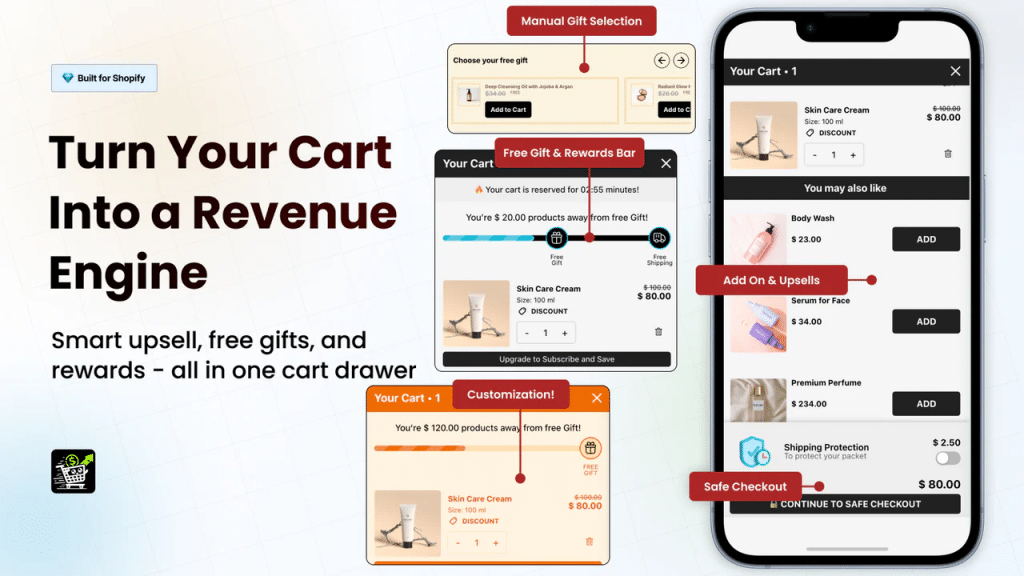
Slide-Out Cart Design: Best Practices Checklist
Good slide-out cart design is mostly restraint: one incentive, one or two offers, and a checkout button that never scrolls away. For a scored version you can run against your own store, use our cart drawer best-practices checklist (10 pass/fail tests).
1. Keep It Clean
Do not cram ten widgets into the cart. Show cart items at the top, one or two product suggestions below, your main incentive (shipping bar or gift unlock), and a sticky checkout button. That is it.
2. Make the Checkout Button Sticky
Pin the checkout button at the bottom of the drawer so it is always visible, even when the shopper scrolls through a long cart. The same idea on the product page is a sticky add to cart bar; see our sticky cart and sticky add to cart apps guide.
3. One Clear Incentive at a Time
A free shipping bar works great. A free gift threshold works great. But stacking five promotions creates confusion. Pick one main incentive per campaign cycle.
4. Limit Upsells to 1-2 Products
More than two suggestions inside the cart causes decision fatigue. Show the most relevant recommendation based on cart contents. Quality over quantity.
5. Auto-Open on Add to Cart
The slide cart should open automatically when a shopper adds a product. This provides instant feedback, confirms the action, and keeps them engaged with the cart.
6. Test on Real Phones
Do not just use a browser resize tool. Open your slide cart on actual iPhones and Android phones. Check that scrolling is smooth, buttons are easy to tap, and the checkout button is always reachable. Check your Shopify analytics: on most stores, mobile is the majority of sessions.
7. Lazy Load Upsell Images
Product recommendation images should only load when the drawer opens. This prevents them from impacting your initial page load time and protects Core Web Vitals scores (LCP and CLS).
8. Show Exact Product Variants
If a shopper ordered a blue shirt in size medium, the cart thumbnail should show a blue shirt. Not a generic product image. This reduces returns and builds purchase confidence.
9. Enable Easy In-Cart Editing
Shoppers should be able to change quantities, remove items, and apply discounts directly inside the drawer. Every redirect to a separate page risks losing them.
10. Track Everything and A/B Test
Measure conversion rate, AOV, checkout start rate, and time-to-checkout before and after implementing the slide cart. Track mobile and desktop separately. Use A/B testing if your traffic supports it.
Common Mistakes That Kill Slide Cart Performance
| Mistake | Why It Hurts | How to Fix It |
| Overloading with upsell widgets | Decision fatigue; slow load time | Limit to 1-2 relevant products max |
| No sticky checkout button | Shoppers can't find how to pay | Pin the CTA at the bottom of the drawer |
| Heavy unoptimized scripts | Kills page speed; hurts Google rankings | Lazy load all drawer assets; minimize JS |
| Not testing on mobile devices | Your largest traffic segment gets a broken experience | Test on real phones weekly |
| Stacking conflicting discounts | Confuses shoppers; breaks cart logic | QA all coupon combinations thoroughly |
| No analytics tracking on the cart | Can't measure if it's working | Track CR, AOV, checkout starts as minimum |
| Cart drawer fully blocks page content | Feels annoying instead of helpful | Use semi-transparent backdrop with close button |
| Missing accessibility features | Excludes users; potential legal risk | Add focus trap, ARIA labels, keyboard nav |
| Ignoring returning customer behavior | Same experience for first-time and loyal buyers | Personalize upsells based on purchase history |
| Not testing drawer vs page for your store | Assuming one is always better | Run a 2-week A/B test; let data decide |
Accessibility: Do Not Skip This
A slide cart must be accessible. This is not optional. It is a legal consideration (ADA, WCAG), an SEO factor, and the right thing to do.
- Use role="dialog" and aria-labelledby on the cart drawer container
- Trap keyboard focus inside the drawer when it is open
- Allow the Escape key to close the drawer
- Make all buttons and links keyboard navigable (tab order)
- Use sufficient color contrast on text and buttons (minimum 4.5:1 ratio)
- Announce cart updates to screen readers using aria-live regions
- Ensure the close button has a clear accessible label
Most well-built Shopify cart drawer apps handle accessibility automatically. Always verify with a screen reader after setup.
How Your Cart Type Affects SEO and Core Web Vitals
Google uses Core Web Vitals as a ranking factor. Your cart choice can affect these metrics. We tested the question in depth in does a cart drawer app slow down your store?
Mini carts and site speed:
Mini carts are lighter. Less JavaScript, fewer DOM elements, smaller CSS footprint. This generally means faster Largest Contentful Paint (LCP) and lower Cumulative Layout Shift (CLS). If your site is already slow, a mini cart adds less overhead.
Slide carts and site speed:
Slide carts use more code because they include recommendations, animations, progress bars, and dynamic elements. A poorly built slide cart can cause layout shifts (bad CLS), block the main thread (bad Interaction to Next Paint), and slow down initial render (bad LCP).
The fix:
A well-built slide cart lazy-loads images, defers JavaScript until the drawer is triggered and keeps inline CSS small. Do not take any vendor's word for it, including ours. Shopify's enforced performance rule is that an app must not lower a store's Lighthouse performance score by more than 10 points, measured across the home, product and collection pages (Shopify storefront performance docs). Shopify also suggests keeping the entry file an app block references to about 10 KB of compressed JavaScript and about 100 KB of compressed CSS (theme app extension limits). Both checked 11 October 2026. These are Shopify's rules, not a ranking of cart apps.
Bottom line: judge a cart app on your own store. Run Google PageSpeed Insights on your home, product and collection pages before and after installing it, and treat a drop that approaches Shopify's 10-point limit as a reason to switch.
The Hybrid Approach: Using a Slide Cart AND a Cart Page
The highest-performing stores in 2026 are not choosing one or the other. They use both. (For the drawer-versus-page decision specifically, including when a full cart page still wins, see our Shopify cart drawer vs cart page comparison.)
Here is how the hybrid model works:
- The slide cart opens automatically on Add to Cart (quick interactions, impulse upsells, instant confirmation)
- Clicking the cart icon in the header goes to a full cart page (for detailed reviews, complex editing, high-ticket orders)
- Mobile users primarily interact with the slide cart (fewer redirects, faster checkout)
- Desktop users who want more detail can access the full cart page
This approach captures every type of buyer: the quick impulse shopper and the careful researcher. If your platform and theme support it, test this hybrid setup.
How to Add a Slide Cart to Your Shopify Store (Step by Step)
You do not need a developer. If your theme still sends shoppers to a cart page, our guide to replacing the Shopify cart page with a slide cart drawer covers the theme settings first. Here is the fastest path (for theme-level styling of Dawn, Horizon and other themes, see how to customize the Shopify cart drawer):
- Go to the Shopify App Store
- Search for a slide cart drawer app
- Install and activate the app on your store
- Configure your settings: choose which upsell products to show, set your free shipping threshold, customize colors to match your brand
- Enable auto-open on Add to Cart
- Test on a real phone and a desktop browser
- Go live and start tracking results
Oxify Cart Drawer & Upsells (our app) handles all of this. It includes:
- A clean, mobile-optimized slide cart that auto-opens on Add to Cart
- Built-in upsell and cross-sell product recommendations
- Free shipping progress bar with customizable thresholds
- Free gift unlocks at spending tiers you define
- Discount code support directly inside the drawer
- Cart announcement banners for promotions
- Works on every Shopify theme out of the box
- Lazy-loaded assets
Setup takes about five minutes. Install, configure, go live. No coding required.
Try it free for 14 days: Oxify Cart Drawer & Upsells on the Shopify App Store. It is not the right pick if you need a free-forever plan; see the app reviews above for those.
The Future of Ecommerce Cart Design
Cart experiences are evolving fast. Here is what is coming:
AI-powered real-time recommendations. Dynamic suggestions based on cart contents, browsing history, time of day, and similar customer behavior. Requires the flexible space only slide carts provide.
Personalized offers by customer segment. Different incentives for first-time vs returning customers. Adjusting free shipping thresholds by location. This level of personalization needs a programmable cart interface.
AI shopping assistants and agentic checkout. More purchases are starting inside AI assistants and chat, including all-in-one AI store platforms like Minicart. Carts will need clean, structured product and pricing data so an assistant can add items and apply offers correctly.
A compact dropdown has little room for recommendations or per-segment offers, which is why these trends mostly build on drawer-style carts.
Frequently Asked Questions
What is a mini cart in ecommerce?
What is a slide-out cart (slide cart or slider cart)?
What is the difference between a slide cart and a mini cart?
Is a cart page better than a mini cart or slide cart?
Which converts better, a slide cart or a mini cart?
Will a slide cart slow down my website?
What are mini cart UX best practices?
What is the best mini cart or slide cart app for Shopify?
What is Minicart (minicart.com)?
Is Minicart legit?
What do Minicart reviews and complaints say?
How much does Minicart cost?
The Bottom Line
Mini carts are simple, fast, and easy to set up. They work for stores with one or two products and no upsell strategy.
Slide carts are built for growth. They give you space for upsells, recommendations, free shipping bars, gift unlocks, and a mobile experience that actually works. There is no independent head-to-head test, but the evidence points the same way: they hold the features that raise order value, and they work far better on phones.
If you are running an ecommerce store and you have not tested a slide cart yet, this is the easiest high-impact change you can make. You do not need more ads. You do not need more traffic. You need a better cart.
The revenue is already in your store. A good slide cart helps you capture it.
Ready to Upgrade Your Cart?
Try Oxify Cart Drawer & Upsells free for 14 days. See the revenue difference in your own store data.