 Oxify
OxifyFBT vs Bundle: Which Drives More Revenue on Shopify?
In May 2026 a merchant DMed me: "I added FBT and bundles last month. FBT take rate is 2.4%. Bundle conversion is 0.7%. AOV went up $11. Did I waste my time?"
Short answer: no. He's actually performing above average on both. But most Shopify merchants have no idea what "good" looks like for either tactic, which is why so many give up after a week. This guide settles it.
Quick answer
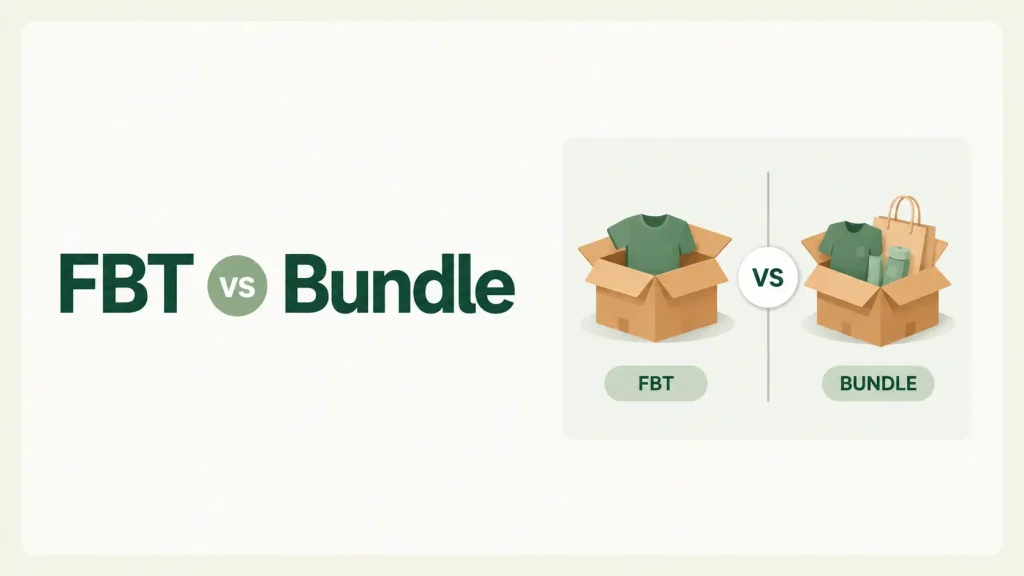
Bundles add more per accepted offer than Frequently Bought Together (FBT): in Oxify merchant data, a 15-25% Average Order Value (AOV) lift versus 5-10%. FBT gets more shoppers to accept (1-3% take rate versus 0.5-1.2%). Running both, at different funnel stages, gave the largest combined lift: 25-40%.
| Metric | FBT | Bundles |
|---|---|---|
| Take rate (average) | 1-3% | 0.5-1.2% |
| Take rate (top stores) | 8%+ | 3%+ |
| AOV lift (average) | 5-10% | 15-25% |
| AOV lift (top stores) | 20%+ | 30%+ |
| Extra revenue per accept | $10-$25 | $30-$90 |
| Setup time | 10 minutes | 30-60 minutes |
| Discount required | 5-10% | 15-25% |
| Best for | High traffic, low AOV | Paid traffic, product sets |
Sources: Oxify merchant data Q1 2026, Oxify FBT Conversion Rate Benchmarks, Shopify's official AOV guide.
Key takeaways
- FBT wins on take rate. 1-3% of shoppers accept on average, 8%+ for top stores.
- Bundles win on order size. 15-25% AOV lift per accepted offer versus FBT's 5-10%.
- The $8-$25 sweet spot. Add-on items priced $8-$25 attach 2.4x more often than items above $40 in Oxify merchant data.
- Manual beats AI on top SKUs. Hand-picked pairings outperform algorithmic ones by ~30% on take rate for top sellers.
- Mobile beats desktop. Mobile take rate beats desktop in 60% of stores we analyzed.
- Cold-start problem is real. FBT algorithms need 50+ orders to detect real patterns. Below that, use manual pairings.
- Stack them. FBT plus bundles plus cart upsells plus post-purchase typically lifts AOV by 25-40%.
What is Frequently Bought Together (FBT) on Shopify?
Frequently Bought Together (FBT) is a Shopify cross-sell tactic that suggests 2 or 3 complementary products on a product page or cart drawer, with a one-click "Add all to cart" button and a small bundle discount (typically 5-10%).
The format originated with Amazon's recommendation engine and is now standard across ecommerce. On Shopify, FBT widgets are added through apps like Oxify Cart Drawer & Upsells (our app) and Frequently Bought Together CBB from Code Black Belt. Our comparison of 15 FBT apps covers the rest.
How FBT works in practice:
- A shopper lands on a product page (say, a coffee grinder).
- They see a "Frequently bought together" section showing the grinder, filters, and a cleaning brush.
- Total displays the bundle price with a 10% discount applied.
- One click adds all three items to the cart.
The shopper barely had to think. That's why FBT has a higher take rate than full bundles.
What is a product bundle on Shopify?
A product bundle is a pre-built set of two or more products sold together as a single offer, typically at a discount of 15-25% versus buying them individually.
Bundle types on Shopify include:
- Fixed bundles. "The Starter Kit" with 3 specific products at one price.
- Mix and match bundles. "Pick any 3 from this collection, save 20%."
- Volume bundles (quantity breaks). "Buy 2 save 10%, Buy 3 save 20%" on the same product (what quantity breaks are and how to set them up).
- BOGO bundles. Buy one, get one free or discounted.
- Build-your-own-box. Step-by-step bundle builder.
Bundles ask shoppers to commit to a bigger upfront purchase in exchange for a meaningful saving and a curated experience.
FBT vs Bundle: the real difference
Both tactics group products. The distinction is when and how they appear:
- FBT is reactive. It reacts to what a shopper is already viewing and suggests add-ons.
- Bundles are proactive. They sell a curated set as its own product, often with its own product page.
FBT lives next to the main product. Bundles often are the product.
The revenue math: which actually drives more?
The honest formula:
Revenue lift = Take rate × Average extra value × Traffic that sees the offer
Let me show you the numbers from our merchant dashboards.
FBT example (Oxify merchant benchmarks)
- Store does 5,000 monthly product page views.
- FBT take rate: 2% (industry average per Oxify Q1 2026 data).
- Extra value per accepted offer: $18.
- Monthly extra revenue: 5,000 × 0.02 × $18 = $1,800.
For a top-tier store hitting 8% take rate, that jumps to $7,200/month from the same traffic.
Bundle example (Oxify merchant benchmarks)
- Same store, same traffic.
- Bundle conversion: 1%.
- Extra value per accepted bundle: $55.
- Monthly extra revenue: 5,000 × 0.01 × $55 = $2,750.
Top bundle programs push this to $5,500+/month.
Real Oxify dashboard data
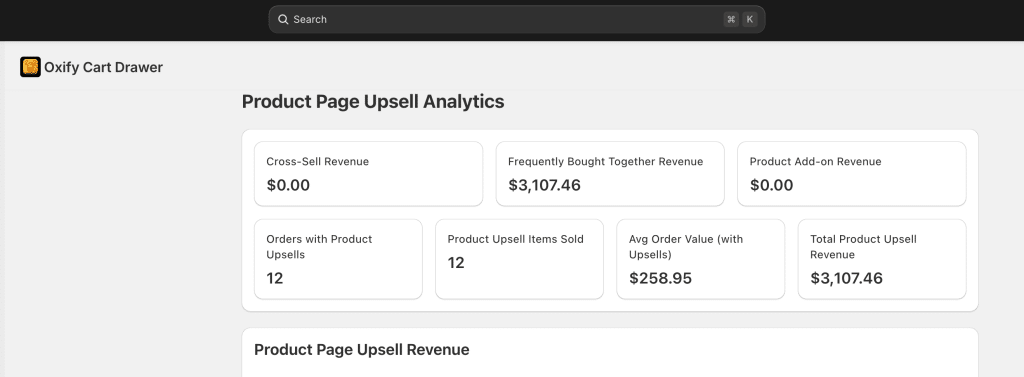
This is from one Oxify Cart Drawer & Upsells merchant's actual dashboard, last 30 days:
- Upsell revenue: $3,107.46
- FBT-attached orders: 12
- Average upsell per order: $258.95
For scale, $3,107.46 is about 155 times the $19.99/month plan price, and that is upsell revenue, not profit. It is one merchant over one 30-day window, not an average, so plan with the benchmarks above and read this as a real example of what a tuned setup can do.
The pattern repeats across our merchant base. Stores that follow the same setup (manual pairings on top sellers, 8-10% bundle discount, widget above the fold) consistently outperform stores running the default app configuration.
Pro tip: Don't judge FBT performance until you have at least 500 widget impressions. Below that threshold, you're reading noise. For low-traffic stores, that's a 30-60 day window.
When FBT drives more revenue
Pick FBT first if any of these are true:
- AOV under $60. Small-ticket items respond best to low-friction add-ons.
- Complementary products. Phone cases for phones, filters for coffee makers, batteries for toys.
- High traffic, decent conversion. FBT compounds across volume.
- Organic-traffic heavy. Organic visitors convert well on small nudges.
- You want fast results. FBT shows clear take-rate data in 48-72 hours.
- Under 50 SKUs. Pairings are obvious and manual setup is fast.
When bundles drive more revenue
Pick bundles first if any of these are true:
- AOV over $50 and you want it higher.
- Consumables business. Supplements, skincare, candles, pet treats, coffee.
- You sell sets. Skincare routines, BBQ kits, gift boxes.
- Running paid ads. You need a bigger AOV to hit profitable Return on Ad Spend (ROAS).
- Clear marketing angle. A pre-built kit can drive its own ad campaigns.
- New product launches. Bundle a hero product with sample sizes or accessories.
When NOT to use each
Skip FBT if:
- Your store has under 30 orders per month. FBT algorithms need 50+ orders of co-purchase data to detect real pairings. Below that, use manual curation.
- Your products don't pair naturally (one-product stores).
- Your product page is already overloaded with reviews, upsells, and badges.
Skip bundles if:
- You can't protect margin on a 15-25% discount.
- Your inventory system can't handle bundled SKUs.
- You haven't validated which products sell well individually first.
The cold-start problem (and how to fix it)
This is the detail most FBT vs bundle guides skip. FBT algorithms need order history to work. Here's the rough threshold map from Oxify merchant data:
- Under 50 orders: Algorithm output is noise. Use manual curation.
- 50-200 orders: Basic pairings emerge. Mix algorithm with manual overrides.
- 200+ orders: Algorithm produces strong suggestions across the catalog.
- 1,000+ orders: Algorithm beats manual on long-tail products. Manual still wins on top sellers.
The fix for new stores: Hand-pick 2-3 complementary products for each of your top 10 sellers. Use the "would I bundle these in a physical store?" test. Switch to algorithmic mode (or hybrid) once you cross 200 orders; our manual vs AI FBT comparison covers when to switch.
Bundles don't have this problem. You build a bundle once, and it works from order one.
The full Shopify upsell stack (where each fits)
The biggest mistake we see merchants make is treating this as "FBT or bundle." It's not. They live in different stages of the customer journey:
| Funnel stage | Tactic | Take rate | AOV lift |
|---|---|---|---|
| Product page | FBT widget | 1-3% (8%+ top) | 5-10% (20%+ top) |
| Product page | Volume bundle (quantity breaks) | 0.5-1.2% | 15-25% |
| Add-to-cart popup | Cross-sell popup | 10-18% | 5-10% |
| Cart drawer | Free shipping bar + FBT | 8-15% | 12-18% |
| Checkout | Last-chance offer | 4-8% | 3-6% |
| Post-purchase | One-click upsell | 5-15% | 6-12% |
Source: Oxify merchant data, Q1 2026. These are our own aggregate ranges, not an independent study, so treat them as directional.
Layered together, this stack lifts total AOV by 25-40% over a baseline store.
That's why we built Oxify Cart Drawer & Upsells to cover these touchpoints in one app instead of forcing merchants to install four separate tools. The checkout-step offer needs Shopify Plus.
Worked example: $60 AOV store
Real numbers on a store with $60 AOV doing 1,000 orders per month ($60,000 monthly revenue).
Without any upsell tactics: $60,000/month baseline.
With FBT only:
- 2% take rate, $15 lift per accept
- New AOV: ~$66-68 (5-10% lift)
- Monthly: ~$66,000-$68,000
With bundles only:
- 1% conversion, $40 lift per accept
- New AOV: ~$69-75 (15-25% lift)
- Monthly: ~$69,000-$75,000
With the full stack (FBT + bundles + cart upsells + post-purchase):
- Combined AOV lift: 25-35%
- New AOV: $75-$81
- Monthly: $75,000-$81,000
That's an extra $15,000-$21,000 per month from the same traffic. No extra ad spend. No new customers required.
5 mistakes that kill both strategies
We've audited dozens of Shopify stores where FBT or bundles quietly leak revenue. The same five problems show up:
- No discount on the FBT widget. A bare FBT widget without a 5-10% discount converts almost no one. The discount is the lever; the widget is just the delivery vehicle. Our internal data shows a 5-10% incentive roughly doubles take rate.
- Too many options. Three is the magic number for FBT. Five products drops take rate by around 40% versus three.
- Below-the-fold placement. Mobile traffic is 72% of Shopify sessions in 2026. If your widget appears only after a scroll, half your shoppers never see it.
- Random or AI-default pairings on small stores. Manual pairings beat AI by about 30% on take rate for top SKUs, especially under 200 orders.
- Bundle pricing too aggressive or too soft. A 5% off bundle won't motivate the leap. A 35% off bundle destroys margin. Stick to 15-25%.
How to choose: a 4-question decision tree
If you're starting from zero, answer these in order.
1. What's your current AOV?
- Under $50: start with FBT.
- $50 to $150: test bundles next.
- Over $150: bundles will drive most of the lift, but FBT is still worth running.
2. Do your products pair naturally?
- Yes: FBT will fly.
- Not really: skip to volume bundles or quantity breaks.
3. Are you running paid ads?
- Yes: bundles. You need bigger orders to make ROAS math work.
- No: FBT first, bundles second.
4. How much time do you have this week?
- One hour: set up FBT.
- A full afternoon: plan and launch your first bundle.
A 30-day implementation plan
The exact order we'd run if launching today:
- Week 1: Launch FBT. Install on top 10 product pages with a 10% bundle discount. Hand-pick 2-3 complementary products per main item (manual beats AI on top SKUs). Measure take rate.
- Week 2: Launch a volume bundle. Add quantity breaks (Buy 2 save 10%, Buy 3 save 20%) on top 5 sellers. Show the pricing table directly on the product page.
- Week 3: Add cart drawer upsells. Enable a free shipping progress bar. Set threshold 15-20% above current AOV. Add one targeted cross-sell below cart items.
- Week 4: Add one post-purchase upsell. Keep the offer under 25% of cart value to avoid friction.
- Month 2: A/B test. Try different discount levels and product pairings. Track AOV before/after, bundle attach rate, and revenue per visitor (RPV).
This progression has taken stores from $42 AOV to $58+ in 30 days without spending one more dollar on ads.
Frequently asked questions
Is FBT the same as a bundle?
Which drives more revenue, FBT or bundles?
What is a good FBT take rate and AOV lift?
What discount should I offer on an FBT widget?
What discount should I offer on a product bundle?
Can I run FBT and bundles at the same time?
Do bundles hurt my profit margin?
Where should the FBT widget appear?
How long until I see results?
Does FBT work for stores with low order volume?
What is the difference between FBT and cross-sell?
What's the ideal price range for FBT add-on items?
Bottom line
If you can only run one this month, pick FBT. Faster, higher take rate, results in 48-72 hours.
If you have a full afternoon and want bigger per-order lifts, launch a volume bundle on your top 5 sellers.
In Oxify merchant data, stores that run both, plus cart drawer upsells and one post-purchase offer, see AOV rise 25-40% from the same traffic, with no extra ad spend.
Set it up
If you want FBT, volume bundles, cart upsells, free gifts, and post-purchase offers running from one dashboard, Oxify Cart Drawer & Upsells handles the full funnel. 14-day free trial, every feature unlocked and the Built for Shopify badge. It is rated 4.9 from 40 reviews on the Shopify App Store (checked 11 October 2026) and starts at $9.99/month for up to 100 orders a month, scaling with order volume, with no revenue share. If all you need is one FBT box on product pages, a dedicated app such as Frequently Bought Together CBB (4.9 from 1,206 reviews, with a free plan for up to 3 manual bundles on the same date) is simpler.
If you mainly need volume bundles, mix-and-match, or quantity breaks (without the full cart drawer setup), Oxify Quantity Breaks (our app; see the Shopify product bundles page) is the lighter, bundle-focused option: one flat $14.99/month plan ($129.99/year) with every bundle feature included, a 14-day free trial, the Built for Shopify badge and a 4.9 rating from 13 reviews (checked 11 October 2026). To compare it with other bundle apps, see our bundle app comparison.
Either way, the worst move is running neither.