Your Shopify cart is either your biggest revenue leak or your most powerful sales tool. It all comes down to one decision Shopify cart drawer or cart page?
We analyzed real merchant data, ran A/B tests, and studied what over 10,000 Shopify stores are doing in 2026. The results are clear. Stores using optimized cart drawers saw a 3.2X revenue growth multiplier before checkout. Stores on basic cart pages? Just 2.2X.
That is not a small gap. That is thousands of dollars in lost revenue every month.
In this guide, you will learn exactly what each cart type does, which one fits your store, the psychology behind why one converts better, and how to set everything up step by step. Plus, we will show you how Oxify Slide Cart Drawer helps merchants turn their cart into a real profit center.
What Is a Shopify Cart Drawer?
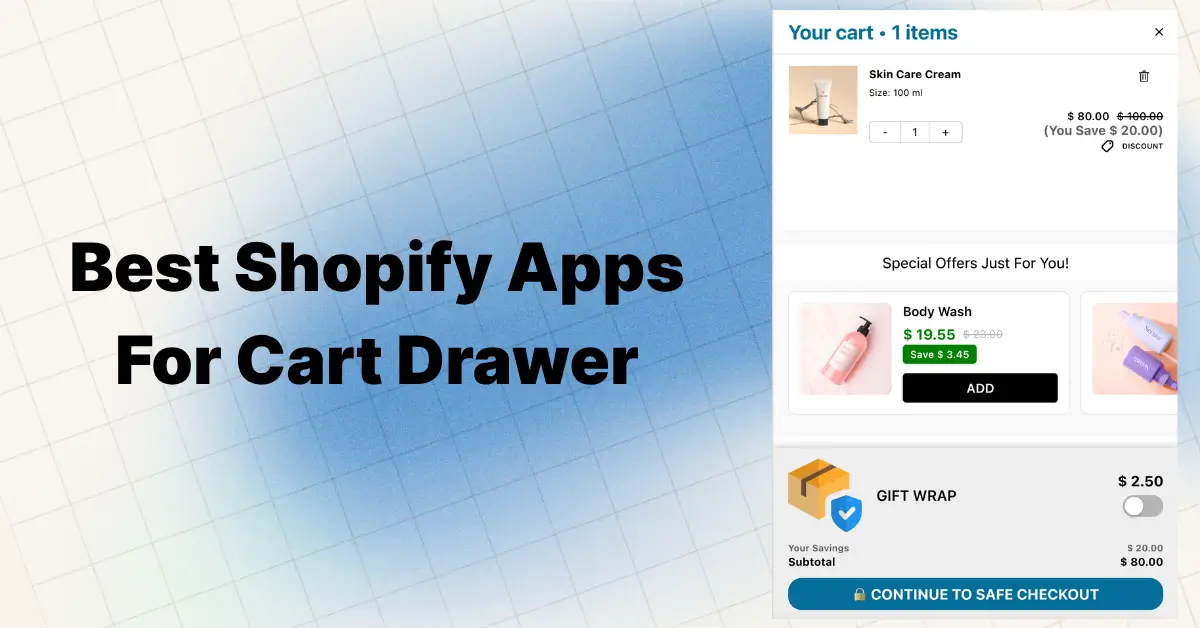
A Shopify cart drawer (also called a slide-out cart, mini cart, side cart, or sticky cart) is a panel that slides in from the side of the screen when a shopper clicks “Add to Cart.” No page reload happens. No redirect. The customer stays exactly where they are.
Picture this: a customer is browsing your best-selling collection. They tap “Add to Cart” on a hoodie. Instead of being sent to a completely different page, a smooth panel slides in from the right. It shows the hoodie, a progress bar saying “You’re $12 away from free shipping,” and a matching beanie suggestion below. They tap “Add” on the beanie without thinking twice.
That entire interaction happened in under 3 seconds. No page loads. No lost momentum.
How it works technically: Cart drawers use Shopify’s AJAX Cart API (/cart.js, /cart/add.js, /cart/update.js) to fetch and update cart contents dynamically. In Dawn and other OS 2.0 themes, it is powered by Section Rendering API and web components like <cart-drawer>. This means the browser never needs to load a new page.
What a cart drawer typically includes:
- “X” button or overlay click to close
- Compact list of cart items (image, title, price, quantity)
- Subtotal and checkout button
- Quick quantity edit and remove buttons
- Optional: upsells, progress bars, discount fields, free gifts
What Is a Shopify Cart Page?
The Shopify cart page is a full, dedicated page at yourstore.com/cart. It uses the templates/cart.json template and renders through sections/main-cart-items.liquid and main-cart-footer.liquid. When a customer adds a product, they are either redirected here or navigate to it by clicking the cart icon.
Think of it as a dedicated checkout preparation room. Everything is laid out on one full screen — every product, every price, every option.
What a cart page typically includes:
- Full table of line items with images, titles, prices, and quantity selectors
- Subtotal and total with any discounts applied
- Cart notes field for special instructions
- Full checkout button (with Shop Pay, Apple Pay, Google Pay options)
- Optional: trust badges, shipping calculators, upsell sections, terms checkboxes
When it makes sense: A customer is buying a $2,500 custom sofa. They need to pick a delivery date, agree to a return policy, check fabric options, and review everything carefully. A small slide-out panel would feel cramped. But a full cart page gives them the breathing room to feel confident about a big purchase.
Shopify Cart Drawer vs Cart Page: Full Comparison
| Factor | Cart Drawer (Slide-Out) | Cart Page (Full /cart) |
|---|---|---|
| User flow | Stays on current page. No reload. | Full redirect. Leaves browsing page. |
| Speed | Instant (AJAX-powered) | Full page load required |
| Revenue multiplier | 3.2X (10K+ store benchmark) | 2.2X (same study) |
| AOV impact | High — impulse upsells + progress bars | Moderate — planned, deliberate purchases |
| Mobile UX | Excellent — full-height on small screens | Good — but feels like leaving the store |
| Cart abandonment | Lower — maintains context and momentum | Higher — extra page = extra drop-off point |
| Screen space | Limited (30-40% of screen width) | Unlimited — full page available |
| Upsell space | Best for 3-5 quick upsells | Better for large bundles and comparisons |
| Trust signals | Limited room for badges and reviews | Plenty of space for UGC, reviews, policies |
| Complex inputs | Not ideal for date pickers, long forms | Perfect for notes, checkboxes, calculators |
| Technical weight | Code loads on every page (watch DOM bloat) | Scripts only load on /cart page |
| Accessibility | Needs focus trap + ARIA roles (modal pattern) | Standard page semantics — easier |
| Best for | Fashion, beauty, FMCG, impulse buys, DTC | High-ticket, B2B, custom orders, luxury |
| SEO impact | None — not indexed | None — /cart rarely indexed either |
What the 2026 Data Actually Shows
We do not believe in opinions without numbers. Here is what real merchant data tells us.
Benchmark: 20,000+ Shopify Stores
- Cart drawers generated a 3.2X revenue multiplier before checkout
- Full cart pages generated 2.2X (still solid, but the gap is real)
- Pop-up carts came in last at 1.95X
- Optimized drawers boosted AOV by 73.8% overall
- Average cart-to-checkout conversion: 5.66% vs the global ecommerce average of just 3%
Feature-Level Impact (Same Study)
- Progress bar in drawer → +260% revenue lift (highest performer)
- Product upsells → +190% revenue lift
- Product recommendations → +165% revenue lift
- Sticky “Proceed to Checkout” button → +6.8% conversion improvement
SalesWarp Conversion Research
- Cart drawers boosted cart engagement by 17% (more items added, more time in cart)
- Full checkout pages led to 13% more completed purchases (the “hard stop” effect)
- Full pages convert 22% better when Shop Pay and Apple Pay buttons are prominent
CXL Institute Case Study
- “Checkout-first” flows outperformed drawer-first by 1.4X in total purchase completions
- But drawers were more valuable for upsells and accessory products
Agency A/B Tests (SEVN Studio, Blend Commerce, 2025)
- Drawers won consistently for stores selling items under $100
- Cart pages won for high-ticket items over $200
- Hybrid setups beat both in most tests
Oxify Internal Data (February 2026)
We pulled these numbers directly from our own merchant dashboards:
- One US-based Oxify merchant generated $90,334 in cart drawer upsell revenue in 30 days
- One India-based Oxify merchant generated Rs. 23,844 in cart drawer upsell revenue in the same period
- Both stores showed consistent daily upsell revenue — not one-time spikes — proving the system works on autopilot once set up
- 100% of this revenue came from in-cart upsells. Zero add-on revenue needed. The upsell module alone did the heavy lifting.
The Big Takeaway
For 80-90% of standard Shopify stores in 2026, the cart drawer generates more revenue. But the highest-performing stores use a hybrid: drawer for quick interactions, cart page for deep reviews.
The Psychology Behind Why Cart Drawers Convert Better
This is not just about technology. It is about how your customer’s brain works.
The Zeigarnik Effect (Unfinished Checklist Trick)
Humans are wired to complete unfinished tasks. It bothers us psychologically when something feels incomplete. Top-converting stores exploit this by showing interactive checklists inside the drawer:
- ☐ Add $15 more for Free Shipping
- ☐ Claim your Free Gift
- ☐ Unlock 10% Off
When shoppers see unchecked boxes, they feel compelled to complete them. This approach lifts AOV significantly more than a passive progress bar.
Oxify Slide Cart Drawer’s multi-tiered progress rewards system is built around this exact principle. You set the thresholds. The drawer handles the psychology.
Momentum vs Hard Stop
A cart page creates a “hard stop” — a deliberate moment where the customer shifts from browsing mode to buying mode. For high-ticket purchases, this is valuable. It builds confidence.
But for most products, that hard stop kills momentum. The customer was happily browsing. Now they are staring at a checkout-focused page. Doubt creeps in. “Do I really need this?” The cart drawer avoids this entirely by keeping the customer in shopping mode.
The Discount Code Abandonment Loop
Here is a pattern that costs stores millions: A customer sees a “promo code” field at checkout. They do not have one. They open a new tab. They Google “[your store] discount code.” They find a coupon site. They get distracted. They never come back.
The fix? Put the discount field inside the cart drawer. When customers apply their code and see savings before checkout, the abandonment loop never starts.
Oxify validates discount codes in real time against Shopify’s backend. The total updates instantly — old price crossed out, savings shown in green. No surprises. No tab-switching. No lost customers.
Even better: When a customer clicks a discount link from your email (like yourstore.com/discount/SUMMER20), Oxify auto-detects and displays it in the drawer. Zero typing required.
When to Use a Cart Drawer
Choose a cart drawer if:
- You sell products priced under $100
- Your customers browse and buy multiple items
- Mobile traffic is 50%+ of your visits (this is most stores)
- You rely on cross-selling, upselling, or free gift promotions
- Speed and a modern UX matter to your brand
- You run a DTC store (fashion, beauty, supplements, home goods, pet, food)
Cart drawers work best for: Apparel, beauty, accessories, home goods, pet supplies, supplements, FMCG, gadgets, and any store where impulse add-ons drive revenue.
When to Use a Cart Page
Choose a cart page if:
- You sell high-ticket items over $1000
- Products need customization (engravings, fabric, configurations)
- Your audience prefers a traditional shopping experience
Cart pages work best for: Luxury goods, custom furniture and any store where the buyer needs space to review and feel confident.
The Hybrid Approach: What the Highest-Converting Stores Actually Do
The smartest Shopify stores in 2026 do not pick one. They use both.
The setup:
- “Add to Cart” button click → Opens the cart drawer instantly. Confirms the item. Shows a quick upsell and free shipping progress bar.
- Inside the drawer → Two buttons:
- Big, bright “Checkout” button (for 90% of customers ready to buy now)
- Smaller “View Full Cart” text link (for 10% who want the full review)
- Cart icon in the header → Links to the full
/cartpage for deep review
This captures impulse buyers, quick shoppers, and careful reviewers — all at the same time.
Oxify supports this hybrid behavior natively. No custom JavaScript hacking needed.
How to Set Up Your Cart Type in Shopify (2-Minute Setup)
No coding required for the basic toggle:
- Go to Online Store → Themes → Customize
- Click the gear icon (Theme Settings)
- Click Cart
- Choose your Cart type:
- Drawer → Slide-out panel
- Page → Redirect to /cart
- Popup notification → Quick toast confirmation
- Click Save
Works on Dawn and all modern Shopify 2.0 themes. Changes go live instantly.
But here is the problem…
Why Shopify’s Default Cart Drawer Is Not Enough
Shopify’s built-in drawer does the basics: shows items, lets you update quantities, has a checkout button. That is it.
It does NOT include:
- Upsells or cross-sells
- Free shipping progress bar
- Free gift with purchase triggers
- Discount code input field
- Countdown timers
- Subscription upgrade options
- Trust badges or payment icons
- Analytics on cart performance
The default drawer is a display tool. It shows your cart. It does not sell.
If you want your cart to actually increase revenue, you need a purpose-built app. That is exactly why we created Oxify.
How Oxify Slide Cart Drawer Turns Your Cart Into a Revenue Machine
Oxify Slide Cart Drawer replaces Shopify’s basic drawer with a fully optimized, conversion-focused slide cart. Every feature is designed to do one thing: make your cart generate more revenue per visitor.
Real Revenue From Real Oxify Merchants
We are not going to throw around vague claims. Here is actual data from two Oxify merchants pulled directly from the Oxify analytics dashboard in February 2026:
Store A (US market): Generated $90,334.55 in upsell revenue in just 30 days — entirely from cart drawer upsells powered by Oxify. That is $90K in extra revenue this merchant would not have made with Shopify’s default cart.
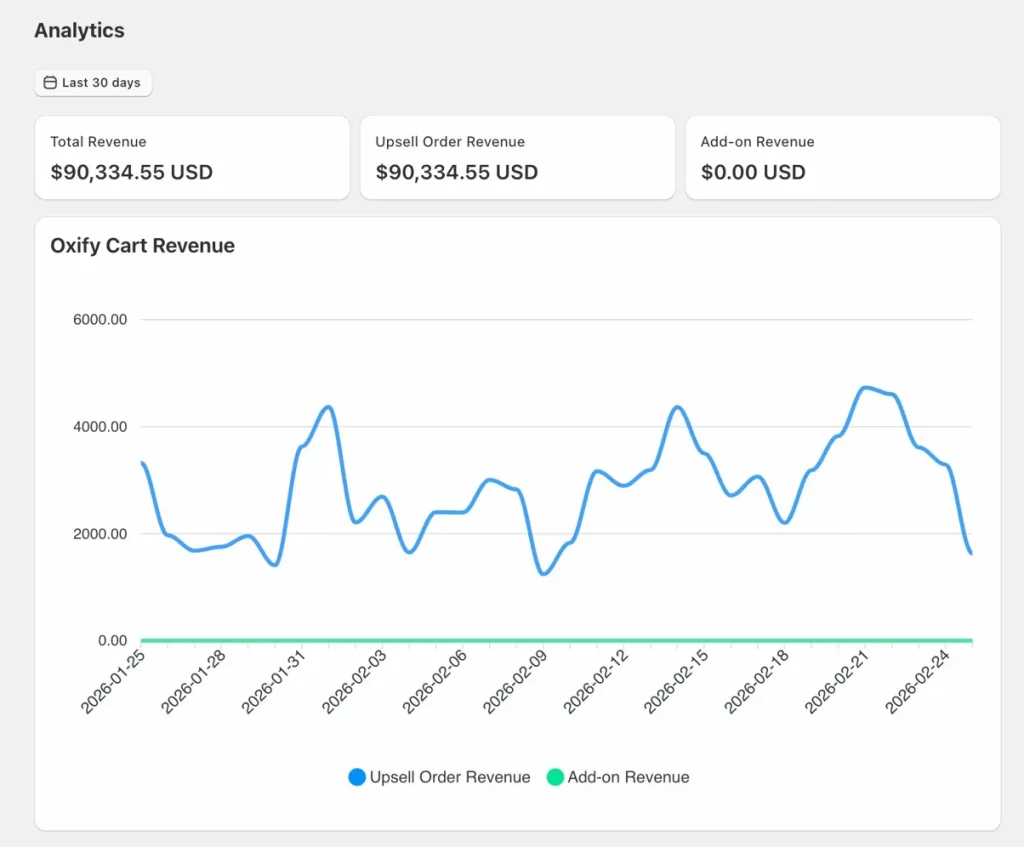
Store B (India market): Generated Rs. 23,844 in upsell revenue in 30 days. Smaller store, same result — consistent daily upsell revenue generated entirely through the cart drawer.

These are not cherry-picked numbers from our best store. These are typical results from merchants who turned on the upsell and progress bar features. The revenue chart shows consistent daily upsell income — not a one-time spike.
The takeaway: A cart drawer by itself does not make you money. An optimized cart drawer with the right upsell features does. That is the difference between Shopify’s default drawer and Oxify.
Here is what Oxify does and why each feature matters:
Multi-Tiered Progress Rewards Bar
Set multiple reward thresholds that motivate customers to spend more:
- Tier 1: Spend $30 → Free shipping
- Tier 2: Spend $50 → Free gift unlocked
- Tier 3: Spend $75 → 10% off your order
The progress bar fills in real time as items are added. Customers see exactly what they unlock next. This “spend → reward” feedback loop lifts AOV by 12-25% on average.
Research backs this up: progress bars alone drove a 260% revenue lift in the 2026 merchant benchmark report.
Smart Cart Upsells and Cross-Sells
Inline product suggestions appear inside the drawer right when purchase intent is highest — before checkout.
- One tap adds the item (variants and subscriptions supported)
- No page reload
- Use proven recipes: “Bundle & Save,” “Premium Add-on,” “Starter + Refill”
Upsells in the cart drove a 190% revenue lift in the same benchmark data.
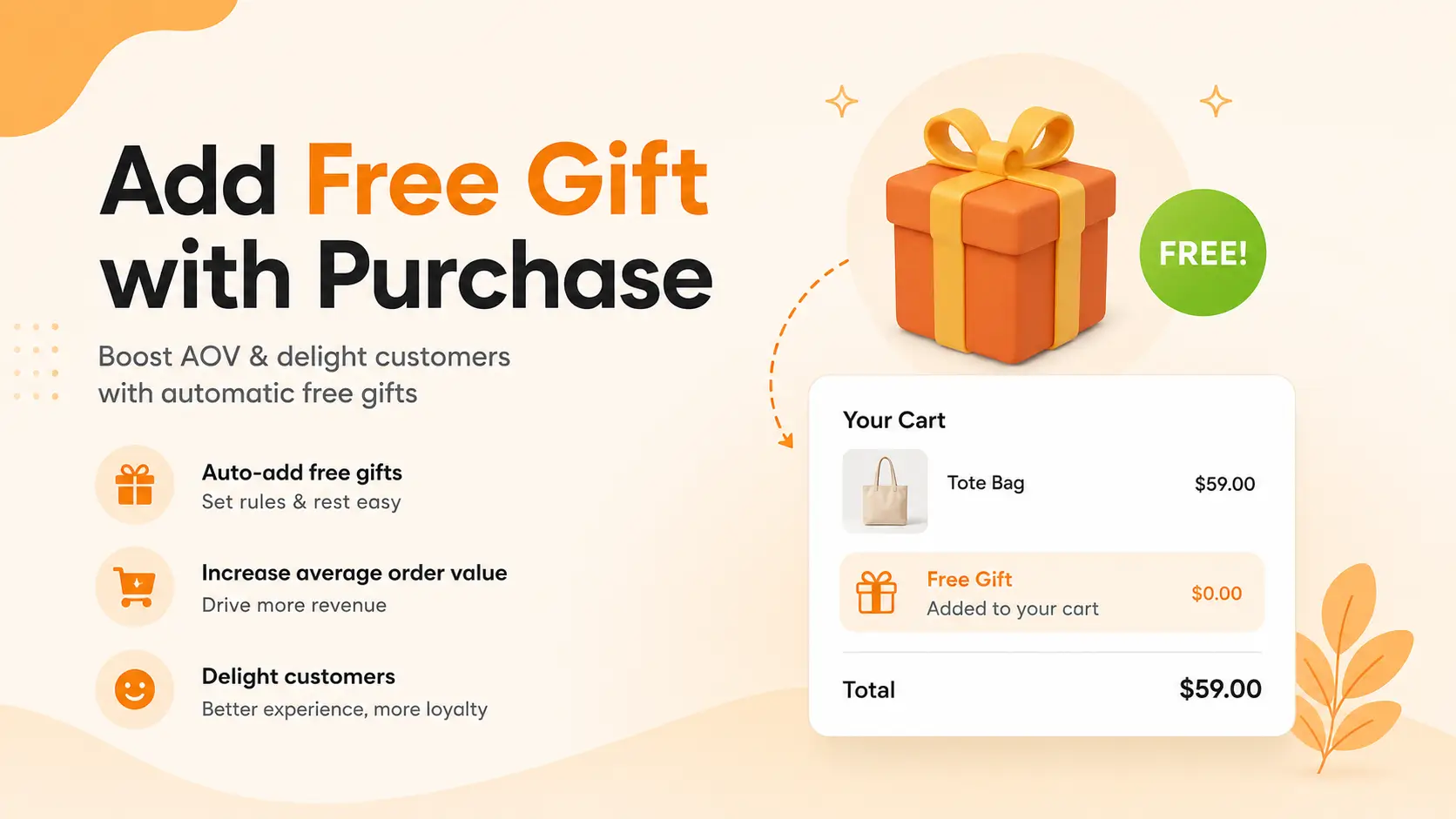
Free Gifts with Purchase
Set up automatic free gifts that unlock when cart value hits a threshold.
Two modes:
- Auto-add: The gift appears automatically when the customer qualifies
- Customer picks: Let shoppers choose from a selection of gifts (this outperforms auto-add because it feels like a reward they earned)
Works globally with multi-currency and Shopify Markets.
Real-Time Discount Code Field
Customers type a promo code. Oxify validates it instantly against Shopify’s backend. The total updates on the spot:
- Old price shows strikethrough
- New discounted total displayed
- Savings amount highlighted in green
Auto-apply from email links: If a customer clicks a link like yourstore.com/discount/SUMMER20, Oxify detects the code and shows it in the drawer automatically. No typing. No confusion. No coupon extensions hijacking your attribution.
This became possible thanks to Shopify Editions ’25 adding native discount support to the cart/update.js endpoint (works on ALL plans, not just Plus).
Read More: Shopify Cart Drawer with Discount Code
One-Click Add-Ons
Gift wrapping. Shipping protection. Extended warranties. Priority handling. These appear as simple toggle buttons inside the drawer. One click adds them. These small extras quietly lift your revenue per order without feeling pushy.
In-Cart Subscription Upgrades
Let shoppers pick “Subscribe & Save” directly inside the drawer. They choose their delivery schedule and lock in savings without extra pages or popups.
- Converts one-off orders into recurring revenue
- Pair with a free gift to make the first subscription irresistible
- Higher customer lifetime value, lower churn
Countdown Timers
Add urgency with timers on upsell offers, free gift deadlines, or flash promotions. Timers create a “buy now or lose it” feeling that speeds up decisions.
Sticky Cart Button
A floating cart button stays visible on every page. Customers can open their cart from anywhere with one tap. Extremely valuable on mobile where the header cart icon can be tiny and hard to reach.
Payment Trust Badges and Split Payments
Show Visa, Mastercard, PayPal, Shop Pay, Apple Pay icons inside the drawer. Display split payment options like Shop Pay Installments. These small signals reduce last-second “is this safe?” hesitation.
Announcement Bar
Share important messages inside the cart: holiday shipping cutoffs, flash sales, new product drops. Keeps customers informed without popups or extra emails.
Real-Time Analytics Dashboard
Track what is actually working:
- Click-through rates per upsell widget
- Conversion rates per feature
- AOV impact over time
- Revenue generated by each element
You cannot optimize what you cannot measure. Oxify gives you the data to make every decision confidently.
Built for Speed (This Matters More Than You Think)
Cart drawer code loads on every page of your site. A bloated app slows down your entire store — hurting your Core Web Vitals, Google rankings, and conversions.
Oxify is built lightweight. It avoids render-blocking scripts and respects CWV scores. Your product and collection pages stay fast.
Works With Your Existing Stack
- All Online Store 2.0 themes (Dawn, Horizon, Impulse, and premium themes)
- PageFly and GemPages page builders
- Judge.me product reviews
- Subscription apps
- Oxify Bundles and Quantity Breaks
- 8 languages: English, Spanish, French, German, Italian, Japanese, Portuguese, Danish
- Multi-currency and Shopify Markets support
- Shopify checkout integration
Oxify Pricing
| Plan | Monthly Orders | Price |
|---|---|---|
| Starter | Up to 200 | $19.99/month |
| Growing | 201–500 | $29.99/month |
| Scaling | 501–1,000 | $49.99/month |
| Enterprise | 1,001–2,000 | $79.99/month |
Every plan includes ALL features. No feature gating. No “upgrade to unlock upsells.”
Every plan includes a 14-day free trial. Test it on your live store risk-free.
Shopify App Store Rating: ⭐ 5.0 (22 reviews — 95% are 5-star)
Built for Shopify badge — meets Shopify’s highest standards for performance, design, and integration.
What Real Merchants Say
“Our conversion rate has increased after using this cart app plus they have done the integration with bundle app.” — Go Ayurveda Dhanvantri (7 months using the app)
“Best cart drawer. Amazing features like free shipping bar and manual gift selection and lots of customization.” — Nutty Village
“The support team really work good and make issues clear.” — FreshLuxe
“It improved our conversion rate even without upselling enabled!” — Oxify customer
→ Start Your Free 14-Day Trial of Oxify Slide Cart Drawer
Other Shopify Cart Apps Worth Knowing
We want to be upfront — Oxify is our app. But we also want you to make an informed decision. Here is how other popular options compare:
UpCart (by AfterSell/Rokt) — 4.6 stars, 720+ reviews. Solid branded slide cart. Known drawback: pricey for high-volume stores, and merchants report problems with multi-language and multi-market setups. Does not support in-cart subscription upgrades.
Rebuy Smart Cart — Starts at $99/month. AI personalization for enterprise stores doing $50K+/month. Overkill and overpriced for small-to-mid stores.
Where Oxify stands apart: All features on every plan (no gating), perfect 5.0 rating, Built for Shopify badge, lightweight code that respects Core Web Vitals, and features like auto-applied discount links and manual gift selection that most competitors lack.
5 Features Every Shopify Cart Needs in 2026
Whether you use a drawer, a page, or both — make sure these are in place:
1. Free Shipping Progress Bar Drove a 260% revenue lift in benchmark testing. Set the threshold 20-30% above your current AOV. Show customers exactly how close they are.
2. 3-5 Targeted Product Upsells Keep it simple. One-click “Add” buttons. Relevant suggestions only. Do not overwhelm with 20 options.
3. Discount Code Input Inside the cart, not just at checkout. Real-time validation. Visual price update. Kills the coupon-hunting abandonment loop.
4. Sticky Checkout Button Always visible, especially on mobile. Increased conversions by 6.8% in merchant tests.
5. Trust Signals Payment icons, return policy snippet, and security badge. Even a single line like “Free Returns • Secure Checkout” helps.
Oxify includes all five out of the box on every plan.
Common Cart Optimization Mistakes
Overloading the drawer. You have limited space. Pick 3-4 elements max. A cluttered drawer converts worse than a bare one.
Ignoring mobile. Over 60% of traffic is mobile. If your cart drawer’s checkout button gets pushed below the fold on a phone, you are losing sales. Always test on real devices.
Installing bloated apps. Cart drawer code loads on EVERY page. Heavy apps hurt your entire site’s speed. Check your PageSpeed Insights score before and after installing any app.
Not A/B testing. Never assume. Run drawer vs page for 7-14 days. Track add-to-cart rate, cart-to-checkout rate, AOV, and mobile vs desktop separately. Shopify’s built-in experiments make this easy.
Forgetting accessibility. Cart drawers are modal dialogs. They need role="dialog", aria-modal="true", focus trapping, and proper keyboard navigation. Shopify’s Dawn theme handles this natively. Check third-party apps carefully.
How to Track if Your Cart Is Actually Working
Set up these metrics in Shopify Analytics or GA4:
- Add-to-cart rate → What percentage of visitors add items?
- View cart rate → How many open the cart drawer or visit /cart?
- Cart-to-checkout rate → Of cart viewers, how many start checkout?
- Checkout completion rate → Of checkout starters, how many finish?
- Average Order Value → Is AOV trending up after cart changes?
- Mobile vs Desktop split → Track separately. They behave differently.
Pro tip: Oxify’s built-in analytics dashboard tracks upsell CTR, conversion per widget, and AOV impact automatically. No GA4 event configuration needed.
Compare your numbers against these 2026 benchmarks:
- Global ecommerce conversion rate: ~1.4-3%
- Average add-to-cart rate: ~4.6%
- Average cart abandonment: ~70%
- Top-performing stores with optimized drawers: 5.66% cart-to-checkout
Our Honest Recommendation
For 80-90% of Shopify stores: Start with a cart drawer. It is the modern standard. Converts better. Works great on mobile. The upsell and free gift opportunities alone can pay for any app several times over.
For high-ticket: Keep the full cart page as your primary experience. Your customers need that space.
For maximum revenue (what we actually recommend): Use the hybrid approach. Drawer for quick “Add to Cart” confirmations and impulse upsells. Full cart page accessible via the cart icon for detailed reviews. This setup captures every type of buyer.
Your Next Steps
- Check your current cart type in Theme Settings → Cart
- If you sell standard consumer products and are still on “Page,” switch to “Drawer”
- Install Oxify Slide Cart Drawer — activate the 14-day free trial
- Enable the free shipping progress bar + 3-5 targeted upsells + discount code field
- Track your numbers for 14 days
Stores that make this switch and pair it with smart upsells see immediate lifts in engagement and AOV. The 10K+ store benchmark data proves it. The psychology backs it up. And with a free trial, there is zero risk in testing it on your store.
→ Try Oxify Slide Cart Drawer Free for 14 Days
Frequently Asked Questions
What is the difference between a cart drawer and a cart page on Shopify?
A cart drawer is a slide-out panel that appears on the current page when you add items — no redirect needed. A cart page is a full, separate page at /cart that requires navigation away from whatever the customer was browsing. Drawers are faster and keep shopping momentum. Pages offer more space for trust signals and complex inputs.
Does switching from cart page to cart drawer hurt SEO?
No. Neither cart pages nor cart drawers are indexed by search engines. Switching between them has zero impact on rankings.
Can I use a cart drawer AND a cart page at the same time?
Yes. This is the hybrid approach used by top-performing stores. Oxify supports this natively — drawer opens on “Add to Cart,” and the cart icon can link to the full /cart page.
Will a cart drawer app slow down my Shopify store?
It depends entirely on the app. Cart drawer code loads on every page of your site. Bloated apps hurt your entire store’s performance. Oxify is built lightweight and avoids render-blocking to protect your Core Web Vitals.
What is the best Shopify cart drawer app in 2026?
For most stores, we recommend Oxify Slide Cart Drawer. It carries a Built for Shopify badge, a perfect 5.0 rating, includes all features on every plan, and is specifically designed to be lightweight while maximizing AOV through upsells, free gifts, progress bars, and real-time discount validation.
Does Oxify work with subscription apps
Yes. Oxify supports in-cart subscription upgrades, letting customers choose “Subscribe & Save” right inside the drawer without extra steps.
How much does Oxify cost?
Plans start at $19.99/month for up to 200 orders. Every plan includes all features with no gating. A 14-day free trial is included on every plan.
What Shopify themes does Oxify support?
All Online Store 2.0 themes including Dawn and most premium themes. It also integrates with PageFly, GemPages, Judge.me, and subscription apps.
How long should I A/B test cart drawer vs cart page?
Run the test for 7-14 days minimum. Track add-to-cart rate, cart-to-checkout rate, AOV, and checkout completion separately for mobile and desktop. Use Shopify’s built-in experiments or GA4.