 Oxify
OxifyFrequently Bought Together for Beauty & Skincare Shopify Stores
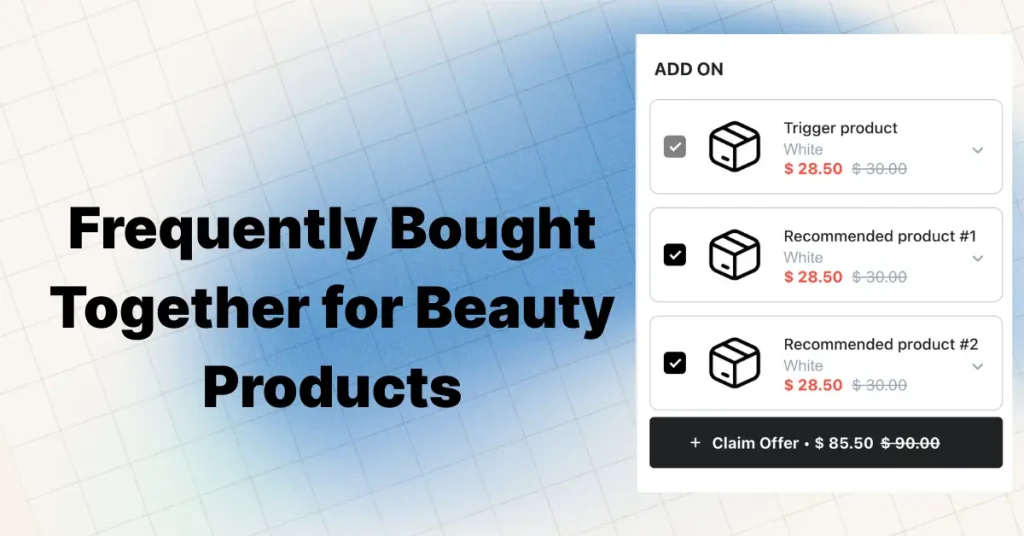
Quick answer: Frequently bought together (FBT) for beauty means showing the other steps of a routine, such as a cleanser and moisturizer, beside a serum, with a one-click add and a bundle discount. On one UK beauty store's Oxify dashboard below, FBT earned £9,642.30 of £15,084.45 in upsell revenue.
Selling frequently bought together beauty products on Shopify is a way to raise your average order value without spending more on ads. But most beauty brands get it wrong. They suggest random products instead of building bundles around how their customers actually use skincare.
Your customer finds your Vitamin C serum. They like it. They add it to cart. They check out. One product. One sale.
But that customer probably needed a cleanser, a moisturizer, and SPF sunscreen to go along with it. They just didn't feel like hunting through 40 product pages to figure out what works together.
That's the gap FBT fills. You're not pushing random add-ons. You're handing them the exact routine their skin needs — and making it dead simple to buy the whole thing at once.
This guide is for beauty founders and marketing teams who want a real skincare bundle strategy they can launch this week. No vague advice. You'll get revenue data from two live Shopify stores running Oxify, a count of how many beauty storefronts we found running bundle or FBT apps on 11 October 2026, a step-by-step setup walkthrough, and five bundle formats to start from.
Why FBT Works Differently for Beauty
In most ecommerce categories, FBT is basic upselling. "You bought a phone case, here's a screen protector." It works fine, but it's nothing special.
Beauty is a completely different game. Skincare products aren't standalone items — they're part of a system. Nobody uses just a serum by itself. They cleanse first, apply the serum, moisturize after, and finish with SPF. Each product depends on the one before it.
That's what makes beauty FBT on Shopify so much more effective than regular cross-selling. You're not suggesting random extras. You're completing a routine the customer already wants to follow.
Here's why this matters for your store:
It drives repeat purchases. Customers who follow a full routine get better results. Better results bring them back.
It matches real behavior. Skincare shoppers already think in routines. Your FBT section mirrors what's in their head.
It kills decision fatigue. New customers don't know which serum pairs with which moisturizer. You solve that instantly.
It builds trust. A logical routine suggestion feels like expert advice, not a hard sell. That's what good cosmetics cross sell should feel like.
The Real Insight
The best beauty cross-sell doesn't feel like selling at all. It feels like a knowledgeable friend saying "you'll need this too." That's what routine-based FBT is meant to do. In the UK store below it out-earned both cross-sell and add-ons, though one store is an example, not a benchmark.
Real Store Data: What FBT Actually Does to Revenue
Let's skip the theory. Here's what happens when real Shopify beauty stores turn on FBT recommendations. This is data from two stores using Oxify's product page upsell features — one based in India, one in the UK. The figures are app-attributed, read from Oxify's analytics, not from a controlled test, so some of that revenue may have happened without the offers.
Store 1: UK Beauty Brand
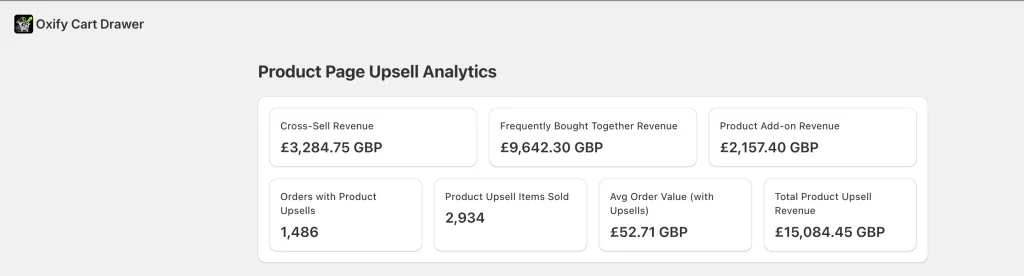
This store runs the full stack — cross-sell, FBT, and product add-ons all active at the same time:
- Frequently Bought Together Revenue: £9,642.30
- Cross-Sell Revenue: £3,284.75
- Product Add-on Revenue: £2,157.40
- 2,934 upsell items sold across 1,486 orders
- Total Upsell Revenue: £15,084.45
Even with all three upsell types running, FBT alone accounts for 64% of total upsell revenue. It outperforms basic cross-sells by nearly 3x and product add-ons by over 4x.
£15K+
Total upsell revenue (UK store)
64%
Revenue from FBT alone
2,934
Upsell items sold
Store 2: Indian Beauty Brand
The Product Page Upsell Analytics tab for this Indian skincare store (also running Oxify Cart Drawer & Upsells) shows:
- Frequently Bought Together Revenue: ₹6,395.60
- 67 upsell items sold across 24 orders
- Average Order Value (with upsells): ₹266.48
- Cross-Sell Revenue: ₹0 | Product Add-on Revenue: ₹0
Cross-sell and product add-on revenue are both ₹0. The dashboard doesn't say whether those offers were switched on, so don't read this as FBT beating them. What it does show is that with FBT live, this store earned ₹6,395.60 from 67 upsell items across 24 orders.
Takeaway for Founders
If you're starting with one product page upsell, FBT is a reasonable first pick for beauty: in the UK store it out-earned cross-sell and add-ons while all three ran, and in the Indian store it was the only type with revenue. Two stores in two currencies is an anecdote, not proof that routine-based "frequently bought together" recommendations beat other upsells everywhere, so note your own baseline AOV first.
The Skincare Routine Framework Your Bundles Should Follow
Before you build a single bundle, understand the framework your customers already follow. Most skincare routines use a layered approach where each product preps the skin for the next one.
- Cleanse — Remove dirt, oil, and makeup to start fresh
- Tone — Balance pH and prep skin for better absorption
- Treat — Apply actives like Vitamin C, retinol, or niacinamide (this is the serum application order step)
- Hydrate — Lock in moisture with a cream or lotion
- Protect — SPF sunscreen for morning routines
This "cleanse, tone, moisturize, protect" sequence is the backbone of every solid skincare bundle strategy. When your bundles follow this natural order, the FBT suggestions feel obvious to the customer — not forced or random.
| ☀️ Morning Routine | 🌙 Night Routine |
| Gentle Cleanser Vitamin C Serum Lightweight Moisturizer SPF 50 Sunscreen | Oil Cleanser or Balm Retinol Serum Hydrating Night Cream Eye Cream |
When someone views your cleanser page, showing the serum and moisturizer as frequently bought together beauty products feels completely natural. You're not selling harder. You're making it easier to buy the routine they already want.
5 Bundle Types That Actually Convert
Not every bundle format fits every catalog. These five map onto how beauty customers already shop, so start with the ones your catalog supports.
1. The Complete Routine Bundle
This is the format to build first. You package every step of a skincare routine together.
Example — Brightening Routine
Step 1: Vitamin C Cleanser → Step 2: Vitamin C Serum → Step 3: Brightening Moisturizer → Step 4: SPF 50
The customer sees the entire routine mapped out. No guesswork. Offer a 10–15% discount, show total savings clearly, and give them a one-click "add all to cart" button.
This kind of beauty FBT Shopify bundle works best on product pages for hero products. Serums make the best anchors because they naturally connect to cleansers (before) and moisturizers (after) in the routine.
2. Concern-Based Bundles
Many shoppers don't browse by product type. They search by problem: "how to treat acne," "best products for dark spots," "dry skin routine."
Build bundles that speak directly to those concerns:
Acne Treatment Set
- Salicylic Acid Cleanser
- Niacinamide Serum
- Oil-Free Moisturizer
Anti-Aging Regimen
- Gentle Cream Cleanser
- Retinol Serum
- Peptide Eye Cream
- SPF Moisturizer
This is one of the strongest cosmetics cross sell approaches. You're positioning products as a complete solution. The customer isn't buying three separate items — they're buying an acne treatment set or a hydration bundle that solves their specific problem.
3. AM / PM Routine Bundles
Splitting by time of day simplifies the decision. Morning routines focus on protection — Vitamin C, lightweight textures, SPF sunscreen. Night routines focus on repair — retinol, peptides, rich creams.
The bonus: you can sell two bundles to the same customer. One for morning. One for night. That can double the order value from a single shopping session.
4. Starter Bundles for New Customers
First-time buyers freeze when they see 30+ products. They don't know your brand. They don't know which products work together. So they either buy one safe item or leave entirely.
A starter bundle fixes that. Keep it tight — cleanser, serum, moisturizer. Three products. One clear routine. Consider offering travel size or sample bundle options so the price feels low and approachable.
Pro Tip
Pair starter bundles with a skin type quiz or product finder. Based on the answers — skin type, concerns, budget — recommend one specific starter bundle (more on this under Quiz-to-Bundle Funnels below).
5. Upgrade Bundles
The customer already added your Vitamin C Serum to cart. Now you show:
"Complete your brightening routine — add these 2 products and save 15%."
This works because they've already committed. The upgrade builds on that momentum. You're turning a single-product purchase into a 3-product routine sale — and the customer feels good about it because they're getting a complete system, not random upsells.
Where to Place Bundles for Maximum Sales
What you bundle matters. Where you show it matters just as much. A beauty store can run three placement layers at once.
Product Page — The #1 Spot
Place your frequently bought together beauty products Shopify widget right below the product description or near the add-to-cart button. The customer is already considering a purchase. A routine suggestion at that moment feels like helpful guidance, not a sales tactic.
Use specific labels: "Complete Your Vitamin C Routine" or "This Serum Works Best With" — not vague "You May Also Like" headers. Specific labels tell the shopper what the products do together.
Cart Drawer — The Momentum Moment
Once a product is in the cart, the customer has said "yes" once already. The cart drawer is perfect for suggesting one more routine product.
Keep it to 1–2 suggestions. "Your routine is almost complete — add Eye Cream?" works without being pushy. For a sense of how the two placements split, UK hair and skin care brand Replenhair's Oxify dashboard attributes £8,742 to the cart drawer and £4,136 to product page upsells out of £15,451 in total (a different store from the one above, measured 31 July 2026, since install; see the Replenhair case study). It is one store, and the figures are app-attributed.
Post-Purchase — The Zero-Risk Upsell
After checkout, offer a discounted routine product on the thank-you page. "Add our Hydrating Night Cream — 20% off, this order only."
This doesn't touch your primary conversion rate. It's pure bonus revenue on top of a completed sale.
Dedicated Routine Landing Pages
Some Shopify beauty brands create standalone pages for their top bundles:
- Acne Treatment Routine page
- Hydration bundle landing page
- Anti-aging regimen collection page
- Holiday edition gift set seasonal page
These pages capture organic search traffic for bundle-related keywords and give shoppers a focused buying experience. They also work great as landing pages for paid ads and email campaigns.
Cross-Category Bundles: Skincare + Makeup
FBT doesn't need to stay within skincare. Some bundles cross the line between skincare and makeup.
Think about it from the customer's perspective. If they're buying a foundation, they likely need:
- A makeup primer for smooth application
- A setting spray to lock everything in
- A brush set for proper application
Lip products follow the same logic — lipstick plus liner plus gloss is a natural "complete your look" bundle.
Here's the clever play: cross-sell skincare into makeup purchases. Someone buying foundation probably isn't thinking about skincare. But a gentle cleanser paired with a hydrating primer bridges both categories — and introduces your skincare line to a customer who came for makeup.
This type of cosmetics cross sell opens up bundle combos beyond a single routine, and more product discovery across your catalog.
How to Set Up Your First FBT Bundle (Step by Step)
Let's get practical. Here's exactly how to set up a routine-based FBT bundle on your Shopify store. We'll use Oxify as the example since the real store data above comes from brands running it.
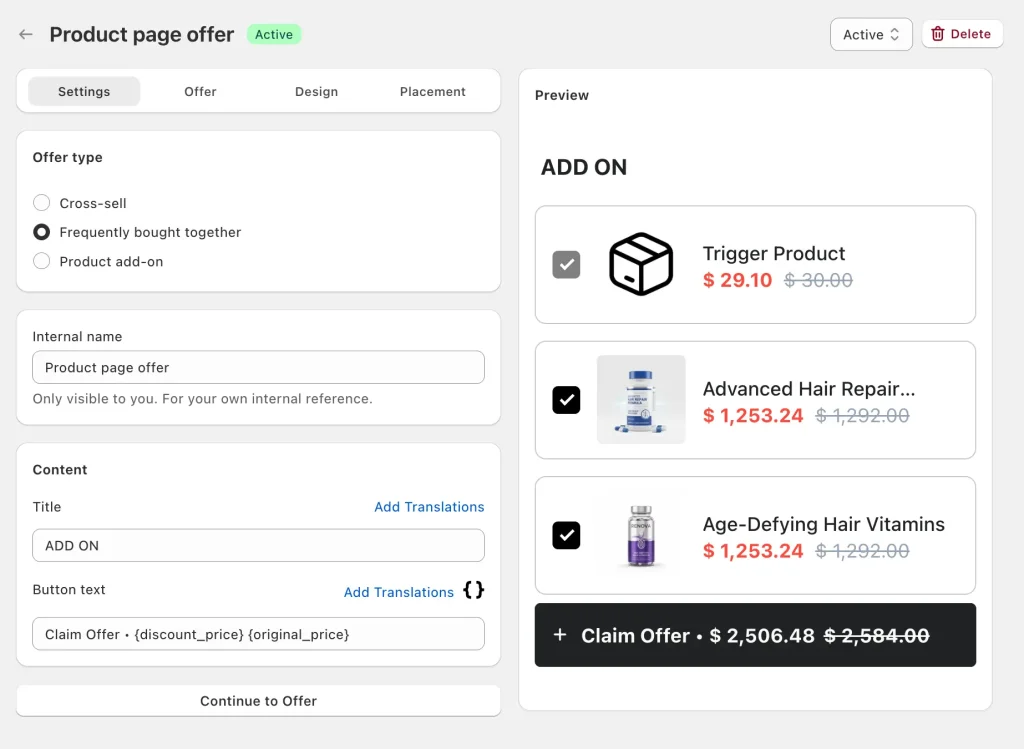
Setting up a product page offer in Oxify — choose between Cross-sell, Frequently Bought Together, or Product Add-on, then customize the title, button text, and preview the widget live
- Install your FBT app. Go to the Shopify App Store and install Oxify Cart Drawer & Upsells (our app), Frequently Bought Together CBB, or another app from the comparison table below. If you also want dedicated product bundles, Oxify Quantity Breaks (our app) is built for that.
- Choose your offer type. As shown in the screenshot, apps like Oxify let you pick between Cross-sell, Frequently Bought Together, and Product Add-on. For routine bundles, select "Frequently bought together."
- Pick your anchor product. Start with your best seller — usually a serum or cleanser. This is the product page where the FBT widget shows up.
- Build the routine around it. If the anchor is a Vitamin C serum, add the cleanser that preps for it, the moisturizer that follows, and the SPF that completes the morning routine. Stick to 2–3 recommended products.
- Set your discount. 10–15% off the bundle is a common starting point. Check it against your margin first (see the pricing section below).
- Write specific copy. Change the default "You may also like" to something routine-focused: "Complete Your Vitamin C Routine" or "These 3 Products Work Together." The title and button text are customizable (see the Content section in the screenshot).
- Choose placement. Product page is the priority. If your app supports cart drawer placement (Oxify does), enable that too for a second upsell layer.
- Publish and watch the data. Give it 7 days. Then check your upsell analytics dashboard — the same kind of dashboard shown in the store data section — to see what's converting and what revenue it's generating.
Can you do this without an app? Partly. Shopify's Search & Discovery app lets you hand-pick up to 10 complementary products per product, shown only in compatible themes. Shopify's page describes a quick-add button on each product card and doesn't mention an add-all button (Shopify Help Center, checked 11 October 2026), and an add-all button plus a bundle discount are what an FBT app typically adds.
Is the Setup Hard?
The technical setup is a handful of screens: pick the offer type, the anchor product, the partner products and the discount. The strategy behind it is what takes time. Start with one bundle on your top product page, collect a week of data, then expand based on what the numbers tell you.
Best Shopify Apps for Beauty FBT
You don't need to code anything. These apps handle the technical work — you focus on picking the right products and writing good copy. Ratings, review counts and prices below come from each app's Shopify App Store listing, checked on 11 October 2026.
| App | Rating (reviews) | Price | Best for | Skip it if |
|---|---|---|---|---|
| Oxify Cart Drawer & Upsells (our app) | 4.9 (40) | From $9.99/mo (up to 100 orders/mo); 14-day free trial | FBT on product pages plus cart drawer upsells and automatic free gifts in one app | You only want a single product page FBT box; a dedicated widget costs less |
| Frequently Bought Together CBB | 4.9 (1,206) | Free Starter plan (3 manual bundles); paid from $14.99/mo | A dedicated FBT widget with AI or manual pairings and bundle discounts | You want cart drawer upsells or free gifts from the same app |
| RG Frequently Bought Together | No reviews yet | $3/mo; 7-day free trial | Testing a basic behavior-based FBT widget on a small budget | You need a review history before installing |
| K: Cross Sell+Related Products | 4.8 (90) | Free on development stores; $18/mo on a live store | Choosing between line, grid and Amazon-style FBT layouts | You want a free plan on a live store |
The right pick depends on your needs. Want product page FBT plus cart drawer upsells plus free gift triggers in one tool? Oxify Cart Drawer & Upsells (our app) covers all three, though it has far fewer reviews than Frequently Bought Together CBB (40 against 1,206). Only need a product page FBT box? CBB's free Starter plan or RG at $3/mo costs less. For build-your-own bundle pages and quantity breaks, our other app is Oxify Quantity Breaks (4.9 from 13 reviews, $14.99/mo, 14-day free trial).
Using Data to Build Better Bundles Over Time
The best beauty FBT Shopify strategies aren't built on hunches. They're built on what customers actually do after you launch. Shopify's behavior reports give you a starting point, and your FBT app's dashboard fills in the detail.
Here's what to track:
- Products bought in the same order — Your FBT app surfaces these patterns. These are your strongest natural pairs. Start here.
- Cart add-on behavior — What do customers add after their first product? That's your most natural cross-sell path.
- Repeat purchase combos — If someone buys your cleanser first and returns for the serum two weeks later, bundle those for the next customer.
- Bundle uptake rate — Which bundles are people actually clicking and buying? Double down on winners. Rework or remove the rest.
- AOV with vs. without upsells — The Oxify dashboard tracks this automatically (see "Avg Order Value with Upsells" in the screenshots). Compare it to your baseline AOV to measure real dollar impact.
Test One Thing at a Time
Swap one product in a bundle. Change the discount from 10% to 12%. Rewrite the headline from "You may also like" to "Complete your morning routine." Small changes sometimes produce big lifts. Give each test at least 7 days before deciding.
Your bundles should evolve monthly based on real purchase behavior — not what you assumed customers would want when you first set things up.
Bundle Pricing Psychology: How to Set Discounts That Convert
Most brands pick one discount number — "let's do 10% off" — and leave it. How you structure the bundle pricing changes how many customers choose the bundle over a single product, so it's worth setting deliberately.
The Tiered Discount Framework
A tiered discount rewards the customer for adding one more product. Here's a framework to start from for beauty stores; adjust it to your margin using the check below:
| Bundle Size | Discount | Why It Works |
|---|---|---|
| Buy 2 products | 10% off | Low commitment. Gets the customer into the habit of buying routine pairs. |
| Buy 3 products | 15% off | The target tier for a three-product routine: cleanser, serum and moisturizer. |
| Buy 4+ products | 20% off | The largest basket, so the deepest discount. Check it against your margin first. |
Why This Works Psychologically
The tiered structure creates a pull effect. A customer looking at a 2-product bundle sees they could save more by adding one more item. That "just one more product to unlock the next tier" feeling is powerful — it's the same psychology behind free shipping thresholds.
For beauty specifically, it also matches natural behavior. A customer who buys a cleanser and serum is already halfway to the four-step morning routine above. Showing them they'll save an extra 5% by adding the moisturizer gives them a concrete reason to add it.
Show the Savings, Not Just the Discount
Don't just say "15% off." Show the actual dollar amount saved. "Save $12.50 with this bundle" is more concrete than a percentage, and it reads clearly on a phone screen. For a date-night or gift kit, show the kit price next to the sum of the individual prices so the saving is visible.
Margin Check
Before setting your tiers, calculate your blended margin across the bundle products. If your average margin is 65%, a 15% bundle discount leaves a margin of about 59%: the price falls to 85% of list while the cost stays the same, so the percentage doesn't drop by the full 15 points. If your margins are tighter, start at 8% / 12% / 15% tiers instead. The product bundle pricing strategy guide goes through the maths in more detail.
Subscriptions + Bundles: The Recurring Revenue Play
Skincare products run out, and how fast depends on the size you sell and how often people apply them. That makes a bundle a natural fit for a subscribe-and-save option.
When a customer buys a 3-product hydration bundle, offer a "subscribe and save" option for automatic delivery every 4–8 weeks. Illustrative arithmetic, not a benchmark:
- One-time bundle purchase: $60
- Same bundle on a monthly subscription at $54 (10% off): $648 over 12 deliveries
- That is about 10.8 times the first order, but only if the customer stays subscribed for the full year. Model your own retention before counting on it.
Put the toggle beside the bundle rather than on a separate page: Oxify Cart Drawer & Upsells (our app) supports in-cart subscription upgrades with Shopify subscription apps (see how subscribe and save works in the cart), and our subscription app comparison covers the fees.
For beauty brands, this turns the skincare bundle strategy from a one-time AOV boost into repeat revenue, for as long as customers keep the subscription.
6 Mistakes That Kill Bundle Conversions
Even experienced beauty brands get tripped up by these. Avoid them from the start.
❌ Too Many Products in One Bundle
Bundles with 5+ products feel expensive and overwhelming. The sweet spot is 2–4 items. A focused routine converts better than a mega kit that makes customers do mental math.
❌ Pairing Unrelated Products
Lipstick with sunscreen? Foundation with a cleanser? These pairings confuse people. Every product in a bundle needs a clear "why" — they should belong in the same routine or solve the same concern.
❌ No Routine Explanation
Don't just list product names. Show the steps: Step 1 Cleanse, Step 2 Treat, Step 3 Hydrate, Step 4 Protect. Labels build confidence and make your brand look like it knows what it's doing.
❌ Ignoring Mobile
Many shoppers browse on phones. If your FBT widget is hard to tap, scrolls poorly, or loads slowly on mobile, you lose bundle sales you'd otherwise get. Test on a real phone before you launch.
❌ Using Generic Headlines
"You may also like" is forgettable. "Complete your Vitamin C routine" tells the customer exactly what they're looking at.
❌ Set-and-Forget Bundles
Best sellers change. Seasons change. Customer preferences shift. Review bundle performance monthly and update based on real data — not last quarter's assumptions.
Advanced Strategies for Growing Brands
Once the basics are working, these tactics push your results further.
Ingredient Matching Bundles
Group products by active ingredient. A "Niacinamide Routine" with a niacinamide toner, niacinamide serum, and barrier repair moisturizer tells the ingredient matching-savvy customer everything works together at a formulation level. This plays especially well in the clean beauty and vegan skincare space.
Mix-and-Match Custom Bundles
Not every customer wants the same three products. If your brand sells multiple variants — different serum strengths, moisturizer textures, or SPF levels — let shoppers build their own routine from a curated selection.
The structure is simple: you define the categories (pick a cleanser, pick a serum, pick a moisturizer), and the customer fills in their preferences. This works especially well for brands with shade ranges, fragrance options, or tiered active ingredient concentrations.
Apps like Oxify Quantity Breaks (our app) let you set up these build-your-own bundle pages where customers select from approved products in each routine step. The result feels personalized without the complexity of a full quiz funnel. It can also reduce returns, since the customer chose exactly what they wanted.
Event-Driven Bundles
Beauty purchases spike around events — weddings, proms, holidays, vacations. Create bundles that match those moments:
- "Pre-Wedding Glow Kit" — exfoliator, hydrating mask, brightening serum, makeup primer
- "Vacation Ready Bundle" — travel size cleanser, SPF 50, after-sun moisturizer, lip balm
- "Date Night Prep" — sheet mask, illuminating primer, setting spray
These bundles tap into emotional purchase triggers. The customer isn't just buying skincare — they're preparing for a moment that matters to them. That emotional connection gives the bundle a reason to exist beyond a discount, and these kits are easy to share on social media.
Seasonal and Limited Edition Kits
Create urgency with time-bound offers. A "Winter Repair Bundle" with rich creams and lip balm sells from November through February. "Summer SPF Essentials" with lightweight sunscreen and setting spray moves fast in warmer months. Holiday edition gift sets are especially powerful for Q4.
Quiz-to-Bundle Funnels
Add a skin type quiz or product finder to your store. Based on answers — oily vs. dry, acne vs. aging, minimal vs. multi-step — recommend a specific bundle. This creates a personalized routine experience, and the answers show you which concerns and skin types deserve their own bundles next.
Free Gift Thresholds
Some apps (including Oxify Cart Drawer & Upsells, our app) let you trigger automatic free gifts when cart value reaches a set amount. For beauty: "Spend $75, get a free mini serum." Customers may add that extra bundle item to hit the threshold, lifting AOV without a discount on the bundle itself. Our guide to adding a free gift with purchase on Shopify covers four ways to set one up.
Your Launch Checklist
Ready to get your first routine-based FBT bundle live this week? Follow this order.
- Pull your Shopify order data and find which products are already bought together
- Map your catalog into routine steps (cleanse, tone, treat, hydrate, protect)
- Create 3 starter bundles: one complete routine, one concern-based, one beginner kit
- Install a Shopify FBT app (Oxify Cart Drawer & Upsells (our app), Frequently Bought Together CBB, or RG Frequently Bought Together)
- Set up your first product page offer anchored on your best seller
- Write specific widget copy — "Complete Your [Product Name] Routine"
- Set bundle discount at 10–15%
- Enable cart drawer cross-sell with 1–2 add-on suggestions
- Test everything on mobile — tap every button, scroll every widget
- Track AOV, bundle uptake, and upsell revenue for the first 7 days
- A/B test one variable after 2 weeks of baseline data
- Review and refresh all bundles monthly based on purchase patterns
Related: Looking for the whole beauty app stack, not just bundles? See the best Shopify apps for beauty and skincare brands. Deciding between a recommendation widget and a fixed bundle? Read FBT vs bundle: which drives more revenue on Shopify.