Quick answer: No, post-purchase upsells do not hurt your conversion rate. They appear after the payment goes through, so the first sale is already locked in. If a shopper says no, they just land on the order confirmation page and you lose nothing. Reported acceptance rates run from about 3% to 15%, depending on the offer and the store. The upside is real. The risk to checkout is zero.
Now here is the part most guides skip. Post-purchase upsells are safe, but they are not magic. This article gives you the honest version: how they work, what they win at, what they do not do, and how to set them up the right way.
We build a Shopify cart and post-purchase app, so this comes from what we see work for real stores, not just theory.
Do post-purchase upsells hurt checkout?
- No. The payment is captured before the offer ever appears. The original order is done.
- The worst a shopper can do is click “No thanks.” Their first order still ships.
- That is why people call post-purchase the one upsell with upside and no downside.
(Average order value, or AOV, just means the average amount each order is worth.)
The one thing most people get wrong
People lump all upsells together. That is the mistake. Timing changes everything.
Pre-purchase upsell (some risk)
- Shows before payment, on the product page or in the cart.
- Push too hard and a shopper can hesitate and leave.
- This is the type that can lower checkout conversion if you overdo it.
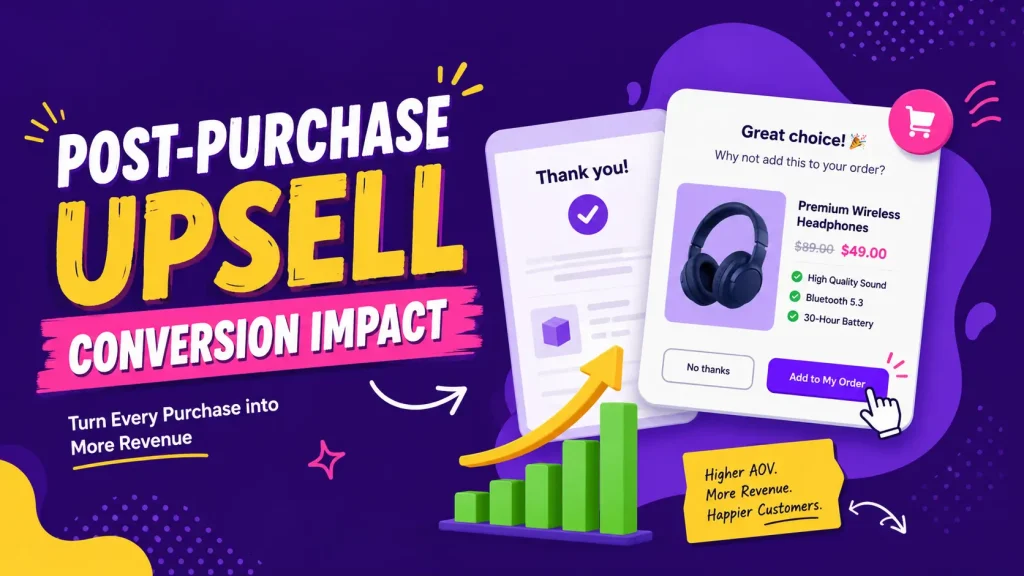
Post-purchase upsell (no risk to the sale)
- Shows after payment, right before the thank-you page.
- The first order is already locked in.
- Say no, and the shopper just sees their confirmation.
Here is a simple way to think about it. The customer already paid. You are not asking them to buy again to keep the first sale. You are just asking, “Want to add one more thing?”
What the customer actually sees
- They click “Pay now” and the order goes through.
- Before the thank-you page loads, one offer appears.
- They add it with a single click. No card details again.
- The item joins their existing order.
- If they decline, they land on the thank-you page like normal.
The original sale never moves.
What post-purchase upsells do NOT do (the honest part)
Most articles only sell you the upside. Here is the truth that helps you build a smart strategy.
- They do not reach everyone. Only people who finish checkout see the offer. If 60% to 70% of your traffic abandons the cart, they never see it. So post-purchase cannot be your only way to lift AOV.
- They are not always your highest-converting offer. Some data shows offers shown during checkout (called order bumps) can convert higher, because the buyer is still in “buying mode.” Right after payment, some shoppers feel “done.” Post-purchase always wins on safety. It does not always win on raw acceptance.
- Acceptance rates vary a lot. You will see “4%” in one study and “15%” in another. Both are real. Your number depends on your product, your offer, and your price.
None of this makes post-purchase weak. It makes it one piece of a complete funnel, not the whole thing.
The complete funnel (why smart stores use both)
The best stores do not choose pre or post. They use both, at different moments.
- Before checkout: a slide cart drawer with upsells and a free shipping bar. This reaches 100% of shoppers, even the ones who do not buy. (Here is how to add upsells to your cart drawer.)
- After checkout: a one-click post-purchase offer plus a thank-you page offer. This catches buyers at peak trust with zero risk.
Together they cover the whole journey, which is the heart of a strong Shopify upselling strategy. This is also why running one app that does both is simpler than stitching four apps together. More on that below.
The proof
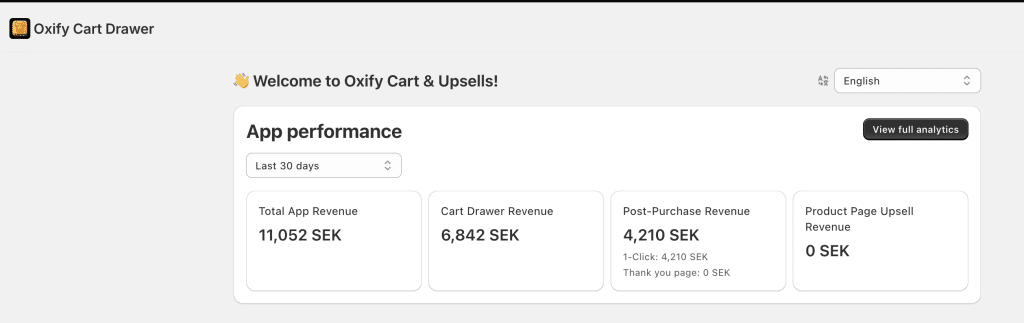
You do not have to take this on faith. Here is 30 days of real data from one store running Oxify Cart Drawer. It is a Swedish store, so the revenue shows in kronor (SEK).
| Placement | Revenue (last 30 days) | Status |
|---|---|---|
| Cart drawer (before checkout) | 6,842 SEK | On |
| One-click post-purchase | 4,210 SEK | On |
| Thank-you page offer | 0 SEK | Off |
| Product page upsell | 0 SEK | Off |
| Total app revenue | 11,052 SEK |
Two things jump out.
- The post-purchase offer alone added 4,210 SEK, all from one-click offers, with zero risk to checkout. That is pure extra revenue from orders the store was already getting.
- But two placements sat at 0 SEK. The thank-you page offer and the product page offer were never switched on. Those zeros are not proof the placements fail. They are money left on the table.
So this store made 11,052 SEK from two placements while two more sat idle. Turning on the thank-you page offer would catch the Apple Pay and PayPal buyers the one-click offer cannot reach. Turning on the product page offer would reach shoppers before they ever check out. Same traffic, more revenue. This is the cost of a placement gap.
What each placement typically converts at
| Upsell placement | Typical acceptance rate | Risk to checkout |
|---|---|---|
| Product page (FBT, “you may also like”) | 8 to 15% | None |
| In-cart / cart drawer | 5 to 12% | Low |
| One-click post-purchase | 3 to 8% | Zero |
Ranges vary by store, product, and offer, so treat them as a starting point, not a promise. The pattern holds though: product page and cart reach more people, while post-purchase carries no risk at all.
A couple more numbers worth knowing:
- Post-purchase offers are widely reported to convert better than pre-purchase ones, because the buying decision is already made. One app team’s study of more than 1,500 stores put post-purchase at two to three times the pre-purchase rate.
- Shopify’s own research shows upsells can lift AOV and revenue per visitor with no new traffic.
Small numbers stack up fast. A store with 1,000 orders a month and a 5% take on an $18 add-on earns about $900 a month, close to $11,000 a year, from orders it was already getting.
Why buyers say yes
Right after a purchase, the brain sits in a useful spot. Smart brands use it.
- Buying mode. They just said yes once. Saying yes again feels easy.
- High trust. They trusted you with their card seconds ago. That trust is still warm.
- Commitment. People like to stay consistent. Adding to an order they just placed feels natural.
- A little dopamine. Finishing a purchase feels good, and a good feeling makes people open to one more yes.
This only works when the offer fits what they just bought. A random product feels like spam, while a relevant one can even improve the post-purchase experience.
The one catch nobody tells you (payment types)
Here is an honest, technical detail most articles skip.
One-click post-purchase offers need a saved card. So they do not show for every payment type.
- They work with standard credit card checkouts. That is still most orders for most stores.
- They usually do not show for Apple Pay, Google Pay, PayPal, or “buy now, pay later.” Those methods do not let the store charge a saved card again.
The fix is simple. Add a thank-you page offer as a backup. It works with every payment type. The shopper just taps through a quick add instead of a true one-click.
Bonus tip: since Shopify’s 2024 checkout update, the thank-you page and the order status page are two separate spots. The thank-you page shows right after payment. The order status page is the tracking page buyers come back to. Good apps let you place offers on both. (We break down the difference in post-purchase page vs thank-you page.)
Real brands doing this
- A gourmet gift brand added thank-you page offers and a birthday capture form. It reported about a 10% revenue lift in under three months.
- A skincare brand offered a travel-size version of its top product after checkout. About 14% of buyers accepted, adding roughly $8 to each order.
Small, relevant offers. Perfect timing. That is the whole trick.
How post-purchase upsells grow AOV and lifetime value
Two wins come from one tactic.
Bigger orders today (AOV)
- Every accepted offer raises that order’s value.
- You spend nothing extra to earn it. The traffic is already paid for.
More value over time (LTV)
- LTV means how much a customer is worth across all their orders.
- A buyer who adds a matching item gets more from your brand, which gives them a reason to come back.
- Selling to a current customer is far cheaper than finding a new one. Shopify notes that first-time buyers return about 27% of the time, but that jumps to around 54% after a second or third order.
So post-purchase is not just a one-time bump. It can start a longer relationship.
Your 5-step setup framework
You can launch your first offer today. Follow these steps.
- Pick one hero offer. Choose a product that pairs with a top seller. (Shoes? Offer socks. Coffee maker? Offer beans.)
- Keep the price small. A simple rule: keep the upsell at 25% or less of the order value. An $80 order should see a $20 offer, not a $60 one.
- Add a downsell. A downsell is a cheaper backup shown if they say no. You get a second shot.
- Match the offer to the order. Show it based on what they bought. Relevant beats random every time.
- Add a thank-you page offer too. This catches the Apple Pay and PayPal buyers your one-click offer cannot reach.
Then watch the numbers for two weeks. Keep what works. Swap what does not.
Best Shopify post-purchase upsell apps (and pricing)
You need an app for this. Shopify does not offer full post-purchase flows on its own for most plans. These apps use Shopify’s checkout extensibility (the modern replacement for Shopify’s old checkout code), so offers load fast and never block your checkout. Here are strong options, ranked. For a deeper breakdown, see our full guide to the best Shopify post-purchase upsell apps.
| Rank | App | Post-purchase offers | Pricing | Built for Shopify |
|---|---|---|---|---|
| 1 | Oxify Cart Drawer | One-click + thank-you page | $19.99 to $149.99/mo (flat by orders), 14-day trial, no revenue cut | Yes |
| 2 | AfterSell | One-click + thank-you + checkout (Plus) | Free plan (shows third-party ads), paid from about $34.99/mo | Yes |
| 3 | ReConvert | One-click + thank-you page | From about $4.99/mo, scales with orders and upsell revenue | No |
| 4 | Zipify OCU | One-click upsell + downsell | Revenue-based (you pay on the upsell revenue it makes) | No |
| 5 | Selleasy | Post-purchase + cross-sell | Free up to 50 orders/mo, then paid tiers | Yes |
Other names you will see include Kaching ($4.99 to $249.99/mo by order volume), AOV.ai (free to install with a 5% cut, or flat $49.99/mo), and Honeycomb (up to $54.99/mo).
1. Oxify Cart Drawer (best overall)
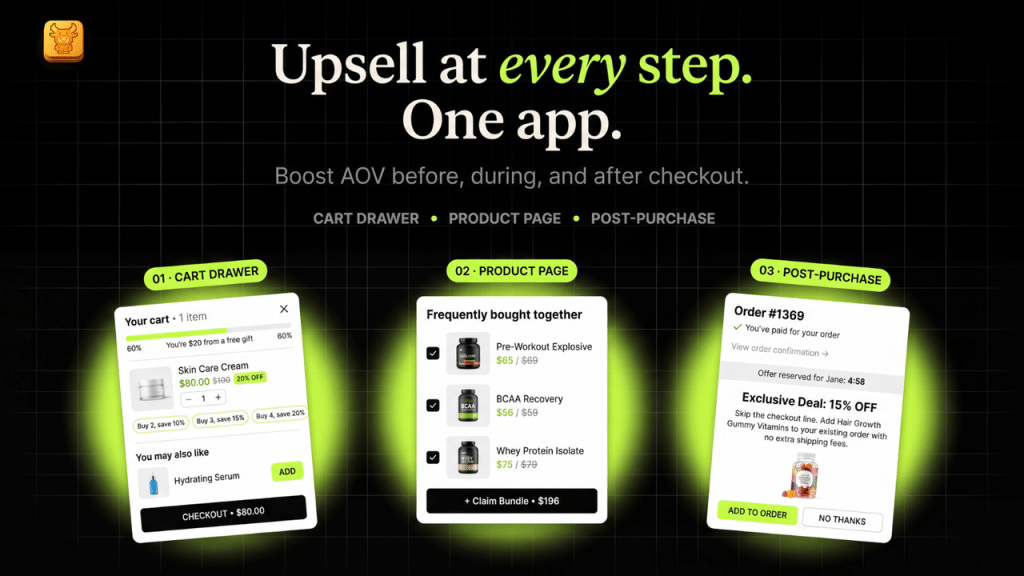
Oxify Cart Drawer is the only app here that covers your whole funnel in one install: the slide cart drawer, the product page, and post-purchase. You get one-click post-purchase offers, thank-you page offers, free gifts, BOGO, volume discounts, and frequently bought together bundles. It is Built for Shopify with a 5.0 star rating, and pricing is flat by order volume with no cut of your sales.
- Pricing: $19.99 to $149.99 per month by order volume. 14-day free trial on every plan. Full pricing at oxify.app/cart-drawer-pricing.
- Best for: stores that want cart, product page, and post-purchase offers without paying for four separate apps.
2. AfterSell
A checkout and post-purchase specialist with strong A/B testing. Built for Shopify.
- Pricing: free plan that shows third-party ads on your confirmation page, with paid plans from about $34.99 per month that scale with order volume.
3. ReConvert
A thank-you page specialist with lots of widgets like surveys and reorder buttons.
- Pricing: scales with orders and upsell revenue, from about $4.99 per month.
4. Zipify OneClickUpsell (OCU)
A full upsell-to-downsell funnel with revenue-based pricing.
- Pricing: you pay a share of the upsell revenue the app generates.
5. Selleasy
A budget-friendly cross-sell and post-purchase tool. Built for Shopify.
- Pricing: free up to 50 orders a month, then paid tiers.
Quick tip: flat pricing usually beats a revenue cut once you scale. A 0.75% cut on $10,000 of upsell sales is $75 a month, more than most flat plans.
Mistakes that DO hurt you
Post-purchase is safe, but bad offers waste it. Avoid these.
- Too many offers. Stick to one or two. More just slows people down.
- Random products. An offer that does not fit feels spammy and hurts trust.
- Pricey add-ons. A huge offer after a small order rarely lands.
- No backup. Skipping the thank-you page offer means you miss every Apple Pay and PayPal buyer.
- Using post-purchase as your only AOV tool. Pair it with a cart drawer so you reach the shoppers who never finish checkout.
FAQ
Do post-purchase upsells hurt my conversion rate?
No. The offer appears after payment is captured, so your checkout rate is safe. The worst case is a shopper clicking “No thanks,” and the first order still goes through.
Are post-purchase upsells better than checkout order bumps?
They are safer. A post-purchase offer carries zero risk because the sale is already done. An order bump at checkout can sometimes convert higher, since the buyer is still in buying mode, but it carries a small risk to checkout. The best stores use both.
Do I need Shopify Plus for post-purchase upsells?
No. Post-purchase and thank-you page offers work on every paid Shopify plan through Shopify’s checkout tools. Some offers placed inside the checkout page are Plus-only, but post-purchase is not.
Will an upsell app slow down my checkout?
A well-built app uses Shopify’s native checkout tools and should not cause a noticeable delay. Always test your page speed after installing any app.
What is a good post-purchase acceptance rate?
Most stores land between about 3% and 15%. Relevant offers and a smart downsell push you toward the higher end.
How much should the upsell cost?
Keep it at 25% or less of the order value. Small, easy “yes” offers convert best.
Can post-purchase upsells raise lifetime value?
Yes. A matching add-on gives customers more use from your brand, which builds a reason to buy again.
Start growing every order today
You already do the hard part. You bring in the traffic. You earn the sale. A post-purchase offer simply makes each of those sales worth more, with zero risk to your checkout.
Oxify Cart Drawer gives you one-click post-purchase offers, thank-you page offers, and full cart upsells in one app. It is Built for Shopify, rated 5.0 stars, and starts at $19.99 a month with a 14-day free trial.