
Crossword Bookstores earned +20% from its cart
India's best-known bookstore chain took a 20% lift in additional revenue from a cart drawer built to its own spec — one where every basket is a few rupees short of the next reward.

- Industry
- Books, stationery & gifts
- Market
- India
- Platform
- Shopify
- Reporting window
- Since install, all-time
A 20% lift in additional revenue from one custom-built cart
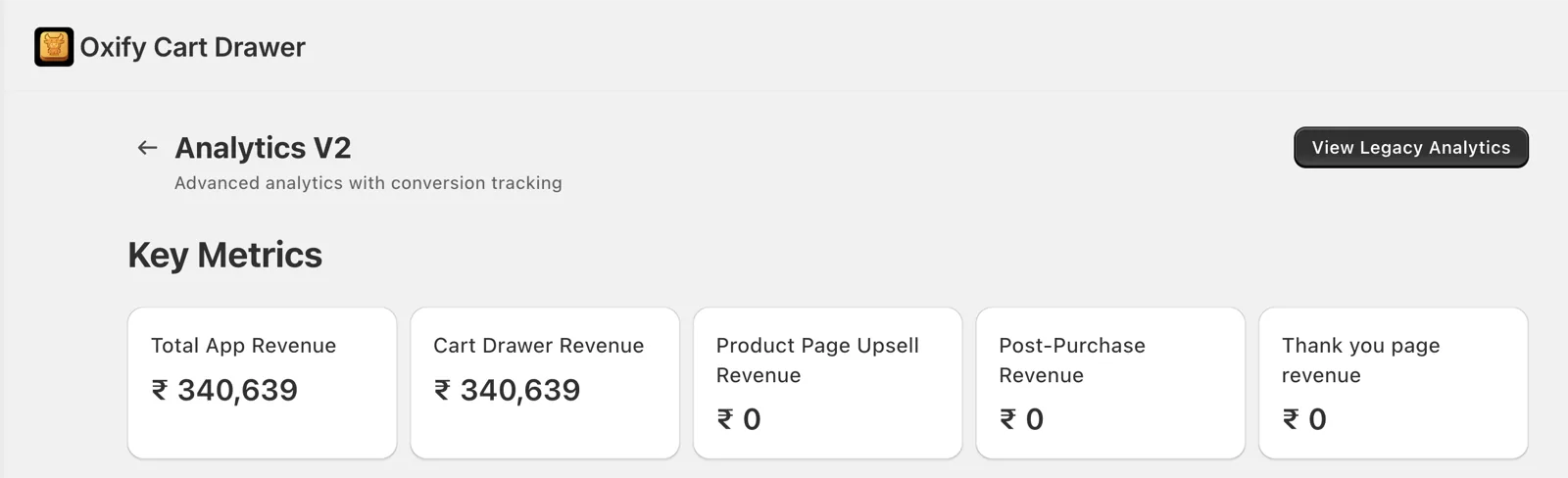
Revenue read from Crossword Bookstores’ own Oxify analytics dashboard on 31 July 2026.
Where Crossword Bookstores was losing the second sale
Crossword sells books, stationery, toys and gifts across India — a catalogue where the average order is one paperback and the difference between a good month and a flat one is whether that paperback ever becomes two. At ₹250–₹600 a title, a single-item basket is the default outcome, not the exception.
The chain already ran deep, well-communicated discounts: most titles carry a struck-through MRP and a rupee saving on the product page. That solved the first purchase and did nothing for the second — a shopper who has decided to buy one book has no reason to look for another, and the cart page gave them nowhere to look.
An off-the-shelf drawer would not have fitted. Crossword's cart has to carry Indian payment reality — Express Checkout, gift cards, no-cost EMI — alongside its own promotional ladder, in its own yellow-and-black identity. So the drawer was built to their spec rather than configured from a template.
Three gaps, none of them a pricing problem
And the cart drawer that was built to close them.
One book, and no reason for a second
The cart was a receipt. A shopper who had chosen a ₹300 paperback saw a subtotal and a checkout button — no recommendation, no threshold, nothing that made a second title the obvious next move at the one moment they had already decided to spend.
The discount was invisible where it mattered
Crossword's savings were doing their work on the product page and then disappearing. By the cart, a shopper saw one number. The rupee saved per line and the total saved on the order — the strongest arguments the store had — were not being made at the point of decision.
A stock drawer would have looked borrowed
Crossword is a thirty-year-old retail brand with its own storefront identity and India-specific payment methods. A templated drawer would have broken both, and a cart that looks like it belongs to someone else is a cart shoppers hesitate in.
What was actually switched on
In the order it was rolled out. The drawer itself was built to spec by us — everything inside it is standard Oxify configuration.
Build the drawer to Crossword's own design
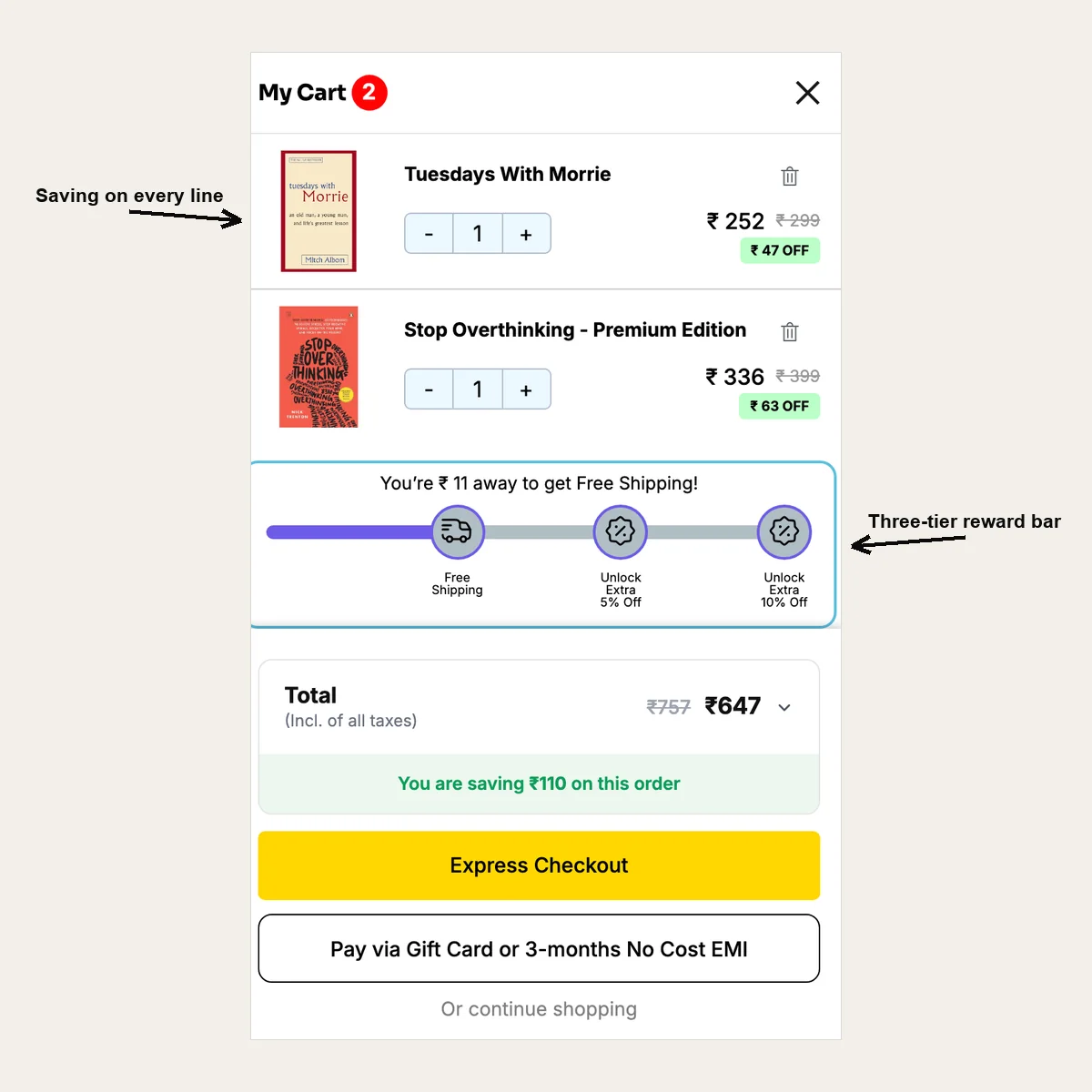
Not a themed version of a stock component: the layout, the typography, the yellow Express Checkout button and the payment row beneath it were built to match the storefront, so the drawer reads as part of Crossword rather than as an app bolted onto it.
Put a three-tier reward bar above the total
Free shipping first, then an extra 5% off, then an extra 10% off. One threshold gives a shopper a single reason to add; three means there is almost always a next one within reach — the capture on this page shows a basket ₹11 short of the first tier.
Show the saving on every line, not just the total
Each item carries its struck-through MRP and its own rupee saving, and the drawer footer restates the total saved on the order. The discount Crossword was already giving becomes visible at the moment it can still change the basket.
Keep the Indian checkout options in the drawer
Express Checkout, gift card and three-month no-cost EMI all sit inside the drawer. Sending a shopper to a separate cart page to find their payment method is where Indian carts leak, so nothing about paying required leaving the drawer.
Carry the same offer ladder onto the product page
The 'add ₹999 for an extra 5% off' and 'add ₹1,499 for an extra 10% off' tiles appear on the product page too, so the shopper knows what the ladder is before they ever open the cart.
What it added up to
- A 20% increase in additional revenue against the pre-Oxify baseline, reported by Crossword.
- ₹340,639 in Oxify-attributed cart drawer revenue in the app's own analytics.
- All of it from a single placement — the drawer — with nothing yet running on the product page, post-purchase or thank-you page.
- A drawer built to Crossword's own design, carrying their payment methods rather than a generic checkout button.
- No additional ad spend and no change to the underlying discount ladder.
- Three placements sitting at ₹0 are the obvious next step, and post-purchase is the largest of them.
Other stores running Oxify
Your cart is already the highest-intent page you own
Every shopper who reaches it has decided to buy. Crossword Bookstores turned that moment into +20% without spending another pound on traffic. Install Oxify and the same analytics dashboard starts filling on your store today.
Free migration from any cart drawer app · See pricing · Compare Oxify with the alternatives