
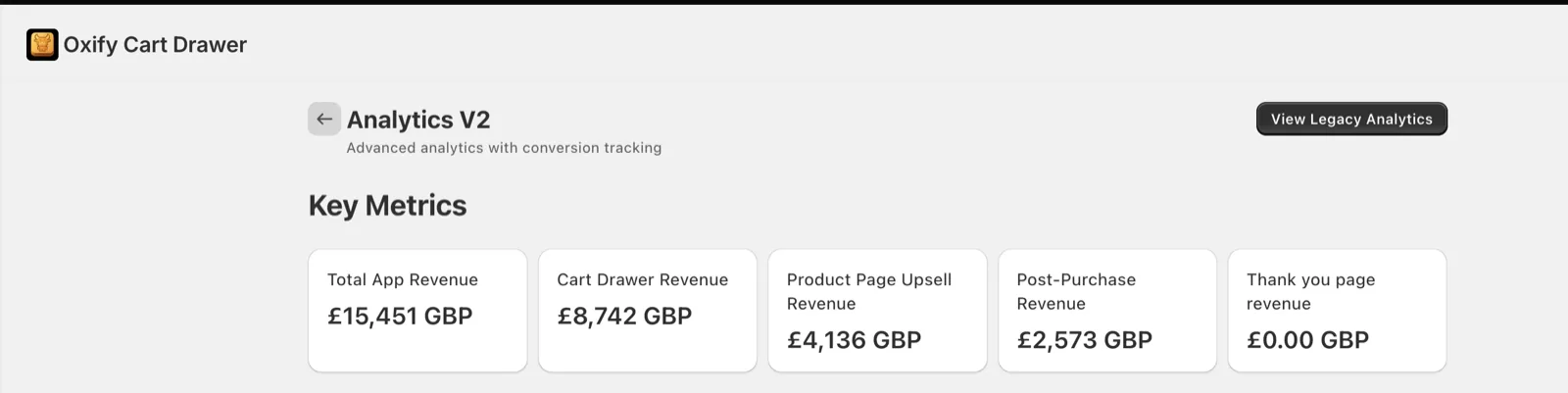
Replenhair earned £15,451 from its cart
A UK textured-hair brand added £15,451 of app-attributed revenue across the cart drawer, the product page and the post-purchase offer — without touching ad spend.

- Industry
- Hair & skin care
- Market
- United Kingdom
- Platform
- Shopify
- Reporting window
- Since install, all-time
£15,451 in app-attributed revenue from three placements
Revenue read from Replenhair’s own Oxify analytics dashboard on 31 July 2026.
Where Replenhair was losing the second sale
Replenhair sells natural hair care for textured hair in the UK — a catalogue where almost every product has a natural partner. A shampoo wants its conditioner; a growth oil wants the scalp serum; a colour-protect range only works as a set. That pairing was obvious to the brand and invisible to the customer.
The default Shopify cart page was the bottleneck. Adding a product bounced the shopper out of the browsing flow onto a separate page, and once there the only thing to do was leave or check out. There was no moment where a second product could be suggested at the point the customer had already decided to buy.
Discounting harder was the alternative on the table, and it was the wrong one: with products between £14.99 and £49.99 and promotions already running at 20–50%, another slice off the price would have bought volume out of margin. The audit turned up three specific gaps instead — none of which needed the price of the first product to move.
Three gaps, none of them a pricing problem
And the cart drawer that was built to close them.
No offer on the cart at all
The cart was a receipt. It listed what the shopper had chosen, totalled it and sent them to checkout — no recommendation, no bundle, no reason to look at a second product at the exact moment intent was highest. Every cart view was a chance to raise the order value, and every one of them was being spent on a subtotal.
No discount attached to the upsell
Where a related product was suggested elsewhere on the store, it was suggested at full price, competing with the sitewide 20–50% promotions the shopper had just been browsing. An add-on has to be worth adding now rather than in a future order, and at list price it never is.
Nothing after the order was placed
Once checkout completed, the customer went straight to a static thank-you page. The one moment where payment details are already captured and a second purchase costs the shopper nothing but a tap was going unused — no post-purchase offer, no one-click upsell, no order bump.
What was actually switched on
In the order it was rolled out. Nothing here required a theme rebuild or a developer.
Replace the cart page with a slide-out drawer
The Oxify cart drawer opens over the page instead of navigating away, so adding to cart no longer interrupts browsing. That alone recovers the shoppers who used to be dropped onto a dead-end cart page — and it creates the surface everything below sits on.
Put the natural partner in the drawer
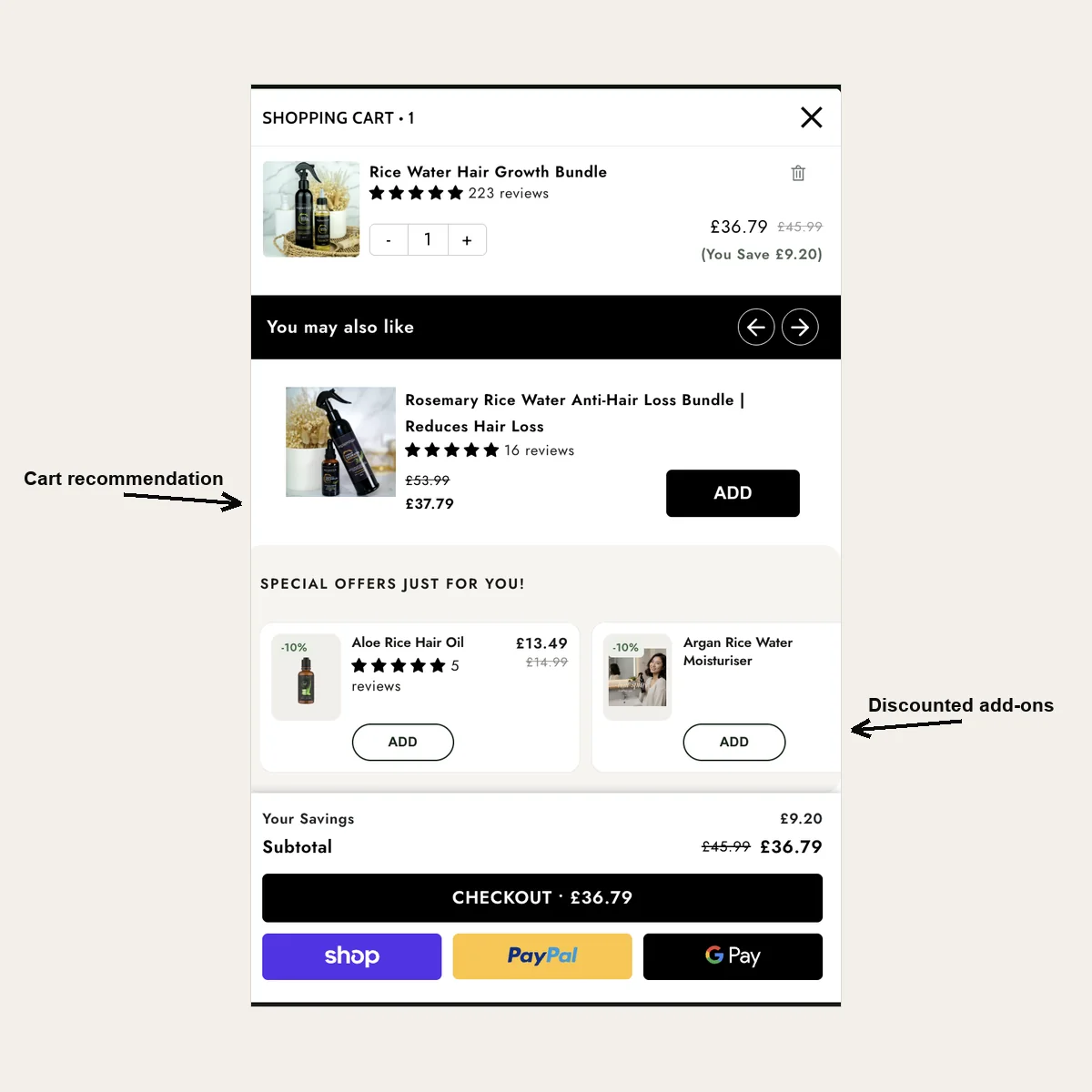
Rule-based recommendations inside the drawer surface the matching conditioner, scalp treatment or set for whatever is already in the cart. It is the one moment where intent is highest and friction is lowest: the customer has committed, and accepting is a single tap with no page load.
Give the add-ons a discount of their own
The second offer row — 'Special offers just for you' — carries its own 10% saving, shown against the struck-through price. That is what turns a suggestion into a decision: the shopper is not being asked whether they want the product, they are being asked whether they want it at this price, now, on this order.
Move one offer earlier, to the product page
Frequently-bought-together blocks on the product page catch the shopper who buys in one motion and never lingers in the cart. This placement contributed £4,136 on its own — revenue the drawer would never have seen.
Add a one-click post-purchase offer
After the order is placed, a single upsell appears before the thank-you page. Payment details are already captured, so accepting adds to the existing order rather than starting a second checkout — the reason this placement converts at all.
Progress bar toward free shipping
A shipping-threshold bar at the top of the drawer gives the added product a reason beyond wanting it. On a basket of £14.99 products, being £6 short of free delivery is a stronger argument than a discount.
What it added up to
- £15,451 in total Oxify-attributed revenue across the account.
- £8,742 of that from the cart drawer — the single largest placement at 57% of the total.
- £4,136 from product-page upsells, reaching shoppers who never pause in the cart.
- £2,573 from one-click post-purchase offers, added to orders that had already converted.
- No additional ad spend, no additional discounting, and no change to product pricing.
- The thank-you page placement sits at £0 — it has not been switched on yet, and is the obvious next lever.
Other stores running Oxify
Your cart is already the highest-intent page you own
Every shopper who reaches it has decided to buy. Replenhair turned that moment into £15,451 without spending another pound on traffic. Install Oxify and the same analytics dashboard starts filling on your store today.
Free migration from any cart drawer app · See pricing · Compare Oxify with the alternatives