 Oxify
Product Bundle Pricing Strategy: Boost AOV Without Slashing Margins
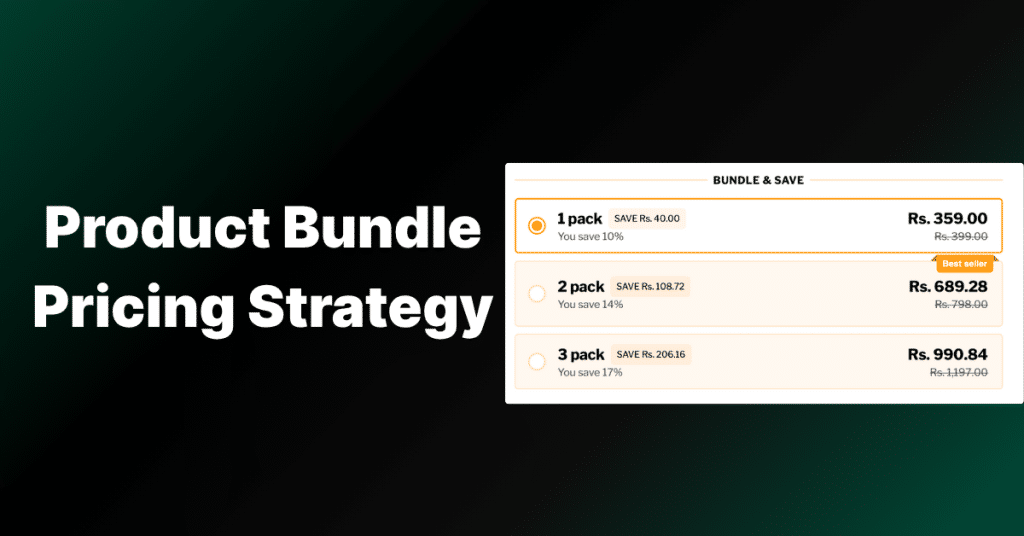
The best product bundle pricing strategy prices the set from your margin, not from a round discount. Start 10–20% below the items bought separately, then check that the bundle still earns more gross profit per order than the main product alone. If it doesn’t, the discount is too deep.
What Is Product Bundle Pricing?
Product bundle pricing means selling two or more products together as one package at a lower price than buying them separately. Shopify’s help center describes a bundle the same way: a set of two or more related products, commonly offered at a discount.
Types of bundles:
- Pure bundle: Customers can only buy the products as a set (like a shampoo + conditioner duo).
- Mixed bundle: Customers can buy each item on its own, but the bundle gives them a better deal.
Bundling raises average order value (AOV) and can move slow-selling stock. Whether it raises profit depends on how much of the discount goes to shoppers who would have bought both items anyway. The margin section below shows the arithmetic.
Why Do Bundles Convert? The Psychology
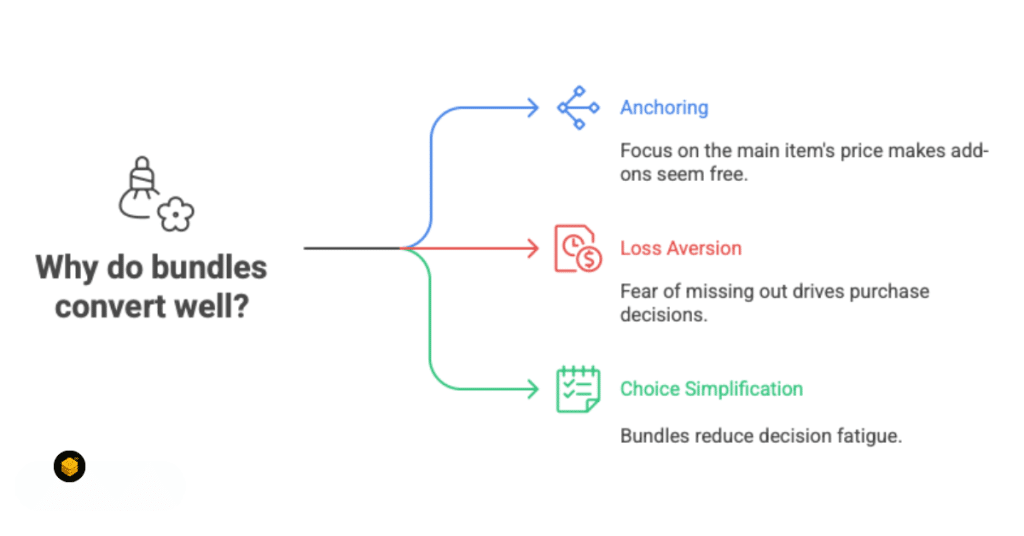
Bundles work because of how shoppers judge a price:
- Anchoring: The combined price of the items bought separately becomes the reference point, so the bundle price reads as a saving.
- Loss aversion: People weigh a lost saving more heavily than an equal gain, so a visible “you save” amount is hard to walk away from.
- Fewer decisions: A bundle replaces several choices with one.
Be careful what you add to the set. Weaver, Garcia and Schwarz found that people judge a package by the average of its parts, not the sum, so adding a mildly attractive item to a strong one can make the whole package look less valuable (the Presenter’s Paradox, Journal of Consumer Research, 2012). A $3 freebie stapled to a $50 hero product can make the set look cheaper, not richer.
How Deep Can a Bundle Discount Go Before You Lose Money?
A bundle discount affects two kinds of buyer differently. If the shopper would have bought only the main product, the bundle adds profit. If they would have bought both items anyway, the bundle just hands them the discount. The bundle pays only when the first group outweighs the second.
Worked example (hypothetical numbers and plain arithmetic, not a case study): a $40 main product that costs you $16 and a $20 add-on that costs you $8. The pair sells for $60 and earns a 60% gross margin before shipping and fees. The main product sold alone earns $24 of gross profit.
| Bundle discount | Bundle price | Gross margin on the bundle | Profit change if the buyer would have bought only the $40 product | Profit change if the buyer would have bought both anyway |
|---|---|---|---|---|
| 10% | $54.00 | 55.6% | +$6.00 | -$6.00 |
| 15% | $51.00 | 52.9% | +$3.00 | -$9.00 |
| 20% | $48.00 | 50.0% | $0.00 | -$12.00 |
Divide the gain by the gain plus the loss to get the share of bundle buyers who can be “would have bought both anyway” before total profit falls. At 10% off that share is half of all bundle buyers (6 ÷ 12). At 15% off it is one in four (3 ÷ 12). At 20% off it is zero, because even the shoppers you win add nothing: the $48 order earns the same $24 as the $40 order it replaced, so AOV rose while profit did not.
Three practical points follow:
- 10–20% is a starting range, not a target. At a 60% gross margin the top of it already stops paying. A lower-margin product runs out of room sooner.
- Estimate the “bought both anyway” share before launch. If many of your orders already contain both items, those buyers are the first to switch to the cheaper bundle.
- The table ignores shipping, payment fees and packing, all of which rise with a second item. Put your own costs into our free bundle calculator, and see quantity breaks vs regular discounts for the same break-even logic applied to tiers.
Which Bundle Pricing Model Fits Your Products?
| Pricing model | Example | Best for | Watch out for |
|---|---|---|---|
| Fixed-price bundle | Buy all 3 for $50 | Launch kits, gift boxes, pairing a slow seller with a bestseller | The price is set by hand, so it can slip out of step with its parts (see the Shopify limits below). Shopify’s free Bundles app builds fixed bundles and multipacks. |
| Tiered discount (quantity break) | Buy 2, get 10% off; buy 3 or more, get 20% off | Repeat-use items | The deepest tier is the one most likely to fall below break-even, and tiers confuse shoppers if they are not shown clearly. See how many tiers a quantity break needs. |
| Build-your-own bundle (mix-and-match) | Pick any 3 teas for $30 | Interchangeable items such as teas or accessories | Inventory across many combinations. Shopify’s help center says the free Bundles app doesn’t support mix-and-match, so you need a third-party app: see mix and match bundle apps. |
| Subscription bundle | Monthly box of vitamins | Consumables | Customers may cancel if bored. Shopify’s help center lists subscriptions as incompatible with product bundles. |
Where Should a Bundle Price Sit Against Your Free-Shipping Threshold?
A bundle moves the cart total, so check each tier against your free-shipping line before you fix the price.
Your threshold should come from your own shipping cost and margin. For bundles, write the threshold down and see where each tier lands. A tier over the line carries free shipping, so its real cost is the discount plus the shipping you absorb. A tier under the line leaves the shopper paying shipping on top. Either can be right; the mistake is not knowing which one you set.
How Do You Set Bundle Pricing on Shopify?
Shopify’s help center says you need a bundles app installed to sell bundles. Shopify’s own Bundles app is free and creates fixed bundles and multipacks; its App Store listing showed “Free” and a 2.9 rating from 568 reviews on 11 October 2026. Steps for that app:
- Create the products that will go in the bundle first, with the prices you want to compare against.
- In the Shopify admin, go to Apps > Bundles > Create bundle, add a title and select the products. Adjust quantities, or add quantity as an option, to build multipacks.
- Click Save and continue, then set the bundle’s price on its product page. Shopify lists three ways to discount a bundle: a discount code, editing the bundle price by hand, or Cart transform for custom bundles.
- Change the status from Draft to Active and publish it to your sales channels. A new bundle is saved as Draft.
- Show the saving: the combined “worth” price and the amount saved, in dollars and in percent, on the product page and in the cart.
- Watch Apps > Bundles, which reports bundle total sales, bundle orders, top bundles by sales and the most ordered bundle.
Which Shopify Bundles limits affect your pricing?
- The bundle price doesn’t follow its parts. When a bundled product’s price changes, by hand or by price import, the bundle price does not update. You edit it yourself, so re-run the margin check after every price change or sale.
- Discounts attach to the bundle. A product- or collection-specific discount must include the parent bundle product to apply; selecting only the components won’t apply it. Shopify spreads a bundle discount across the components in proportion to their prices and calculates tax per component.
- Only some bundle types. Fixed bundles (up to 30 components) and multipacks, with at most 3 options and 100 variants per bundle. No mix-and-match, and a bundle can’t contain another bundle.
- Not with purchase options. Subscriptions, pre-orders and try-before-you-buy are incompatible with product bundles, and so is the Shopify Subscriptions app.
- Stock and returns follow the parts. The component with the least stock caps how many bundles you can sell, and a bundle can’t be marked final sale: return eligibility follows each product’s own rules.
Source: Shopify Help Center, Shopify Bundles and Eligibility and considerations for using product bundles, read 11 October 2026; app listing: Shopify Bundles.
When do you need more than the free Bundles app?
When you want tiered quantity breaks, mix-and-match boxes or per-bundle A/B tests. Oxify Quantity Breaks (our app) covers quantity breaks, build-your-own boxes, BOGO and free-gift offers, with A/B tests and revenue per bundle, on a 14-day free trial. Skip it if Shopify’s free Bundles app already covers your fixed bundles and multipacks and you don’t need tiers, mix-and-match or tests. To compare options, see our guide to the best bundle apps for Shopify.
Common Mistakes to Avoid
- Discounting past break-even: At a 60% gross margin, a 20% bundle earns no more than the main product alone.
- Letting the price drift: Shopify Bundles doesn’t update the bundle price when a component’s price changes.
- Hiding the saving: A discount shoppers can’t see can’t anchor anything. Show the combined price and the amount saved.
- Judging by AOV alone: Track gross profit per order and the share of orders that include the bundle, not just AOV.
Pricing bundles for the holidays? The same margin math applies, but the discount depth and timing change. Our Black Friday bundle playbook for Shopify walks through BFCM 2026 pricing, dates and a launch calendar.
FAQ
What is the best product bundle pricing strategy?
How much discount should a product bundle have?
How do bundles increase AOV?
Is bundling better than discounting?
Can I bundle products on Shopify without an app?
Can I sell a subscription bundle on Shopify?
Does the bundle price update when I change a product’s price?
Should I add a free gift or give a discount?
How do I measure bundle performance?
Want to test these prices? Try Oxify Quantity Breaks free for 14 days (our app).