 Oxify App
Shopify Quantity Breaks: 15 Examples That Encourage Customers to Buy More
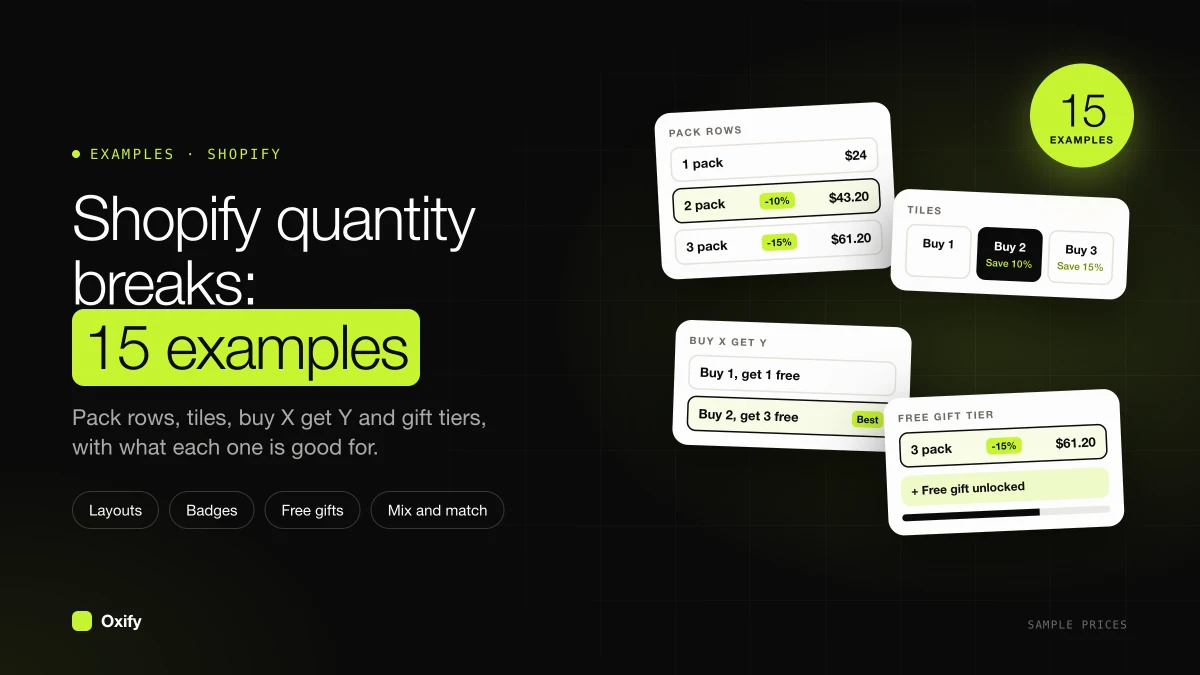
Short answer: Shopify quantity breaks are packs on the product page where each bigger pack costs less per item. The ladder most stores show is 1, then 2, then 3. Below are 15 worked examples, with the price a shopper pays and the discount type to pick in Oxify Bundles & Quantity Break.
A public study of Shopify stores, not our sales data, is the reason 1-2-3 comes first. Section Store read 1,275 bundle offers on 4,861 stores from October 16 to 23, 2026. Of 556 quantity-break offers, 62% showed 3 choices. Of 553 ladders, 37% were 1, 2, and 3 units. In 397 stores whose pages showed the exact bars, the middle discount was 15% at 2 units and 25% at 3. Those shares describe what stores display. They do not say which ladder sells more.
The prices under each example are samples so you can check the math. Swap in your price and your cost before you publish. The clicks are in how to add quantity breaks to Shopify.
How to read each example
- Discounted % takes that percent off each item. 10% off a $18 bag is $1.80 off each bag.
- Amount Off takes that many dollars off each item. $6 off on a 2-pack saves $12 in total.
- Fixed Price is the price of the whole pack. "3 for $36" means $36 for all three, not $36 each.
- Percents in Oxify round down to the cent on each item (Discount types).
On this page
- Which ladder shape to copy first
- The 15 examples
- More store types, at a glance
- When a percent is the right tool
- When a pack price reads better
- When the items are not the same
- Three products to leave alone
- How to tell if it is working
- How to build one of these today
- FAQ
Which ladder shape to copy first
Start with 1, 2, and 3 unless the product is used in a different count. That is the shape in 37% of the ladders Section Store counted. A coffee drinker can picture 3 bags. A phone-case buyer cannot picture 3 cases.
- 1-2-3 for anything people finish and buy again: coffee, soap, serum.
- 1-2 when a third unit is a stretch, such as a $60 device.
- 1-3-6 when one unit is a month, as with vitamins.
- 1-3-5 with a fixed pack price when you want "3 for $60" instead of a percent.
- A gift on the top tier only when a deeper percent would wreck the margin. In that study, 85% of ladders with a gift kept it off the first tier.
Badge the middle row, and preselect it, if that is the pack you want. In the same study, 82% of "popular" badges sat on a middle tier, and 40% of ladders opened on 2 units. Write "Most popular" only when people really pick it. A badge is a claim.
Why keep a bigger tier that few people pick? Research says it still does a job. In two experiments published in the European Journal of Marketing (Huang and Yang, 2015), shoppers who missed a "buy 4, get 30% off" deal were more willing to buy one item at full price than shoppers who missed "buy 2, get 30% off". A follow-up study found that several price breaks beat a single one on the same measure. The tests used clothing and imagined shopping trips, so treat this as a reason to test, not a promise.
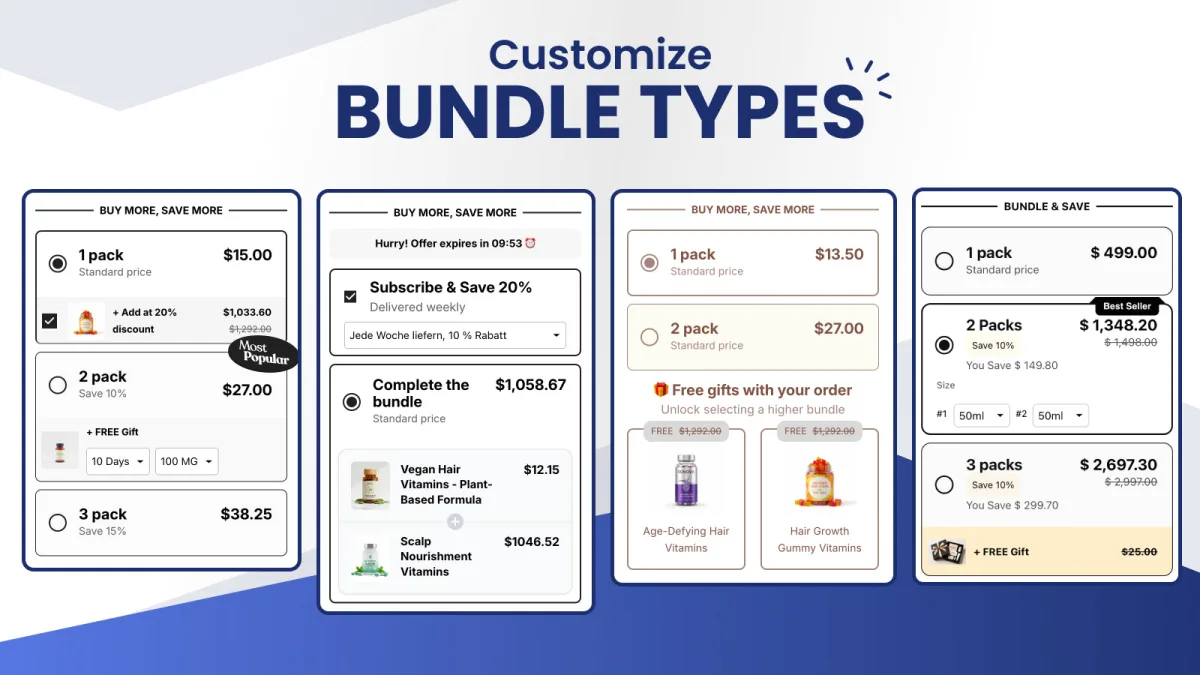
If your margin is thin, use the low end of what those stores show, about 10% at 2 units and 15% at 3, and run the profit check later on this page. A 15% and 25% pair is the middle of that study, not a rule for your cost.
15 Shopify quantity break examples
1. Ground coffee, $18 a bag
- Packs: 1 at full price, 2 at 8% off, 3 at 15% off.
- Shopper pays: $18, then $33.12, then $45.90.
- Why it can work: People drink it on a schedule. Three bags is about a month. Title the rows "1 bag", "2 bags", and "Month supply".
2. Vitamin bottle, $28
- Packs: 1, 2 at 10% off, 3 at 18% off. Discounted %.
- Shopper pays: $28, then $50.40, then $68.88.
- Why it can work: A bottle is a month if the label says 30 days. Say "2 months" on the second row so the quantity has a job.
3. Face serum, $32
- Packs: 1, 2 at 10% off, 3 at 20% off.
- Shopper pays: $32, then $57.60, then $76.80.
- Why it can work: Serum lasts, so the 2-pack is the row most people can say yes to. Mark that row Selected by default. Leave the 3-pack as the stretch.
4. Hand soap refill, $9
- Packs: 1, 3 at 15% off, 6 at 22% off.
- Shopper pays: $9, then $22.95, then $42.12.
- Why it can work: 15% of $9 is $1.35. The percent sounds bigger than the money. Put
{{saved_amount_total}}in the label so they see "$4.05 off" on the 3-pack.
5. Crew socks, $14 a pair
- Packs: Fixed Price. 3 for $36. 5 for $55. The single stays $14.
- Shopper pays: $14, then $36 (save $6), then $55 (save $15).
- Why it can work: A small percent on a $14 item looks like coins. "3 pairs for $36" is a price people can repeat to a friend.
6. Protein tub, $49
- Packs: Amount Off. $0, then $6 off each tub, then $10 off each tub.
- Shopper pays: $49, then $86, then $117.
- Why it can work: "$6 off each" is easier to trust than "12% off" on a $49 tub. Remember the amount comes off every tub, so two tubs save $12, not $6.
7. Dog treats, $16 a bag
- Packs: 1, 2 at 10% off, 4 at 18% off.
- Shopper pays: $16, then $28.80, then $52.48.
- Why it can work: If most orders are 1 bag, the first break is 2. A first break at 6 asks for a jump almost nobody makes.
8. Candle, $24
- Packs: 1, 2 at 10% off, 3 at 15% off.
- Shopper pays: $24, then $43.20, then $61.20.
- Why it can work: Gift buyers think in sets. Title the rows "One candle", "Set of 2", and "Set of 3". The math is the same. The words do the selling.
9. Tea, $14 a box
- Packs: 1, 3 at 10% off, 6 at 15% off.
- Shopper pays: $14, then $37.80, then $71.40.
- Why it can work: Six boxes is a season of tea. If your orders show that nobody buys 6, delete that row. An empty stretch tier still takes space on a phone.
10. Baby wipes, $18 a pack
- Packs: 1, 2 at 8% off, 4 at 15% off.
- Shopper pays: $18, then $33.12, then $61.20.
- Why it can work: If the case you receive holds 4, put a tier on 4. You sell a full case instead of opening one to pull out 3.
11. Printer ink, $22
- Packs: 1, 2 at 8% off, 4 at 12% off.
- Shopper pays: $22, then $40.48, then $77.44.
- Why it can work: People know a second cartridge is coming. At an $8 cost, one cartridge leaves $14. Two at 8% off ($20.24 each) leave $24.48. At 30% off, two cartridges leave $14.80. You shipped two items to make an extra $0.80. That cut is too deep.
12. Beard oil, $26, plus a gift on the big pack
- Packs: 1, 2 at 10% off, 3 at 15% off, and a travel tin only on the 3-pack.
- Shopper pays: $26, then $46.80, then $66.30, plus the tin.
- Why it can work: The gift is attached to one tier, so single-bottle buyers do not get it. The tin has to be a real product in your catalog. Setup: Free gifts.
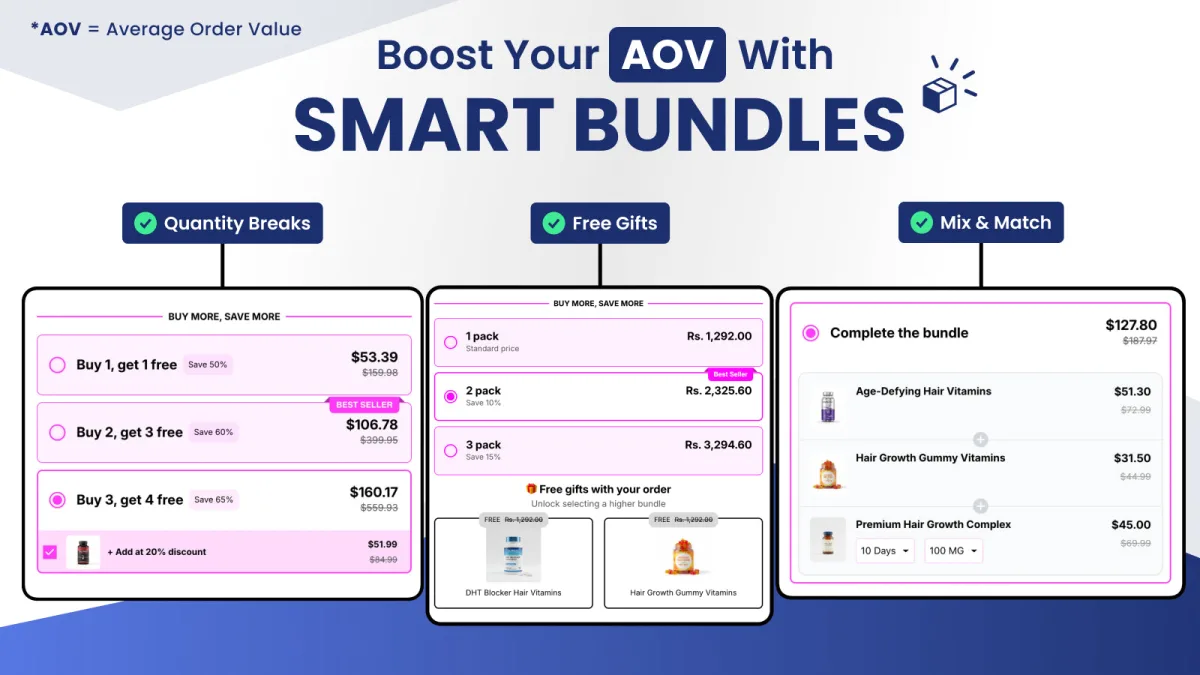
13. Same coffee, as a subscription
- Packs: The same 1, 2, and 3 bags, using the Subscription Bundles template.
- What changes: The shopper can pick one-time or subscribe on those packs.
- Why it can work: The template uses subscription plans you already made in Shopify admin. It does not invent a plan. See Subscription bundles.
14. Any 2 or 3 t-shirts, $35 each
- Offer: If the colors are variants of one shirt, keep the quantity break and turn on Let customers choose different variants for each item. If each design is its own product, use the Bundle Builder: Box of 2 at 10% off, Box of 3 at 15% off.
- Shopper pays: $63 for two shirts, or $89.25 for three, if each shirt is $35.
- Why it can work: People want colors, not three identical shirts. Per-item pickers solve that inside one product (Variant settings). Different products need a box. Box sizes are in Box sizes and discounts. The longer setup is build-a-box on Shopify.
15. Mixed case of wine, $30 a bottle
- Offer: Bundle Builder again. Box of 6 at 10% off. Box of 12 at 15% off.
- Shopper pays: $162 for 6, or $306 for 12, when every bottle is $30.
- Why it can work: A quantity break on one wine makes them buy 6 of that bottle. A box lets them mix. Put the size you want them to start on in Option 1. The page loads on Option 1.
More store types, at a glance
Not every catalog fits the 15 above. Here is where to start for other stores. Prices are yours to fill in.
| Store type | Starting ladder | Why |
|---|---|---|
| Plain jewelry (studs, stacking rings) | 1, 2 at 10% off, 3 at 15% off | "One to keep, one to gift." Skip it on engraved pieces. |
| Phone cables and chargers | 1, 2 at 10%, 3 at 15% | Home, car, desk. Cases are different: one phone, one case. |
| Kids' clothes in a size run | 1, 3 at 10%, 5 at 15%, mixed sizes on | Parents buy the next size up too. |
| Cleaning concentrate | 1, 2 at 10%, 4 at 18% | Refills run out on a schedule. |
| Wholesale buyers | 10, 25, 50 units in a B2B catalog | Company buyers expect a price table, not packs. |
| Print shops and stickers | Fixed Price: 10 for $15, 25 for $30, 50 for $50 | People order stickers in round counts. |
For the wholesale row, Shopify's B2B catalogs allow up to 10 price breaks per product, set per variant (Shopify Help: Quantity pricing). The clicks are in how to set up tiered pricing.
When a percent is the right tool
Examples 1, 2, 3, 4, 7, 8, 9, 10, and 11 use Discounted %. One deal can cover a whole collection, because 10% means something on a $14 item and on a $32 item.
Check that each bigger pack is cheaper per item than the one above it. On the candle, the prices per candle are $24, then $21.60, then $20.40. The steps go down. If your 3-pack costs more per item than your 2-pack, shoppers will feel the table is a mistake.
Also check profit dollars. A $24 candle with a $10 cost leaves $14 on one candle. The 2-pack at $43.20 leaves $23.20 after $20 of cost. The order makes more money.
If your cost is $20, that same 10% deal leaves $3.20 of profit on two candles. One candle at that cost leaves $4. Leave the row unpublished.
When a pack price reads better
Socks and other low prices do better as Fixed Price. "5 pairs for $55" beats "save 21%".
Use Fixed Price only when the products in that deal cost about the same. A $24 fixed 3-pack is a bargain on a $20 item and a bad deal on an $8 item. The app will not raise a price to meet your fixed number. Shoppers on the cheap item simply pay the normal total, and the row looks broken.
Amount Off fits big round prices, like the protein tub. Say the words "off each" in the subtitle. Otherwise a shopper thinks $6 off is $6 off the whole 2-pack.
When the items are not the same
Examples 14 and 15 are in the same app, on a different tool. Quantity breaks sell more of one product. The Bundle Builder sells a box of different products, with a discount per box size.
Turn on the other embed for that tool: Oxify: Bundle Builder. Quantity breaks use Oxify: Product Bundle. A merchant on the listing, Snuggle and Hush in the United States, wrote on 25 August 2026 that they could design the bundle builder quickly with the team's help. That is a review about setup help, not a sales result.
Inside the builder, % Off is a percent off the box total. Fixed Price is the price of the whole box. Three sizes is plenty. A sample ladder from the docs is Box of 4 with no discount, Box of 6 at 10% off, and Box of 10 at 15% off.
Three products to leave alone
- One phone, one case. A 3-pack of cases asks for phones they do not own. Sell a screen protector with the case instead.
- A mattress, a bike, a sofa. Almost nobody wants two. A quantity break on these pages looks like a pricing error.
- A personalized necklace. The second unit is a different engraving, and many buyers only need one gift.
If people already buy that product in twos, the break belongs there. If they never do, a louder discount will not create a second person to wear the second item.
How to tell if your example is working
Revenue going up is not proof. Discounted packs can raise revenue and lower profit. Track three numbers for two to four weeks.
- Take rate per tier. What share of orders picked 1, 2, and 3. In Oxify, the Bundle conversion chart on the Analytics page shows this split.
- Units per order. Total units divided by orders, before and after. This is the number the break is meant to move.
- Profit per order. Price minus product cost minus the discount, per order. If units go up and this goes down, the cut is too deep.
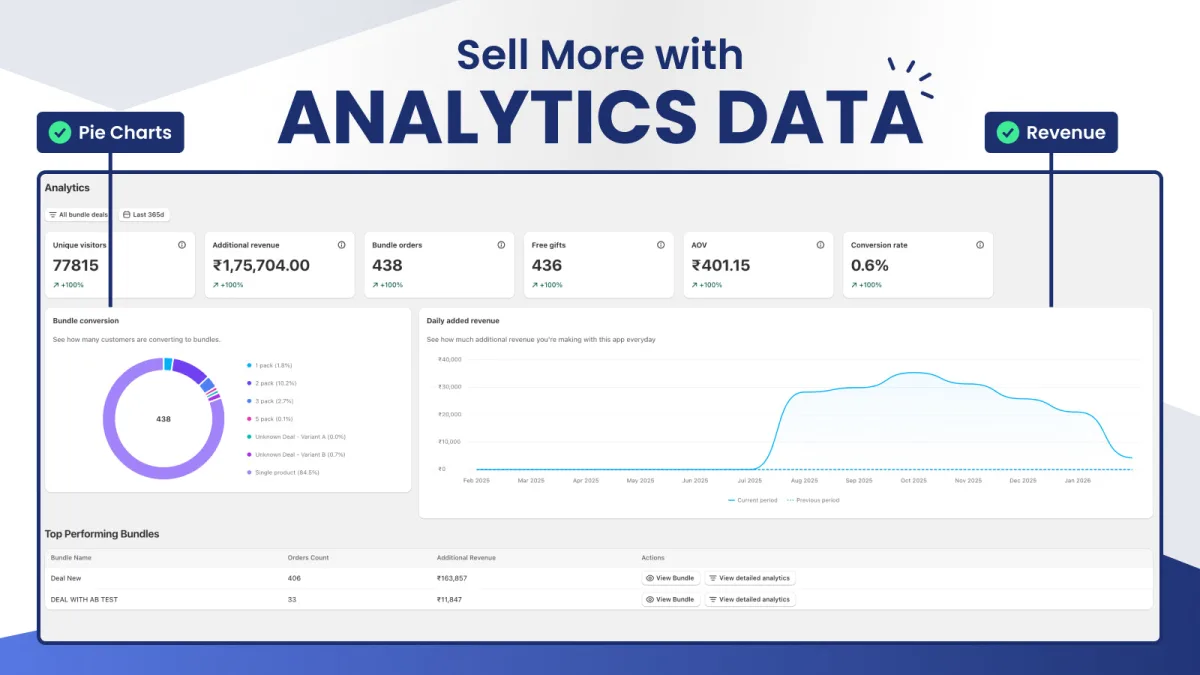
Two patterns to act on. If almost nobody picks the middle row, the gap from the single is too small, or the badge is on the wrong row. If most people pick the top row, it may be priced too low. Change one thing at a time. Oxify's A/B test runs up to three versions and picks a winner by revenue per visitor.
How to build one of these today
- Install Oxify Bundles & Quantity Break and turn on Oxify: Product Bundle.
- Add a deal from the Quantity Breaks template. For shirts or wine, use the Bundle Builder instead.
- Copy one example above. Change the prices to yours. Run the profit check from the candle section.
- Set the block title and a per-item label. Wording help: buy more save more offers.
- Save, open the product, and place a test order. The cart can show full price for a moment. Checkout is where the discount lands.
Pack-sized wording for 2, 3, and 5 is in 2-pack, 3-pack, and 5-pack discounts. How the first number should sit against your real orders is in quantity discounts and units per order.
Copy one example onto one product
Pick the row closest to what you sell. Rebuild it in Oxify Bundles & Quantity Break with your price and your cost. Publish it on that product only, then read the checkout total before you roll it out to the collection.