
Best Email Marketing Apps for Shopify in 2026: 17 Compared by Real Cost
The best email marketing app for Shopify in 2026 is Omnisend for most stores (4.7 stars, 3,183 reviews, free for 250 contacts, paid from $16 a month). Klaviyo (4.7 stars, 3,312 reviews, from $20 a month) is the best for scale and deep segmentation. Shopify Messaging, the app formerly called Shopify Email (4.7 stars, 4,497 reviews), is the best free option with 10,000 free emails a month, and Sender is the best budget pick: free up to 2,500 subscribers, then from $9 a month. Every rating, review count, free plan limit, and price in this guide was checked against the live Shopify App Store listing or the vendor's pricing page on September 18, 2026.
Jump to: the short answer · all 17 reviews · comparison table · cost as your list grows · what is actually free · Klaviyo vs Omnisend vs Shopify Messaging · what merchants say · pick by list size · FAQ
Key Facts (Verified September 2026)
- Best overall: Omnisend, 4.7 stars from 3,183 reviews. Free for 250 contacts and 500 emails a month; Standard from $16, Pro from $59.
- Best for scale: Klaviyo, 4.7 stars from 3,312 reviews. Free for 250 active profiles; email from $20 a month, about $150 at 10,000 profiles and $720 at 50,000.
- Best free: Shopify Messaging (formerly Shopify Email), 4.7 stars from 4,497 reviews. 10,000 free emails a month, then $1 per 1,000. Abandoned checkout automations are always free.
- Best budget: Sender, 4.8 stars from 17 reviews. Free for 2,500 subscribers and 15,000 emails a month; paid from $9.
- Built for Shopify badge: only three of the 17 carry it: Seguno (4.8 stars, 728 reviews), Wiz AI Email Marketing (5.0 stars, 227 reviews), and Uppush (4.9 stars, 165 reviews).
- Pricing has shifted in 2026: Omnisend Pro ($715 at 50,000 contacts) now costs about the same as Klaviyo ($720). The real saving is Omnisend Standard ($413), which caps sends at 12 times your list size.
- Free plans that are gone: Privy has no free plan, Mailchimp's free plan is now 250 contacts and 500 sends, and MailerLite's old 1,000 subscriber free tier is now 250.

Most roundups in this category are written by an email vendor that ranks itself first, and most quote ratings and free plan limits that are months or years out of date. We build Shopify cart and upsell apps, not email software, so nothing on this list is ours. This guide gives you the verified numbers, what each app costs as your list grows, what is actually free, and how to run email on Shopify once you have picked.
Which Email Marketing App Should You Pick? The Short Answer
| Best for | Pick | Main advantage | Watch-out |
|---|---|---|---|
| Most growing stores | Omnisend | Email, SMS, and web push in one app; every feature on the free plan; 24/7 support | New accounts get SMS only on Pro; non-subscribed contacts are billable |
| Large lists and lifecycle teams | Klaviyo | Deepest Shopify data, predictive analytics, no feature gating | Bills on all active profiles with automatic upgrades; $720 a month at 50,000 |
| New stores with no budget | Shopify Messaging | 10,000 free emails a month inside the admin; free abandoned checkout automation | Basic segmentation and editor |
| Tight budgets | Sender | Free for 2,500 subscribers; paid from $9 | Only 17 App Store reviews; SMS needs a paid plan |
| Staying inside Shopify | Seguno | Built for Shopify badge; unlimited sending on every plan | No built in SMS; $35 to $215 jump between tiers |
| Big list, infrequent sends | Brevo PushOwl | Priced by emails sent, not contacts; push, email, and SMS together | Free tier starts at 500 emails a month |
| Popup led list growth | Privy | Best popup toolkit of the group | No free plan; popup plan is billed on pageviews |
How We Verified This Guide
Oxify builds Shopify cart drawer, upsell, and bundle apps. We do not sell an email tool and have no commercial relationship with any app listed here. For this update we did three things:
- Pulled every listing live. Star rating and review count come from each app's Shopify App Store listing on September 18, 2026. We also checked whether the listing carries the Built for Shopify badge. Plan names, limits, and entry prices come from the same listings.
- Checked vendor pricing pages. Cost at list size for Omnisend comes from the tier data in Omnisend's own pricing calculator. Klaviyo does not publish a static price table, so its at scale figures come from its calculator as reported by multiple independent pricing trackers; re-run Klaviyo's estimator before you commit.
- Removed what we could not source. Statistics in this guide link to the primary source. Where we could not verify something, we say so.
We rank on five things: depth of Shopify data sync (the basis of email list segmentation), automation coverage, cost at your list size, deliverability tooling, and how usable the app is for a small team. Star ratings are shown but are not a ranking factor: the top apps are all within 0.2 stars of each other.
The Best Email Marketing Apps for Shopify in 2026
1. Omnisend: Best Overall for Most Shopify Stores
Omnisend is the best email marketing app for most Shopify stores. It holds a 4.7 star rating across 3,183 Shopify App Store reviews, starts at $16 a month, and puts email, SMS, and web push in one platform. The rating slipped from 4.8 earlier in 2026, so roundups still quoting 4.8 are out of date.
Standout features:
- Email, SMS, and web push with cross channel flows (email first, SMS if unopened)
- 250+ templates and prebuilt cart, welcome, and post purchase workflows
- Product Picker pulls product images, prices, and links straight from your Shopify catalog
- Popups and signup forms, A/B testing, and AI segments included
- 24/7 live support on every plan, including Free
Pricing (verified September 2026): Free for 250 contacts, 500 emails, and 500 web pushes a month with every standard feature unlocked. Standard from $16 a month (up to 500 contacts, 6,000 emails; the email cap is always 12 times your contact count). Pro from $59 a month (up to 2,500 contacts, unlimited emails). At 10,000 contacts Standard is $132 and Pro is $150.
The catch: Two things changed that most guides miss. First, for accounts created on or after May 4, 2026, SMS is available only on Pro, billed by volume from $0.009 per US message down to $0.007 at very high spend. The old deal where Pro included SMS credits equal to the plan price applies only to legacy accounts, per Omnisend's pricing help article. Second, billable contacts include non-subscribers, such as customers who bought without opting in. Only unsubscribed contacts are excluded. Segmentation and predictive analytics are also shallower than Klaviyo's.
Best for: Growing stores that want fast setup, one tool for email and push, and support that answers at any hour.
2. Klaviyo: Best for Scale and Advanced Segmentation
Klaviyo is the power tool. It carries a 4.7 star rating across 3,312 Shopify App Store reviews and starts at $20 a month. Its Shopify integration syncs tags, catalog, and coupons and pulls more event types natively than any other app here.
Standout features:
- Nested AND/OR segmentation on behavioral and predictive attributes
- Predictive analytics: lifetime value, churn risk, predicted next order date
- Personalized product recommendations and send time optimization
- 160+ campaign templates and a best in class flow builder
- Email, SMS, push, and reviews in one customer profile, with no feature gating across plans
Pricing (verified September 2026): Free for up to 250 active profiles and 500 email sends a month, plus 150 SMS/MMS credits. Email from $20 a month at 251 to 500 profiles, then roughly $30 at 1,000, $100 at 5,000, $150 at 10,000, $400 at 25,000, $720 at 50,000, and $1,380 at 100,000. SMS plans start at $15 a month for 1,250 credits and are billed on top of email.
The catch: Klaviyo bills on active profiles, which means every profile that can be emailed, whether or not you ever send to it. Since February 2025 your plan upgrades automatically when your active profile count passes your tier, and downgrades are not automatic. Suppress unengaged profiles regularly or you pay for them. The interface is also more than a team running four flows and a newsletter needs.
Best for: Stores with lists above roughly 25,000, eight or more flows, and someone who owns email as a job.
3. Shopify Messaging (Formerly Shopify Email): Best Free Starter
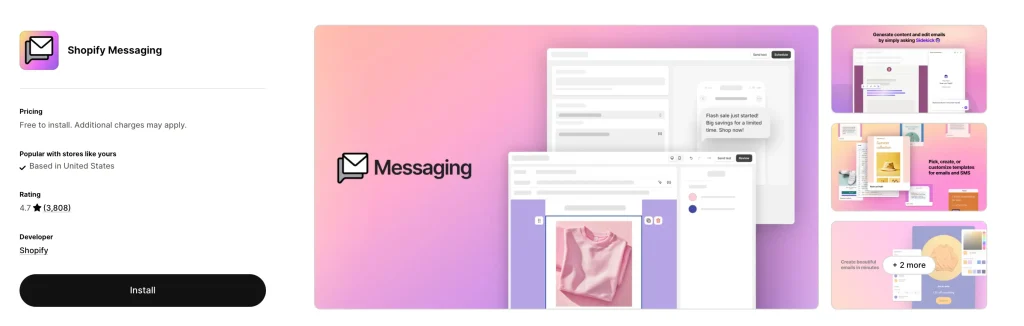
Shopify renamed Shopify Email to Shopify Messaging, and the old listing URL now redirects. It holds a 4.7 star rating across 4,497 reviews, the largest review base in this guide, and lives inside your admin.
Standout features:
- 10,000 free emails at the start of every month on Basic, Grow, Advanced, and Plus plans
- After that, $1 per 1,000 emails up to 300,000, $0.65 per 1,000 up to 750,000, and $0.55 beyond, per Shopify's pricing documentation
- Abandoned checkout automations are always free. Other marketing automations count toward the monthly allowance
- Products, prices, and customer segments come straight from your store with nothing to sync
The catch: The editor, segmentation, and automation triggers are basic, and unused free emails do not roll over. If welcome emails are the gap, see our roundup of Shopify apps that send automated welcome emails.
Best for: New stores proving that email makes money before paying for a platform.
4. Seguno: Best App That Lives Inside the Shopify Admin
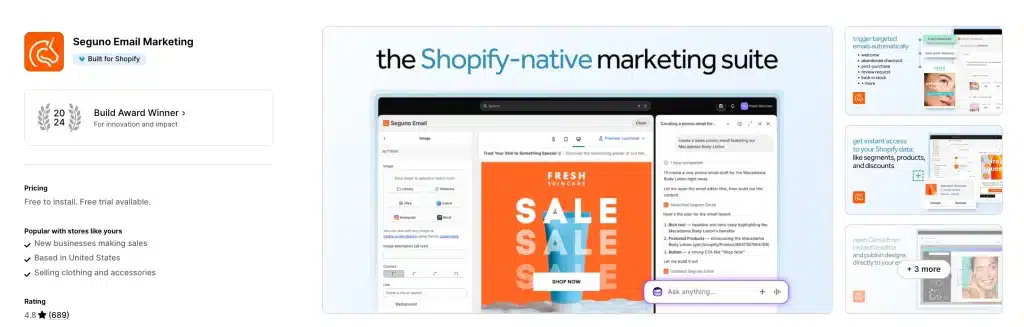
Seguno runs entirely inside the Shopify admin and holds a 4.8 star rating across 728 reviews. It is the only email app in this guide whose listing carries the Built for Shopify badge, Shopify's own quality mark for performance and design.
Standout features:
- Embedded in the admin, so store data is already there with no sync to configure
- Unlimited sending on every plan, including Starter
- 200+ templates, Canva design integration, and unique discount codes
- Standard adds popups, banners, back in stock alerts, and browse and cart abandonment
Pricing (verified September 2026): Starter is free for up to 250 subscribers. Standard is $35 a month including 2,500 subscribers. Pro is $215 a month including 25,000, with onboarding and a deliverability audit. Paid plans have a 10 day free trial.
The catch: No built in SMS, lighter segmentation than Klaviyo or Omnisend, and a steep step from $35 to $215.
Best for: Merchants who send often and never want to leave the Shopify admin.
5. Brevo PushOwl: Pay for Emails Sent, Not Contacts Stored
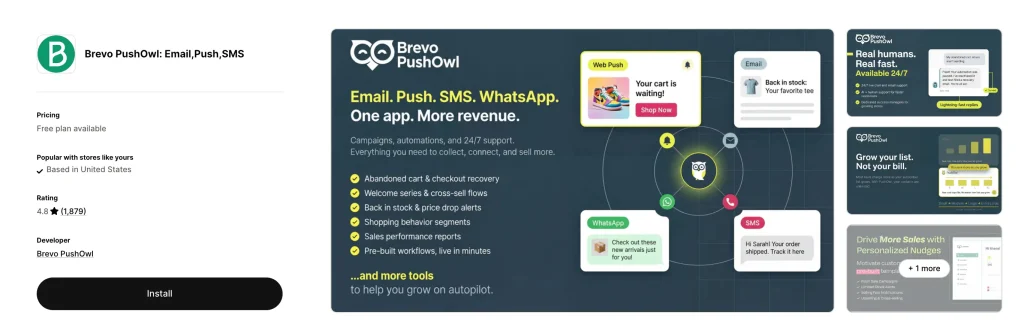
PushOwl is now Brevo PushOwl, and it is how Brevo (once Sendinblue) reaches Shopify merchants. It holds a 4.8 star rating across 2,256 reviews. The pricing model is the draw: unlimited subscribers on every plan, and you pay for volume sent.
Pricing (verified September 2026): The Basic bundle is free with 500 web pushes and from 500 emails a month, newsletters, popups, back in stock reminders, and welcome emails. Plus is $19 a month and adds abandoned cart automation, custom popups, and SMS. Power is $79 a month with browse abandonment, custom segmentation, and unlimited push.
The catch: Abandoned cart recovery is not on the free bundle, and the email builder is simpler than the leaders. Brevo's standalone platform has its own plans outside the App Store; compare both before paying.
Best for: Large lists emailed infrequently, and stores that want web push alongside email.
6. Sender: Best Budget Pick and Biggest Free Plan
Sender has the most generous free plan we verified: 2,500 subscribers and 15,000 emails a month, with automation included. That is ten times the contact allowance of Omnisend, Klaviyo, MailerLite, or Mailchimp. Its listing shows 4.8 stars from 17 reviews, a small sample, so treat the rating as early.
Pricing (verified September 2026): Free Forever carries Sender branding. Standard is $9 a month and removes branding, adds SMS and MMS, and allows multiple users. Professional is $15 a month with advanced automation and a dedicated IP. Annual billing cuts both by 30 percent.
The catch: SMS is not on the free plan, the Shopify sync is less deep than Omnisend or Klaviyo, and there is little community or agency support.
Best for: Small stores that want real automation for $0 to $15 a month.
7. MailerLite: Simple Newsletters at a Low Price
MailerLite is a clean, inexpensive newsletter tool with a good editor. Its current Shopify app, MailerLite Email Automation, syncs customers, pulls products into emails, sends abandoned cart emails, and tracks revenue. The honest caveat is the rating: 2.4 stars from 27 reviews, far below MailerLite's reputation elsewhere. Read the recent reviews before you commit.
Pricing (verified September 2026): Free for up to 250 subscribers and 2,500 emails a month. Comfort is $12 a month for up to 500 subscribers and 5,000 emails. Power is $25 a month with unlimited emails. Many roundups still quote the retired free tier of 1,000 subscribers and 12,000 emails.
One data point of our own: a small store we ran on MailerLite showed £337.46 in email attributed revenue over 30 days, £293.23 of it from campaigns rather than automations.
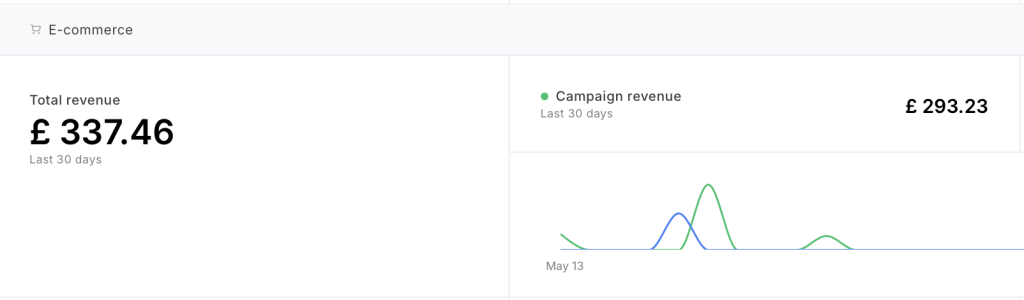
That is one store and platform attributed revenue, not a benchmark. We include it only to show that a low cost tool can pay for itself on a small list.
Best for: Solo founders who mainly send newsletters and want a friendly editor.
8. Privy: Best for Popups Plus List Growth
Privy started as a popup tool and added email later. It holds a 4.5 star rating across 4,221 reviews. The popup product is excellent: exit intent, scroll and cart value triggers, spin to win, multi step forms, and mini quizzes. The email side covers campaigns, a flow builder, and segmentation.
Pricing (verified September 2026): There is no free plan. Pop Ups & Displays starts at $24 a month for up to 10,000 monthly pageviews. Email is $30 a month for up to 1,500 contacts with unlimited sends. Email and SMS is $45 a month for 1,500 contacts and 1,250 SMS credits. Older guides still describe a free tier that no longer exists.
The catch: The popup plan is billed on pageviews, so a traffic spike raises the bill before the revenue lands. Pick it when list growth is the goal and email needs are light.
9. Mailchimp: Biggest Integration Library
Mailchimp holds a 4.8 star rating across 1,467 Shopify App Store reviews. Paid plans start at $13 a month (Essentials, up to 4 automations), $20 (Standard, up to 200 automations, send time optimization, behavioral targeting), and $350 (Premium), all priced by contact count. SMS is a paid add on. The free plan has shrunk to 250 contacts and 500 sends a month with no automation, per Mailchimp's pricing page, so guides quoting 500 contacts or 2,000 contacts are stale. Pick Mailchimp when the rest of your stack already plugs into it. For pure ecommerce depth, Omnisend and Klaviyo do more.
10. ActiveCampaign: Most Powerful Automation Logic
ActiveCampaign carries a 4.5 star rating across 260 reviews. Starter is $19 a month and includes the Shopify integration, multi step automation, site tracking, a CRM, abandoned cart, and order status triggers. Plus ($59) adds the product catalog, coupon blocks, and revenue reporting. Pro ($89) adds predictive sends and conditional content, and Enterprise starts at $159. There is a 14 day trial and no free plan. Pick it when branching automation and a CRM matter more than a Shopify first interface.
11. Drip: Ecommerce CRM for DTC Brands
Drip holds a 4.5 star rating across 56 reviews. It has one subscription from $39 a month that rises with active people on your list and email volume, with a 14 day trial and no free plan. You get segmentation on Shopify customer data, a workflow builder with split testing, Shopify specific automation templates, onsite popups, and unlimited users. It has the highest entry price here, so it suits brands that want CRM style personalization and already have a list worth $39 a month.
12. SmartrMail: Simple AI Product Recommendations
SmartrMail holds a 4.7 star rating across 305 reviews. The free plan reaches up to 200 active subscribers with 1,000 emails a month. Essentials is $10 a month plus $0.0125 per subscribed profile, with every ecommerce automation and one click AI newsletters. Pro is $49 a month plus $0.01 per subscribed profile and adds A/B testing, SMS flows, and managed strategy. Non subscribed profiles are free. Both paid plans have a 15 day trial. Pick it for personalized product emails without a learning curve.
13. AiTrillion: All in One Marketing Suite
AiTrillion holds a 4.9 star rating across 310 reviews, the highest rating in this guide. Starter is $19 a month for up to 1,000 active contacts, Basic is $49 for 2,500, and Growth is $99 for 5,000, each with a 14 day trial and no free plan. Every tier includes email, SMS and WhatsApp campaigns, workflow automation, loyalty points and referrals, photo and video reviews, memberships, and affiliates. Each module is shallower than a specialist. If loyalty is the main draw, compare it with our best Shopify loyalty apps roundup first.
14. GetResponse: Webinars, Funnels, and Courses
GetResponse shows 5.0 stars from just 5 reviews. Starter is $19 a month with unlimited sends, a welcome series, and one custom workflow. Abandoned cart recovery, product recommendations, promo codes, and unlimited workflows need Marketer at $59. Creator at $69 adds webinars and a course builder. All have a 14 day trial, and the listing shows no free plan. Pick it if you sell courses or run webinars next to your store.
15. Constant Contact: Email for Event Driven Businesses
Constant Contact holds 2.9 stars from 25 reviews on Shopify. Lite starts at $12 a month with templates, a welcome email, and event management. Standard ($35) adds automation templates, segmentation, and resend to non openers. Premium ($80) adds custom automations and dynamic content. Every plan has a 30 day trial and is priced by contacts; there is no free plan. Given the rating, choose it only if you already rely on its event tools.
16. Wiz AI Email Marketing: AI Built Flows With the Built for Shopify Badge
Wiz AI Email Marketing holds 5.0 stars from 227 reviews and carries the Built for Shopify badge. It ranked fourth in Shopify's own email marketing category when we checked on September 18, 2026, above every app here except Klaviyo. The pitch is speed: an AI agent drafts your welcome, abandoned cart, abandoned checkout, browse abandonment, and winback flows plus campaigns from a prompt, in 20+ languages, with a popup builder and live chat support.
Pricing: The listing says "free plan available", but the free tier is for development stores only. Live stores pay $14.99 a month for up to 500 active contacts, $19.99 for 1,000, and $29.99 for 2,000, with a 7 day trial; the price keeps rising with active contacts.
The catch: It launched in May 2024, is email only (no SMS), and at 1,000 contacts it costs about the same as Omnisend Standard or Klaviyo without their depth of segmentation. We have not run it on a store, so treat the rating as the evidence.
Best for: Solo owners who want flows written and live in an afternoon and do not need SMS.
17. Uppush (Abandoned Cart Email Marketing): Pay as You Send, Unlimited Contacts
Uppush, listed on the App Store as "Abandoned Cart Email Marketing", holds 4.9 stars from 165 reviews and also carries the Built for Shopify badge. It ranked eighth in the email marketing category on September 18, 2026. It combines email and web push with abandoned cart, welcome, winback, price drop, and back in stock automations, plus popups and a spin wheel.
Pricing: The free plan has unlimited subscribers but only 100 emails and 500 web push impressions. PRO is $12.99 a month with 3,000 emails and 3,000 pushes included, then from $0.35 per 1,000 emails and $0.15 per 1,000 pushes. Contacts are never metered, the same logic as Brevo PushOwl.
The catch: Abandoned checkout recovery, browse abandonment, and campaigns sit on PRO, so the free plan is a trial in practice. No SMS.
Best for: Stores with a large, rarely mailed list that want cart recovery and web push for about $13 a month.
At a Glance: All 17 Apps Compared
| App | Best For | App Store Rating (Sep 2026) | Free Plan | SMS | Starting Paid Price |
|---|---|---|---|---|---|
| Omnisend | Most stores, multichannel | 4.7 (3,183) | 250 contacts, 500 emails/mo | Pro plan only | $16/mo |
| Klaviyo | Scale, segmentation | 4.7 (3,312) | 250 profiles, 500 sends/mo | Yes, from $15/mo | $20/mo |
| Shopify Messaging | New stores | 4.7 (4,497) | 10,000 emails/mo | Yes | $1 per 1,000 emails |
| Seguno | Inside the admin (Built for Shopify) | 4.8 (728) | 250 subscribers, unlimited sends | No | $35/mo |
| Brevo PushOwl | Pay per email, web push | 4.8 (2,256) | From 500 emails + 500 pushes/mo | Plus plan and up | $19/mo |
| Sender | Budget, biggest free plan | 4.8 (17) | 2,500 subscribers, 15,000 emails/mo | Paid plans | $9/mo |
| MailerLite | Simple newsletters | 2.4 (27) | 250 subscribers, 2,500 emails/mo | No | $12/mo |
| Privy | Popups, list growth | 4.5 (4,221) | No | $45 plan | $24/mo |
| Mailchimp | Integration library | 4.8 (1,467) | 250 contacts, 500 sends, no automation | Add on | $13/mo |
| ActiveCampaign | Complex automation, CRM | 4.5 (260) | No, 14 day trial | Yes | $19/mo |
| Drip | Ecommerce CRM | 4.5 (56) | No, 14 day trial | Not listed | $39/mo |
| SmartrMail | AI product emails | 4.7 (305) | 200 subscribers, 1,000 emails/mo | Pro plan | $10/mo + per profile |
| AiTrillion | Email plus loyalty and reviews | 4.9 (310) | No, 14 day trial | Yes | $19/mo |
| GetResponse | Webinars, courses | 5.0 (5) | No, 14 day trial | Not listed | $19/mo |
| Constant Contact | Event driven businesses | 2.9 (25) | No, 30 day trial | Yes | $12/mo |
| Wiz AI Email Marketing | AI written flows (Built for Shopify) | 5.0 (227) | Development stores only | No | $14.99/mo |
| Uppush | Pay as you send, web push (Built for Shopify) | 4.9 (165) | Unlimited subscribers, 100 emails/mo | No | $12.99/mo |
Ratings, review counts, badge status, plan limits, and entry prices verified against live Shopify App Store listings on September 18, 2026. Review counts in brackets.
What Does Each App Really Cost as Your List Grows?
"Starts at" prices tell you almost nothing, because email tools bill by contacts. Here is the monthly email price at each list size for the two apps most stores choose between. Omnisend figures come from the tier data in Omnisend's pricing calculator (list price, before its 30 percent first three months offer). Klaviyo figures are its email plan as reported from Klaviyo's estimator.
| Contacts | Klaviyo Email | Omnisend Standard | Omnisend Pro |
|---|---|---|---|
| 1,000 | $30 | $20 | $59 |
| 5,000 | $100 | $81 | $90 |
| 10,000 | $150 | $132 | $150 |
| 25,000 | $400 | $282 | $400 |
| 50,000 | $720 | $413 | $715 |
| 100,000 | $1,380 | $900 | $1,334 |
| Monthly email cap | About 10x profiles | 12x contacts | Unlimited |
What this table changes:
- How do Klaviyo and Omnisend compare at 10,000 contacts? Klaviyo is $150, Omnisend Pro is $150, and Omnisend Standard is $132. Price is not the deciding factor at this size.
- The "Omnisend is 40 percent cheaper at scale" claim is only true of Standard. At 50,000 contacts Standard is $413 against Klaviyo's $720, but it caps you at 12 emails per contact per month and, for new accounts, has no SMS. Omnisend Pro at $715 is level with Klaviyo.
- Both bill more people than you think. Klaviyo counts every emailable profile. Omnisend counts subscribers plus non-subscribers and excludes only unsubscribed contacts. Clean your list before comparing quotes.
Three apps price on a different axis:
- Shopify Messaging charges per send. A 5,000 subscriber list emailed four times a month is 20,000 emails: 10,000 free and 10,000 at $1 per 1,000, so $10 a month.
- Seguno includes unlimited sending: $35 a month includes 2,500 subscribers and $215 includes 25,000.
- Brevo PushOwl does not meter subscribers: you pay for email and push volume, from free to $19 and $79 a month.
What Is Actually Free? The Free Plan Truth Table
The best free email marketing app for Shopify is Shopify Messaging on send volume (10,000 emails a month) and Sender on list size (2,500 subscribers). Seven of the 17 apps have no free plan for a live store. Everything below was verified on September 18, 2026.
| Tool | Free plan limits | Automation on free? | What to know |
|---|---|---|---|
| Shopify Messaging | 10,000 emails/mo | Yes | Abandoned checkout automation is free beyond the cap |
| Sender | 2,500 subscribers, 15,000 emails/mo | Yes | Sender branding; no SMS until $9 Standard |
| Omnisend | 250 contacts, 500 emails, 500 pushes/mo | Yes, all features | 24/7 live support even on Free |
| Klaviyo | 250 profiles, 500 sends/mo, 150 SMS credits | Yes, all features | Auto upgrades once you pass 250 active profiles |
| Brevo PushOwl | From 500 emails and 500 pushes/mo, unlimited subscribers | Welcome and back in stock only | Abandoned cart needs $19 Plus |
| MailerLite | 250 subscribers, 2,500 emails/mo | Yes | The 1,000 subscriber free tier is retired |
| Seguno | 250 subscribers, unlimited sends | Prebuilt automations | Browse and cart abandonment need $35 Standard |
| Mailchimp | 250 contacts, 500 sends/mo | No | Automation starts on $13 Essentials |
| SmartrMail | 200 subscribers, 1,000 emails/mo | All email flows except browse abandonment | Paid from $10 plus per profile fee |
| Privy | None | n/a | From $24 (popups) or $30 (email) |
| ActiveCampaign, Drip, AiTrillion, GetResponse | None, 14 day trial | n/a | From $19, $39, $19, and $19 |
| Uppush | Unlimited subscribers, 100 emails and 500 web pushes/mo | Abandoned cart only | Abandoned checkout, browse abandonment, and campaigns need $12.99 PRO |
| Constant Contact | None, 30 day trial | n/a | From $12 |
| Wiz AI Email Marketing | Development stores only, 7 day trial | n/a | From $14.99 for 500 active contacts |
Best Budget Email Marketing Tools for Shopify Small Business Owners
For small business owners on Shopify, the best email marketing tools are Shopify Messaging (nothing new to learn, 10,000 free emails), Sender (free to 2,500 subscribers, then $9), and Omnisend (from $16 when you want deeper flows and support). These are also the simplest tools here: all three can be sending within a day. This is what email costs at the two list sizes most small stores sit at.
| Tool | About 1,000 subscribers | About 5,000 subscribers |
|---|---|---|
| Shopify Messaging | $0 (four sends is 4,000 emails) | $10 (four sends is 20,000 emails) |
| Sender | $0 | Paid plan from $9, rising with list size |
| AiTrillion | $19 | $99 |
| Omnisend Standard | $20 | $81 |
| Klaviyo Email | $30 | $100 |
| Privy Email | $30 (up to 1,500 contacts) | Higher tier, check listing |
| Seguno | $35, unlimited sends | Above $35; $215 includes 25,000 |
Our advice: start free, build a welcome flow and an abandoned cart flow, and upgrade only when you hit a limit you can name, such as a segment you cannot build or a channel you cannot add. Paying $100 a month for capability you do not use yet is the most common small store mistake.
What Is the Best Newsletter App for Shopify?
If you mainly send a regular newsletter rather than complex flows, the best newsletter apps for Shopify are Shopify Messaging for cost, Seguno for unlimited sending inside the admin, and MailerLite or Mailchimp for editor quality. SmartrMail is worth a look if you want the newsletter built for you: its one click AI newsletters pull products automatically.
- Send weekly to under 2,500 people: Shopify Messaging, since 10,000 free emails covers four sends.
- Send more than weekly: Seguno at $35 with unlimited sending, or Omnisend Pro.
- Design matters most: MailerLite or Mailchimp, accepting a lighter Shopify sync.
Watch frequency whichever you choose. In Baymard Institute's 2026 survey of 1,083 US online shoppers, 48 percent said they unsubscribe because emails come too often from one retailer, now the top reason, ahead of general inbox overload at 46 percent. Baymard's earlier benchmark found 80 percent of sites offer no way to reduce frequency. A "fewer emails" option on your unsubscribe page keeps people you would otherwise lose.
How Deep Is Each App's Shopify Integration?
Integration depth decides what you can segment and automate. Real ecommerce email runs on five events: product viewed, added to cart, checkout started, order placed, and refund. It also depends on whether the editor can pull product images and prices from your catalog automatically, so you never paste a price that later goes stale.
| Tier | Apps | Product images and prices auto pulled? | What the sync covers |
|---|---|---|---|
| Native to Shopify | Shopify Messaging, Seguno | Yes, read directly from the store | Uses Shopify's own customer segments and products with nothing to sync. Event depth is simpler. |
| Deep ecommerce sync | Klaviyo, Omnisend | Yes. Klaviyo syncs catalog, tags, and coupons and adds personalized recommendations; Omnisend has Product Picker and a product recommender on Pro | Browse, cart, checkout, and order events feed segments and flows in near real time |
| Strong, not Shopify first | ActiveCampaign, Drip, SmartrMail, AiTrillion, Privy | Yes, with plan limits. ActiveCampaign's product catalog block needs the $59 Plus plan | Abandoned cart and order triggers; segmentation on Shopify customer data |
| Connector level | Mailchimp, MailerLite, Sender, Brevo PushOwl, GetResponse, Constant Contact | Mostly yes for product blocks. GetResponse keeps product recommendations for its $59 plan | Customers, orders, and carts. Confirm browse events before committing |
If you want the top rated email software that automatically pulls in Shopify product images and prices, the short list is Klaviyo, Omnisend, Shopify Messaging, and Seguno. Before installing anything, check three things on the listing: which of the five events it syncs, whether it imports historical orders, and whether it carries the Built for Shopify badge. Among these 17, only Seguno, Wiz AI Email Marketing, and Uppush do.
How does Klaviyo's segmentation differ from Omnisend's?
Klaviyo lets you nest AND/OR conditions across any event or property and adds predicted values such as next order date, lifetime value, and churn risk. Omnisend's segment builder covers shopping behavior, campaign engagement, and profile data, plus AI suggested segments, and is quicker to learn. If your plan is "VIPs, lapsed buyers, and category browsers," both do it. If you need predictive and multi level conditional logic, that is what Klaviyo's price buys. Our guide to why email list segmentation matters covers which segments to build first.
Head to Head: Klaviyo vs Omnisend vs Shopify Messaging
Most merchants end up choosing between these three, so here is the decision in one table. All figures are the ones verified elsewhere in this guide.
| Question | Shopify Messaging | Omnisend | Klaviyo |
|---|---|---|---|
| What is free? | 10,000 emails a month, any list size | 250 contacts, 500 emails a month | 250 active profiles, 500 sends a month |
| Cost at 50,000 contacts | $1 per 1,000 emails past the free 10,000 | $413 Standard, $715 Pro | About $720 |
| Segmentation | Basic, native Shopify segments | Shopping behavior and lifecycle stages | Nested conditions plus predictive values |
| SMS and push | SMS | SMS on Pro for new accounts, web push on every plan | SMS from $15 a month, plus push |
| Move up when | You need richer triggers, segments, or design | You have a team that will use predictive segmentation | n/a |
Shopify Messaging vs Klaviyo: this is a question of stage, not quality. Messaging bills on sends and Klaviyo on stored profiles, so a store mailing 5,000 people twice a month pays nothing on Messaging and a monthly fee on Klaviyo. Klaviyo earns that fee only once you use what Messaging lacks: branching flows, browse and predictive triggers, and deep segments. Klaviyo vs Omnisend: features are close for a typical store; the gap is price on Omnisend Standard and depth of data on Klaviyo. Klaviyo vs Mailchimp: Klaviyo for any store where email is a revenue channel; Mailchimp ($13 entry, no automation on its free plan) only if you already run the rest of your marketing in it.
What Merchants Say: The r/shopify Thread Google Ranks for This Search
Google ranks a r/shopify discussion above every review site for this query. A store owner who had outgrown a starter setup asked what to use for abandoned cart, post purchase flows, and basic segmentation without price jumps or feature gating. We read an archived copy of the thread (97 comments). We are paraphrasing, not quoting, and a Reddit thread is opinion, not data:
- Klaviyo is named most often, in roughly a quarter of comments, usually with the argument that it pays for itself and integrates with everything. Several replies push back that it is overkill for a merchant who asked for nothing fancy, and more than one long time user said recent price increases pushed them to look elsewhere.
- The most upvoted reply came from someone who says they ran a Klaviyo agency: they now see Omnisend as the natural step up from Shopify's own email tool and had moved two businesses from Klaviyo to Omnisend after a rate increase.
- The second most upvoted reply argues for staying on the built in Shopify Messaging app, noting it now includes SMS and that Shopify's Marketing automations cover more than people assume. Others agreed that most stores lose money by never finishing their flows, not by picking the wrong tool. The counterpoint raised: its email designs feel basic.
- Also mentioned: Seguno (for its Shopify and Canva integration), Brevo, Mailchimp (one user finding it pricey as their list grew), and Kit as a stopgap. Be aware that a few comments recommending lesser known apps read like vendor promotion, which is common in these threads.
The thread's consensus matches our ranking: start on Shopify Messaging, move to Omnisend when you need more, and choose Klaviyo when you will use its depth.
Mailchimp vs Klaviyo vs ActiveCampaign vs HubSpot: Ranked for Shopify Integration
Asked to rank these four strictly on how well they integrate with Shopify, this is our order:
- Klaviyo (4.7 stars, 3,312 reviews). Built for ecommerce first. Syncs catalog, tags, and coupons, with the widest set of Shopify events and no feature gating.
- Mailchimp (4.8 stars, 1,467 reviews). A stable official app with a large review base and automation from $13 a month. It is a general marketing tool, so ecommerce segmentation is shallower.
- ActiveCampaign (4.5 stars, 260 reviews). The strongest automation logic of the four, with abandoned cart and order status triggers from $19. The product catalog and revenue reports need the $59 Plus plan, and Shopify Plus support needs Pro.
- HubSpot (1.0 stars, 8 reviews). The app syncs customers, products, and orders into HubSpot's CRM, but merchants rate it poorly, and the listing prices Professional at $1,450 a month. Choose it only if your company already runs on HubSpot.
For other languages and markets the answer is the same. Klaviyo, Omnisend, Shopify Messaging, Seguno, Mailchimp, Brevo, and ActiveCampaign all integrate directly with Shopify through official App Store apps, whether your store sells in Germany, France, Spain, or anywhere else Shopify operates.
Which Email Platforms Support Time Zone Sending?
Time zone sending delivers a campaign at the same local hour for each recipient, so 9 a.m. means 9 a.m. in Berlin and in Boston. Support varies more than you would expect.
| Platform | Per recipient time zone sending? | Details |
|---|---|---|
| Klaviyo | Yes | Campaigns can send in each recipient's local time zone; send time optimization is also included |
| Omnisend | Yes, email campaigns only | Time Zone Optimization uses the IP address captured at signup. Imported contacts fall back to your store's time zone. Not available for automations, SMS, or push |
| Mailchimp | Yes, on higher paid plans | The feature is called Timewarp |
| HubSpot | Yes, Marketing Hub Professional and Enterprise | Schedule at least a full day ahead; contacts with no time zone use the account's |
| MailerLite | Yes, paid plans | Delivery by time zone option when scheduling |
| ActiveCampaign | Not for standard scheduled campaigns | Campaigns use the account time zone. Predictive sending on Pro picks a time per contact instead |
| Brevo | Not confirmed | Brevo documents a "send at best time" option; we could not confirm per recipient time zone scheduling in its help center |
| Shopify Messaging, Seguno | Not documented | Campaigns schedule on the store's time zone as far as we could verify |
Deliverability: Will Your Emails Reach the Inbox?
Since February 2024, Gmail and Yahoo have enforced rules for bulk senders, meaning anyone sending about 5,000 or more messages a day to their users. Google's email sender guidelines require three things:
- Authenticate: set up SPF and DKIM for your domain and publish a DMARC record (a policy of "none" is accepted).
- One click unsubscribe: marketing messages must support it and show a clearly visible unsubscribe link.
- Spam complaints: keep your rate in Postmaster Tools below 0.10 percent and never reach 0.30 percent or higher.
Microsoft added similar authentication requirements for high volume senders to Outlook.com in 2025. Every app in this guide adds the unsubscribe headers for you. The part only you can do is authenticate your own sending domain, which each app's setup guide walks through. After that, your own behavior decides more than your vendor: send to engaged segments, sunset people who have not opened in months (this also lowers your bill on Klaviyo and Omnisend), and warm up gradually after a migration. Seguno's Pro plan includes a deliverability audit, and Sender's Professional plan includes a dedicated IP, if you want help.
Which Email Platform Is Best for Abandoned Cart Recovery?
Klaviyo and Omnisend are the strongest platforms for abandoned cart recovery. Both ship prebuilt cart and checkout flows on native Shopify events and let you branch by cart value, so discounts go only to carts that justify them. Shopify Messaging does support automated abandoned cart flows, and its abandoned checkout automation is always free and outside the 10,000 email allowance, which makes it the best zero budget option.
Know where cart recovery is gated: Brevo PushOwl needs the $19 Plus bundle, GetResponse needs the $59 Marketer plan, and Seguno needs $35 Standard.
How much should you expect? Klaviyo's abandoned cart benchmarks, based on more than 143,000 flows in 2023, put the average placed order rate at 3.33 percent per recipient and revenue at $3.65 per recipient. That is the highest of any flow type, and still a reminder that most abandoners do not come back. Email is the second line of defense. The first is fixing the cart itself, which we cover in our guide to the best Shopify apps to reduce cart abandonment.
Hidden Costs the Pricing Pages Do Not Lead With
You are billed for contacts you never email
Klaviyo defines an active profile as any profile that can receive email marketing, whatever its consent status, and since February 2025 it moves you up a tier automatically when the count grows. Omnisend's billable contacts include subscribers and non-subscribers, such as customers who checked out without opting in. In both, the fix is the same: suppress or remove unengaged and non-consented contacts on a schedule. SmartrMail is the exception, charging $0 for non subscribed profiles.
SMS is a second bill
| Platform | SMS model (verified September 2026) | Entry US rate |
|---|---|---|
| Omnisend | Pro plan only for accounts created from May 4, 2026; pay by volume; credits expire after 60 days | $0.009 per SMS, $0.0085 above $50 of spend, $0.007 above $10,000 |
| Klaviyo | Separate SMS plan on top of email; 150 free credits | $15 a month for 1,250 credits, about $0.012 per credit |
| Privy | Bundled in the Email and SMS plan | $45 a month includes 1,250 credits |
| Sender | SMS and MMS from the $9 Standard plan | See vendor |
At 5,000 US texts a month that is roughly $43 on Omnisend and $60 on Klaviyo at entry rates, before carrier surcharges or longer messages that use more than one credit. We left out the "98 percent SMS open rate" figure many guides repeat, because no primary source exists for it.
Switching platforms means rebuilding flows
Contacts and lists move by CSV or a sync tool in hours. Flows, segments, forms, and templates do not transfer; they are rebuilt by hand, and a new sending setup needs a warm up period. That is why the right question is what you will need in twelve months, not which app is $10 cheaper today. Omnisend and ActiveCampaign both advertise migration help, so ask what it covers before you sign.
Bundles can close a price gap
Klaviyo sells reviews inside the same account, AiTrillion bundles loyalty and reviews from $19, and Seguno Standard includes popups, banners, and reviews. If you already pay for a separate reviews or popup app, count that saving. Our best Shopify review apps guide has the standalone prices to compare against.
One product to skip: Yotpo Email and SMS
Yotpo announced in August 2025 that it was leaving email and SMS to focus on reviews and loyalty, and it shut both products down in December 2025. Some roundups still list Yotpo email at $15 a month. If a guide recommends it, the guide has not been updated.
How to Do Email Marketing With Shopify: A Five Step Start
- Install one app and authenticate your domain. Start with Shopify Messaging or a free plan above, then add the SPF, DKIM, and DMARC records the app gives you.
- Collect emails with consent. Turn on the marketing opt in checkbox at checkout and add a signup form or popup.
- Build the five core flows listed below before sending any campaign.
- Send one campaign a week to engaged subscribers: a product story, a restock, or an offer.
- Review monthly. Check revenue per recipient, unsubscribe rate, and spam complaints, then prune contacts who never open.
The five flows to build first
Automations are a small share of sends and a large share of revenue. Omnisend's 2026 ecommerce marketing report, covering 27 billion emails sent in 2025, found automated emails were 2 percent of sends and produced 30 percent of email revenue, with abandoned cart, welcome, and back in stock messages performing best.
- Welcome series: three to five emails after signup covering brand story, social proof, and a soft offer.
- Abandoned cart: two or three emails over 24 hours, the first within the hour.
- Browse abandonment: for shoppers who viewed a product but did not add it to cart.
- Post purchase: thank you, how to use it, then related products.
- Win back: for customers who have not bought in 90 days or more.
Best ways to grow your email list on Shopify
- Checkout opt in. Enable the email marketing checkbox in your Shopify checkout settings. It is free and captures buyers, your highest value subscribers.
- A welcome popup with a reason to join. Omnisend, Klaviyo, Seguno Standard, and Privy all include popups. Shopify's free Shopify Forms app does the basics.
- Exit intent and cart value triggers. Privy is strongest here, with spin to win and mini quiz formats.
- Back in stock and price drop alerts. Seguno Standard and Brevo PushOwl collect signups from shoppers with clear intent.
- An embedded footer form and a post purchase opt in. Low volume, but these subscribers chose you unprompted.
- Never buy a list. Purchased addresses push spam complaints past Google's 0.30 percent line quickly.
Decision Framework: Pick by List Size and Budget
| Your situation | Best fit | Why |
|---|---|---|
| Under 1,000 subscribers, no budget | Shopify Messaging or Sender | $0 at this size, with automation |
| 1,000 to 10,000, under $150 a month | Omnisend Standard | $20 to $132, all features, 24/7 support |
| 10,000 to 25,000 | Omnisend Pro or Klaviyo | Same price, so choose on segmentation depth and who runs it |
| 25,000 plus with a dedicated email owner | Klaviyo | Predictive segmentation pays back at this scale |
| Large list, one or two sends a month | Brevo PushOwl or Shopify Messaging | Priced on volume sent, not contacts |
| Frequent sender who stays in the admin | Seguno | Unlimited sending, Built for Shopify |
| Want email, loyalty, and reviews on one bill | AiTrillion | $19 to $99 covers all three |
Accuracy Audit: What Other Roundups Get Wrong
We compared the figures in the pages that rank for this topic with the live listings on September 18, 2026. We name no one; the point is to show which numbers go stale.
| Area | What ranking guides say | What we verified |
|---|---|---|
| Klaviyo rating | 4.5 stars, 2,570 reviews | 4.7 stars, 3,312 reviews |
| Omnisend rating | 4.8 stars, around 2,950 reviews | 4.7 stars, 3,183 reviews |
| MailerLite free plan | 1,000 contacts, 12,000 emails | 250 subscribers, 2,500 emails |
| Mailchimp free plan | 500 contacts, 1,000 emails | 250 contacts, 500 sends, no automation |
| Privy | "Limited" free plan, from $12 | No free plan; from $24 (popups) or $30 (email) |
| Seguno | Trial only, from $10 | Free for 250 subscribers; paid from $35 |
| Yotpo email | Listed from $15 a month | Shut down December 2025 |
| Shopify Email | Still named Shopify Email | Renamed Shopify Messaging; 4.7 stars, 4,497 reviews |
| Omnisend SMS | Pro includes SMS credits equal to plan price | Legacy accounts only; new accounts pay per SMS on Pro |
| Omnisend vs Klaviyo at 50,000 | Omnisend about 40 percent cheaper | True for Standard ($413) only; Pro is $715 against Klaviyo's $720 |
Earlier versions of this article carried some of the same errors, including the Omnisend SMS bundle and the 50,000 contact comparison. They are corrected above.
Email Brings Them Back. Your Cart Decides What They Spend.
Disclosure: this part is about our own product. Email recovers shoppers after they leave; your cart decides order value while they are still on the site. Oxify Cart Drawer & Upsells adds a slide cart with in cart upsells, a free shipping bar, free gifts, and post purchase offers, and it works alongside any email app in this guide. Our cart upsell strategy guide explains the approach.
Frequently Asked Questions
What is the best email marketing app for Shopify in 2026?
Does Shopify have built-in email marketing?
Is Shopify Email free?
Is Klaviyo or Mailchimp better for Shopify?
What is the best free email marketing app for Shopify?
What is the best email marketing platform or service for Shopify on a small budget?
What is the best newsletter app for Shopify?
How do Klaviyo and Omnisend pricing compare for 10,000 contacts?
Does Shopify Messaging support automated abandoned cart flows?
Which Shopify email apps include native SMS and push notifications?
Which email platforms integrate best with Shopify: Mailchimp, Klaviyo, ActiveCampaign, or HubSpot?
Which email software automatically pulls in Shopify product images and prices?
Which email service providers support time zone sending?
Which platform is best for abandoned cart recovery?
What do Gmail and Yahoo require from Shopify stores sending email?
What hidden costs should I watch for?
How do I start email marketing with Shopify and grow my list?
Is Yotpo still an email option in 2026?
Can I use an email app and a cart upsell app together?
Final Verdict
Pick Omnisend (4.7 stars, 3,183 reviews, from $16 a month) if you want one capable tool with support at any hour. Pick Klaviyo (4.7 stars, 3,312 reviews, from $20 a month) if your list is large and someone will use its segmentation. Start on Shopify Messaging if you are new, and look at Sender when you want automation on a budget. Whichever you choose, authenticate your domain, build the five core flows first, and re-check the price at your real contact count, because that number, not the "starts at" price, is what you will pay.