 Oxify
OxifyBest Shopify Abandoned Cart Recovery Apps by Channel and Store Size (Checked October 2026)
Short answer: For most Shopify stores the best abandoned cart app is Omnisend (4.7★, 3,184 reviews): email, SMS and web push in one tool, a free plan, paid from $16/month. Pick Klaviyo if someone will build segmented flows, Recapture if you run the store alone, and Cartly for free email plus web push.
For SMS in the US use Postscript or TxtCart AI; for WhatsApp markets outside the US, Dondy or Kanal. Recovery apps only reach shoppers who left an email or phone number, so pair one with on-site prevention such as Oxify Cart Drawer & Upsells (our own app; disclosure below).
Which Shopify Abandoned Cart App Should You Pick? (Best by Situation)
| Situation | Pick | Cost (live listings, 5 Oct 2026) | Watch-out |
|---|---|---|---|
| Solo owner, small store, want it running today | Recapture or Shopify Messaging | Recapture: free until $500 recovered, then $39/mo. Shopify Messaging: first 10,000 emails free | Recapture is 5.0★ but only 45 reviews |
| Zero budget, want email and push | Cartly | Free plan (100 recovery emails/mo, unlimited push); Pro $14.99/mo | Shallow segmentation, dated templates |
| Growing store, one tool for email, SMS and push | Omnisend | Free to 250 contacts; Standard from $16/mo; SMS from $0.007/message | 5% of its reviews are 1-star (163 of 3,184) |
| Marketing team, high AOV, complex segments | Klaviyo | Free to 250 profiles; email from $20/mo; SMS from $15/mo | Bill follows active profiles; 8% 1-star (263 of 3,351) |
| US store, SMS-first | Postscript or TxtCart AI | $49/mo or $29/mo minimum spend, plus about $0.009 per SMS and carrier fees | Consent, 10DLC and quiet-hours rules apply |
| Already on Postscript, thinking of switching | Klaviyo or Omnisend SMS if you want one flow; TxtCart AI if you want AI replies | See the Postscript section below | Move consent records before you cut over |
| Customers on WhatsApp (not the US) | Dondy, Kanal, or CK for budget | Dondy automation $79.99/mo; Kanal Pro $89/mo; CK VIP $9.99/mo, plus Meta message fees | Meta has paused US marketing templates since April 2025 |
| Visitors who never give an email | PushOwl or Cartly push, plus a cart drawer | PushOwl cart recovery from $19/mo; Cartly push free | PushOwl's free bundle has no cart automation |
| Considered purchases ($300+ carts) | Klaviyo plus Tidio | Tidio Lyro AI agent $39/mo (free plan available) | Chat adds friction on impulse buys |
| Shopify Plus or high volume | Klaviyo plus one SMS platform | Postscript Growth $100/mo; TxtCart Pro $399/mo; Recart $299/mo | One attribution source of truth; Scripts ended June 30 |
| Stop carts being abandoned at all | Oxify Cart Drawer & Upsells (ours) | From $9.99/mo, 14-day free trial | Prevention only; needs an Online Store 2.0 theme |
Key Facts (Verified 5 October 2026)
- The average cart abandonment rate is 70.22%, Baymard Institute's average across 50 studies (page last updated 22 September 2025). Baymard's own survey puts "just browsing" at 42% and extra costs at 40%.
- Shopify now has built-in cart, checkout and browse recovery inside Shopify Messaging automations (email and SMS). The first 10,000 emails a month are free, but the new automation sends to marketing-subscribed customers by default.
- Abandoned cart emails convert 1.72% (Omnisend, 2025 data) to 3.33% (Klaviyo) per recipient, at about $3.60 revenue per email sent. That is per email recipient, not per abandoned checkout.
- Free plans differ sharply: Omnisend 250 contacts and 500 emails; Klaviyo 250 profiles and 500 emails; Retainful 500 emails; Cartly 100 recovery emails plus unlimited push; Recapture free until $500 recovered; PushOwl's free bundle has no cart recovery automation.
- Meta has paused WhatsApp marketing templates to US numbers since 1 April 2025, and template review takes up to 24 hours, not days. WhatsApp recovery is a non-US play.
- SMS apps now bill on minimum spend: Postscript $49/month, TxtCart AI $29/month, plus per-message and carrier fees.
- Shopify Scripts stopped executing on 30 June 2026, and script tags on the Thank you and Order status pages stopped working for non-Plus stores on 26 August 2026.
- Only three of the apps we checked carry the Built for Shopify badge: Oxify, Dondy and CK. Ratings and review counts for all 19 apps were read off live listings on 5 October 2026.
Quick Comparison: 19 Shopify Abandoned Cart Apps, Prices Checked October 2026
| App | Best For | Type | Rating | Starting Price | Free Plan |
|---|---|---|---|---|---|
| Oxify Cart Drawer & Upsells | Preventing abandonment on-site | Prevention (Cart Drawer) | 4.9★ (40) | $9.99/mo | 14-day trial, no card |
| Klaviyo | Segmented flows at scale | Recovery (Email/SMS/WhatsApp) | 4.7★ (3,351) | Email $20/mo; SMS $15/mo | Yes (250 profiles) |
| Omnisend | Multi-channel value | Recovery (Email/SMS/Push) | 4.7★ (3,184) | $16/mo | Yes (250 contacts, 500 emails) |
| Recapture | Founder-run stores | Recovery (Email/SMS) | 5.0★ (45) | $39/mo | Yes (to $500 recovered) |
| Cartly (formerly CareCart) | Free email plus push | Recovery (Email/Push) | 4.8★ (252) | $14.99/mo | Yes (100 recovery emails) |
| Recart | Managed SMS list growth | Recovery (SMS) | 4.7★ (487) | $299/mo | Free-to-install onboarding tier |
| Retainful | Budget email plus next-order coupons | Recovery (Email/SMS) | 4.4★ (28) | Pro $14/mo | Yes (500 emails/mo) |
| Postscript | US SMS-first strategy | Recovery (SMS) | 4.7★ (1,206) | Free to install; $49/mo minimum spend | Free to install |
| TxtCart AI | AI conversational SMS (US) | Recovery (AI SMS) | 4.9★ (540) | Free to install; $29/mo minimum spend | $500 trial credits |
| CartBoss | Pay-per-SMS in Europe, but see the rating | Recovery (SMS) | 3.1★ (9) | Pay per SMS, no monthly fee | Free to install |
| Brevo PushOwl | Browser push, no email needed | Recovery (Push) | 4.8★ (2,279) | Plus $19/mo (cart recovery) | Yes, but no cart automation |
| Wisepops | Exit-intent popups for high-traffic stores | Prevention (Popup) | 4.9★ (71) | $299/mo | 14-day trial |
| Adoric | Budget popups plus recommendations | Prevention (Popup) | 4.9★ (259) | $4.99/mo | Yes (to 20 orders/mo) |
| Dondy | WhatsApp recovery, Built for Shopify | Recovery (WhatsApp/AI) | 4.9★ (820) | Automation $79.99/mo | Chat button only |
| Kanal | WhatsApp flows with an AI tier | Recovery (WhatsApp/AI) | 5.0★ (124) | Pro $89/mo | Free demo plan |
| CK: Abandoned cart on WhatsApp | Lowest-cost WhatsApp recovery | Recovery (WhatsApp) | 5.0★ (298) | VIP $9.99/mo | Yes (100 manual messages) |
| BiteSpeed | WhatsApp flows and AI voice calls | Recovery (WhatsApp/Voice) | 4.6★ (403) | Free to install, usage-based | Free to install |
| Tidio | Live chat and AI agent | Recovery (Chat) | 4.8★ (1,350) | $29/mo | Yes |
| Shopify Messaging | Brand new stores | Recovery (Email/SMS) | 4.8★ (4,591) | $1 per 1,000 emails after 10,000 | Yes (10K emails) |
Ratings, review counts and plans were read off each live Shopify App Store listing on 5 October 2026. Every app name links to its listing so you can check us.
How We Picked and Verified These Apps
This is a research-and-verification guide, not a hands-on test of every app. Here is exactly what was done:
- Listings verified live on 5 October 2026. Each rating and review count was read from the app's own App Store page (its structured data and review panel), plans and prices from the listing's pricing section, and the Built for Shopify badge from the listing header. Where a vendor's own pricing page differs from the listing, we say so.
- Pros and cons are synthesised, not lab results. They draw on listing copy, the review-star distribution, vendor documentation and the published benchmarks named below. We build Oxify and use it ourselves; for the other apps we have not run controlled installs, and the guide no longer claims otherwise.
- Statistics traced to the primary publisher. Baymard Institute (abandonment rate and reasons, 2026 UX study), Omnisend's 2026 ecommerce marketing report, Klaviyo's benchmarks, Shopify's help center and shopify.dev changelog, Meta's WhatsApp documentation. Anything we could not trace is labelled "vendor-reported" or cut.
- Honest pros and cons. Where an app is a poor fit (WhatsApp in the US, Klaviyo for solo founders, CartBoss at 3.1★), we say so.
Full disclosure: Oxify publishes this guide, and Oxify Cart Drawer & Upsells is our app. We held it to the same standard as every other app, real cons included, and did not re-rank the list to favour it.
What Changed in This Edition (Corrections Since 9 September)
We re-pulled every listing on 5 October 2026 and found claims in our own previous edition that did not survive. Here are the ones that change a buying decision:
| Claim | Previous edition | Checked 5 October 2026 |
|---|---|---|
| Dondy pricing | Free plan; paid from $8.90/mo | Free plan is a WhatsApp chat button; Pro $6.99/mo is manual recovery only; automated cart recovery is Power Automation at $79.99/mo |
| PushOwl free plan | "Generous enough to test" cart recovery | Free bundle lists 500 pushes, no abandoned cart automation; that starts at Plus, $19/mo |
| Shopify's native recovery | Single send, checkouts only, no multi-step | Messaging automations now cover abandoned checkout, abandoned cart and product browse, on email and SMS, and a second automation or Shopify Flow adds steps |
| WhatsApp template approval | "Takes days" | Meta: review can take up to 24 hours. New: US marketing templates paused since 1 April 2025 |
| Omnisend free plan | "All features, only caps sends" | 250 contacts, 500 emails/month; unlimited web push starts on Standard; SMS billed per message |
| Checkout script deadlines | Described as one 26 August 2026 cutoff | shopify.dev: script tags sunset for non-Plus on 26 August 2026; checkout.liquid and Additional Scripts on those pages on 28 August 2025 |
| Unsourced statistics | Plus abandonment of 64 to 68%, luxury above 80%, 50% more carts than checkouts, Shop Pay Installments 28%, Tidio 60 to 70% resolution | Removed: no primary source found |
Review counts also moved: Klaviyo 3,282 to 3,351, Omnisend 3,178 to 3,184, TxtCart AI 504 to 540, PushOwl 2,240 to 2,279, Shopify Messaging 4,452 to 4,591 (rating 4.7★ to 4.8★), Cartly 248 to 252. CartBoss held at 3.1★ across 9 reviews.
What other "best abandoned cart apps" guides get wrong
Competing roundups are mostly vendor-written, which is why their data ages badly. Examples we found while checking: one published in March 2026 still shows Klaviyo at 4.5★ and 2,570 reviews (live: 4.7★, 3,351); two list Wisepops at $49/month (the App Store plan is $299/month); one lists CartBoss at 3.5★ (live: 3.1★) and Care Cart at $12/month (Cartly Pro is $14.99/month); another lists Recart from $229/month (the live Starter plan is $299/month); and an "AI cart recovery" roundup repeats a 98% WhatsApp open rate we could not trace to a primary source. Roundups also tend to omit what each tool costs once your list grows, which the cost section below covers.
Abandoned Cart vs Abandoned Checkout: Know the Difference First
This decides which app you need, and most guides skip it. An abandoned cart means items were added but checkout was never reached — no email captured, so only on-site prevention reaches this group. An abandoned checkout means the shopper entered checkout and gave an email but did not pay — Shopify records it and recovery apps can act. Far more shoppers drop off before checkout than inside it, and that larger group is the one email can never touch. That is the case for pairing prevention with recovery rather than buying recovery alone.
Why Shopify Stores Lose 70% of Their Carts
| Reason | % of Shoppers | Can a recovery email fix it? |
|---|---|---|
| Just browsing / not ready to buy | 42% | Sometimes — this is the group email genuinely wins back |
| Extra costs too high (shipping, tax, fees) | 40% | No — fix it on-site, before the cart |
| Delivery was too slow | 20% | No |
| Didn't trust the site with card details | 19% | No |
| Site required account creation | 18% | No |
| Checkout too long or complicated | 17% | No |
| Website errors or crashes | 17% | No |
| Returns policy unsatisfactory | 13% | No |
| Couldn't calculate total cost upfront | 12% | No |
| Credit card declined | 10% | Partly |
| Not enough payment methods | 9% | No |
Accuracy note (checked 5 October 2026): older copies of this table, and guides that quote them, show 48% next to extra costs. Baymard's current page says 40%, and lists the 42% "just browsing" figure separately. The page was last updated on 22 September 2025 and gives no sample size or field date for this particular survey, so treat the ordering as more reliable than the decimals.
Source: Baymard Institute checkout abandonment research (respondents could select more than one reason, so the column does not total 100%; Baymard also lists "I don't know" at 7%).
Read the third column, because it is the whole argument of this guide. Nine of the eleven reasons are things a recovery email cannot fix, and they are structural — a discount text cannot un-charge $12 of surprise shipping or un-require an account. Recovery apps compete for the 42% who were "just browsing." Everything else is won or lost on-site, which is why prevention belongs at the top of the stack rather than as an afterthought at the bottom of a listicle.
What Recovery Rate Should You Expect? (Benchmarks by Channel)
Recovery-rate claims vary wildly between vendors, and only two datasets here come from a large, named sample. Everything else is vendor- or merchant-reported and is labelled that way:
| Channel / layer | Typical recovery | Tuned / ceiling | Source and quality |
|---|---|---|---|
| Abandoned cart email, per recipient | 1.72% (Omnisend) to 3.33% (Klaviyo) | 7.69% (Klaviyo top 10%) | Published datasets: Omnisend 2026 report (2025 data, $3.59 per email); Klaviyo benchmarks ($3.65 per recipient) |
| Email, 3-message flow, per abandoned checkout | 3–5% | 10–15% | Vendor-reported ranges; denominator differs from the row above |
| Email + SMS combined | — | 15–20% of abandoned checkouts | Vendor case studies, not audited |
| WhatsApp-first stacks (outside the US) | — | 25%+ | Merchant-reported, not audited |
| Browser push | Add-on channel; reaches shoppers with no contact info | — | No neutral benchmark found |
| Prevention (cart drawer + Shop Pay) | Applies to 100% of visitors | — | Shop Pay: Shopify says up to 50% better conversion than guest checkout (2023 study); cart drawer lifts are merchant-reported |
Read the denominator before you compare any two of these numbers. "1.72% conversion" and "15% recovery" are not rival claims about the same thing — the first is per email recipient, the second is per abandoned checkout across a multi-message programme. Vendors switch between the two freely because the larger number sells better. Recovery percentages also only ever apply to abandoned checkouts, the minority who left contact details.
The best-evidenced finding on sequence length is vendor-reported but from a large sample: Recapture says a 3-email sequence recovered 153 to 231% more revenue than a single email across 11,000+ stores. Treat it as directional, since Recapture sells sequences.
The counterweight nobody in this category cites: Baymard's 2026 quantitative UX study (published 4 August 2026, 1,083 US online shoppers) found that 48% of surveyed shoppers report unsubscribing because emails arrive too frequently from a single retailer, now the top driver of newsletter unsubscribes. That finding is about newsletters, not recovery flows, but the lesson carries: three messages is well supported; five or six is where you start trading a list you own for a short-term bump.
Are Abandoned Cart Apps Worth It? The Actual Math
Here is the arithmetic. It assumes about 45% of checkouts complete (an assumption — replace it with your own figure from Shopify Analytics), so every $1 of completed revenue implies roughly $1.22 of abandoned checkout value. It then applies the per-recipient benchmark rates to that value, which flatters the result, so treat it as order-of-magnitude:
| Store revenue /mo | Est. abandoned checkout value /mo | Recovered (avg 3.33%) | Recovered (tuned 10%) | Typical app cost /mo |
|---|---|---|---|---|
| $10,000 | ~$12,200 | ~$405 | ~$1,220 | $14–39 (Retainful, Omnisend, Recapture) |
| $50,000 | ~$61,000 | ~$2,030 | ~$6,100 | ~$100 (Klaviyo at ~5k contacts) |
| $200,000 | ~$244,000 | ~$8,100 | ~$24,400 | ~$400 (Klaviyo at ~25k contacts) + SMS spend |
Even at the average recovery rate, a $16 to $39/month email app pays for itself 10 to 30 times over at $10k/month revenue. At a $60 AOV, a tuned flow on a $10k store recovers roughly 20 orders a month — about $1 to $2 of app cost per recovered order. Estimates, not guarantees, but the direction is unambiguous.
The exception is SMS. Postscript and TxtCart AI are free to install but carry monthly minimum spends ($49 and $29; Postscript's listing states $0.009 per SMS plus carrier fees). As a rule of thumb (ours, not a published threshold), below roughly $200k/year in revenue you rarely have enough abandoned checkouts with phone numbers to spend the minimum profitably. Get email working first.
What Do Shopify Abandoned Cart Apps Actually Cost? Free Plans and Month-Six Bills
Every roundup in this category publishes a "starting price." Few say what you will pay in month six, which is what decides whether an app was a good choice. The big platforms bill on contacts stored or messages sent, not on features, so the app that looked cheapest at signup often is not. Plans below were read off each app's live listing on 5 October 2026; treat them as planning figures, not quotes:
| Tool | Free tier (what it really includes) | Paid entry | How the bill grows |
|---|---|---|---|
| Shopify Messaging | First 10,000 emails/month free | $1 per 1,000 emails after that | Emails sent; SMS and WhatsApp are priced per message (rates vary by country, see the app) |
| Cartly | 100 recovery emails/month, unlimited push, spin-to-win | Pro $14.99/mo (or $129/yr), unlimited emails | Flat tier on the listing; no per-contact steps shown |
| Retainful | 500 emails/month, abandoned cart flow included | Pro $14/mo | Sends capped at 10x your list; +$4 per extra 500 contacts |
| Recapture | Free until the first $500 recovered | Pro $39/mo | Fee scales with revenue recovered; SMS and email broadcasts are add-ons |
| Omnisend | 250 contacts, 500 emails/month, abandoned cart flow and popups included | Standard $16/mo (500 contacts, 6,000 emails, unlimited web push); Pro $59/mo | Contacts stored; SMS billed per message from $0.007 |
| Klaviyo | 250 profiles, 500 emails/month, 150 SMS credits | Email $20/mo (251–500 profiles); SMS $15/mo (1,250 credits) | Active profiles, defined on its pricing page as contacts who may receive marketing emails |
| PushOwl (Brevo) | 500 web pushes/month — no cart recovery automation | Plus $19/mo adds abandoned cart recovery automation; Power $79/mo | Push and email volume tiers |
| Postscript | Free to install | $49/mo minimum spend; Growth $100/mo; Professional $500/mo | $0.009 per SMS ($0.008 on Growth, $0.007 on Professional) plus carrier fees |
| TxtCart AI | Free to install, $500 trial credits | $29/mo minimum spend; Growth $79/mo; Pro $399/mo | SMS/MMS plus carrier fees; AI agent $0.99 per resolution; tiers by monthly orders |
| Dondy | Free plan is a WhatsApp chat button only | Power Automation $79.99/mo for automated WhatsApp cart recovery; Pro $6.99/mo is manual recovery only | Meta message fees on top (listing: from $0.0158 for US-rated messages); first 1,000 one-click messages free every 30 days |
| CK: Abandoned cart on WhatsApp | 100 manual recovery messages | VIP $9.99/mo automated; Advanced $29/mo | Automated messages from $0.02 each, varying by country |
| Recart | Free-to-install tier aimed at migration and onboarding | Starter $299/mo | Flat floor; includes a customer success manager |
At scale, Klaviyo and Omnisend diverge. Klaviyo's price calculator is interactive, so list prices have to be read off it. Trackers reproducing it in 2026 show roughly $30 at 1,000 profiles, $100 at 5,000, $150 at 10,000 and $720 at 50,000. Trackers disagree more on Omnisend (about $130 at 10,000 contacts, $330 to $410 at 50,000), so use both vendors' calculators before you commit. The pattern is stable, though: the two look a few dollars apart at signup and are roughly 2x apart at 50,000.
The three things this table is really telling you:
- "Free" rarely means "free cart recovery." PushOwl's free bundle does not include abandoned cart automation, Dondy's free plan is only a chat button, and Cartly's free plan caps recovery emails at 100 a month. Check what is inside the free tier before you plan around it.
- Billing basis matters more than the entry price. Klaviyo bills active profiles (everyone who may receive your emails, whether or not you mail them this month), Omnisend bills contacts stored, Recapture bills against what it recovers. If you expect a big list, prune it before you migrate, not after.
- SMS is a variable cost wearing a subscription costume. "Free to install, $49 minimum spend" is not a $49 app. At $0.009 per SMS plus carrier fees, a 3-message sequence to 3,000 abandoners is roughly 9,000 messages — about $80 to $110 of message cost.
The metric to hold every app to: cost per recovered order. Not monthly cost, not recovery rate. Illustratively, a $16/mo email app that recovers 20 orders costs $0.80 per recovered order, while a $299/mo SMS platform recovering 40 orders costs $7.47. Both can be correct decisions — but only one of them survives a margin check on a $25 product.
Which Abandoned Cart Tools Go Beyond Email? Best Apps by Channel and Store Size
Beyond email, the cheapest channel to add is web push (it needs no contact details), then SMS for US stores with enough volume, then WhatsApp for stores selling outside the US, and last AI agents, which sit on top of those channels rather than replacing them. This table maps each channel to who it reaches, which store should buy it, and the apps whose plans we verified on 5 October 2026.
| Channel | Who it reaches | Fits which store | Apps (live plans) | Watch-out |
|---|---|---|---|---|
| Anyone who entered an email at checkout, or a known subscriber | Every store; start here | Shopify Messaging (10,000 emails free), Omnisend, Klaviyo, Recapture, Retainful, Cartly | Shopify's new automation sends only to marketing-subscribed customers by default | |
| SMS (US compliance) | Shoppers with a phone number and written consent | US stores with enough volume to cover a $29 to $49 minimum spend | Postscript, TxtCart AI, Recart; SMS inside Klaviyo ($15/mo), Omnisend (from $0.007/message) and Shopify Messaging | TCPA consent, 10DLC registration, quiet hours; every send costs money |
| Web push | Anonymous visitors who clicked Allow | Any store, especially with low email capture | PushOwl (cart automation from $19/mo), Cartly (unlimited push on the free plan), Omnisend (unlimited push from $16/mo), Wisepops (web push included at $299/mo) | Browser only; WebKit's iOS 16.4 announcement limits iPhone web push to sites added to the Home Screen |
| Opted-in contacts in WhatsApp-heavy markets | Stores selling to India, MENA, LATAM, Europe, SEA | Dondy, Kanal, CK, BiteSpeed | Meta has paused marketing templates to US numbers; per-message Meta fees; templates need approval | |
| On-site and exit intent | 100% of visitors, before they leave | Every store (prevention, not recovery) | Oxify Cart Drawer & Upsells, Adoric, Wisepops | Run one popup tool only |
| AI agents and voice | Shoppers who reply, ask questions or can be called | Higher AOV, or teams that want fewer manual replies | TxtCart AI, Dondy Elite, Kanal Scale, BiteSpeed voice agents, Tidio Lyro | Usually priced per resolution or on top plans; results are vendor-reported |
Which SMS app should you pick — and when should you skip SMS?
Geography decides it. Postscript is the deepest US-focused platform; TxtCart AI adds two-way AI conversations for a lower minimum ($29 versus $49). If you already pay Klaviyo or Omnisend, their built-in SMS may be enough: Klaviyo's SMS plan starts at $15/month for 1,250 credits, Omnisend bills SMS from $0.007 per message. Europe is harder: CartBoss is the only pay-per-SMS tool here with pre-translated texts, but it sits at 3.1★ across 9 reviews, so for most EU stores WhatsApp via Dondy, Kanal or CK is the better-evidenced route. Skip standalone SMS while your abandoned-checkout volume cannot cover the minimum spend. As a rule of thumb (ours, not a published threshold), that is below roughly $200k/year in revenue.
Best AI tools for Shopify cart recovery, including the non-email ones
"AI-powered recovery" means five genuinely different things, so buy the mechanism rather than the label. The facts below come from each app's live listing; results quoted by vendors are marked as such.
- Conversational AI over SMS — TxtCart AI runs two-way text conversations that answer objections. The AI agent is billed at $0.99 per resolution on top of the $29/month minimum spend.
- Conversational AI over WhatsApp — Dondy (Elite plan, $159.99/month) and Kanal (Scale plan, $149/month) add an AI agent that answers product questions in-thread. Outside the US only.
- AI voice calls — BiteSpeed now leads its listing with AI voice agents that call shoppers about abandoned carts and COD orders. Usage-based pricing, so ask for a quote at your volume.
- AI agents on your site — Tidio's Lyro agent ($39/month for 200 conversations) answers questions on product pages and can add to cart, which helps considered purchases.
- AI-written campaigns and segments — Recapture says its AI drafts a store-specific recovery sequence in under 60 seconds; Klaviyo and Omnisend both advertise AI campaign and segment builders, and Omnisend lets you drive it from ChatGPT or Claude over MCP.
The honest limit: AI does not fix a broken offer, and none of these vendors publish an independent recovery benchmark for their AI tier. A shopper leaving over a surprise shipping charge will not be talked around by a chatbot. Fix pricing transparency first (see our cart abandonment CRO fixes).
I run a small boutique alone — what is the easiest cart recovery setup?
Start with Shop Pay plus one email tool, and ignore the rest until you have volume. The lowest-effort choices are Recapture (free until the first $500 it recovers, then $39/month; its AI drafts the first sequence; 5.0★ but only 45 reviews) or Shopify Messaging's own abandoned checkout automation (first 10,000 emails free). If you want to spend nothing and also reach visitors with no email on file, add Cartly's free plan for web push. Send three messages over 72 hours, turn off any duplicate native automation, and skip SMS until the minimum spend makes sense. Skip Klaviyo until you have segments worth building; a boutique's visual, wishlist-style carts are better served by a simple, good-looking flow than by branching logic.
Shopify Plus or high volume — which stack should we run?
At volume the question stops being "which app" and becomes "which tool owns each channel." Klaviyo is the usual owner of email and segmentation (cart-value and customer-value branching, A/B tests; its listing now also lists WhatsApp). Add one SMS platform: Postscript Growth ($100/month, $0.008 per SMS) or Professional ($500/month, $0.007), TxtCart AI Pro ($399/month, up to 5,000 average orders) if you want AI replies, or Recart ($299/month, managed, international texting) if opt-in rate is your bottleneck. Plus status matters for checkout customisation, not for choosing a recovery app. Shopify Scripts ended on 30 June 2026, so any Plus discount logic must now live in Functions, and one source of truth for attribution (see the attribution section) prevents two dashboards claiming the same order.
Anyone using Postscript for cart recovery? Should I switch?
Switch only if one of three things is true. Postscript is a solid US SMS platform (4.7★, 1,206 reviews; Starter is free to install with a $49 minimum spend, Growth $100/month, Professional $500/month). Reasons to switch: you already pay Klaviyo or Omnisend and want email and SMS in one flow (Klaviyo SMS from $15/month, Omnisend SMS from $0.007 per message); the minimum spend exceeds what the channel recovers; or you want AI replies, which TxtCart AI offers from a $29 minimum. Reasons to stay: a dedicated SMS platform with two-way conversations is working and your list is large. If you move, export subscribers with their consent records and opt-in timestamps (numbers without documented consent are not safely sendable), start the new platform's brand and campaign registration before cutover because carrier approval can take days to weeks depending on vendor, and keep the old flow live until the new one is sending. This is practical guidance rather than legal advice.
What is a good Braze alternative for abandoned carts?
For most Shopify stores, Klaviyo is the nearest Shopify-native alternative, with published prices and Shopify data sync, and Omnisend is the cheaper one. Braze does not publish prices; its pricing page says cost scales with monthly active users and action credits and sends you to sales. Keep Braze if you need one engine across web, app push and in-product messaging, since few Shopify apps cover that.
High-AOV stores: recover with answers, not discounts
On considered purchases the blocker is rarely price — it is unanswered sizing, warranty and delivery questions. Use Klaviyo to segment flows by cart value (a $50 cart and a $2,000 cart should never get the same email) and Tidio to answer questions live. Do not lead with discounts; that trains high-value customers to abandon deliberately. Lead with guarantees, free returns and financing.
Recovering international and multi-currency carts
International recovery fails for a specific reason: the shopper abandoned seeing €89, then receives a recovery email quoting $95. That mismatch kills the recovery. Omnisend markets native multi-language support and has a strong EU footprint; CartBoss sends SMS pre-translated into the recipient's language automatically (though at 3.1★ across 9 reviews, trial it rather than commit to it); Dondy, Kanal and CK cover markets where WhatsApp beats email. Before launch, verify thresholds convert per market and Shopify Markets pricing carries into the recovery link — our multi-currency cart drawer guide covers the prevention side.
PART 1: Best Shopify Apps to PREVENT Cart Abandonment
Prevention apps work on-site, in real time, while the shopper is still in your funnel. They reach 100% of visitors, not just the 15–20% who give you contact info.
1. Oxify Cart Drawer & Upsells (Best for Preventing Abandonment Inside the Cart)
Best for: Any Shopify store, especially mobile-heavy and multi-market stores.
Rating: 4.9★ (40 reviews) | Built for Shopify badge (verified on the listing 5 Oct 2026) | Price: From $9.99/mo (14-day free trial, no credit card) | View on the App Store
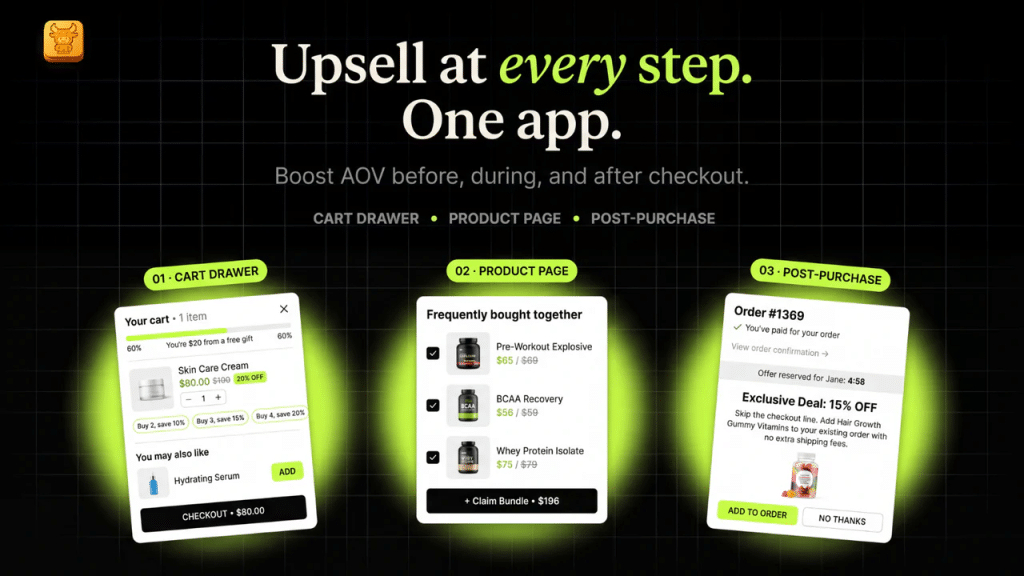
Oxify Cart Drawer & Upsells (our app) adds a slide-out cart with a free shipping bar, discount code field, trust badges and in-cart upsells, addressing several of the on-site reasons in Baymard's table above (surprise costs, trust, checkout friction) with no code or theme edits. Full feature breakdown on our cart drawer upsell page.
Check your theme before you pay for a drawer: many themes already ship one, so the real question is whether a shipping bar, upsells and gift thresholds are worth adding on top of it. See cart drawer vs cart page for the trade-offs.
Key features
- Multi-tier free shipping bar kills the number one abandonment trigger (free shipping at $50, gift at $75, 10% off at $100).
- Real-time discount code field stops shoppers leaving to Google "[brand] coupon code."
- In-cart upsells, frequently bought together bundles, BOGO, and volume discounts with one-click add, plus AI recommendations matched to live cart contents.
- Trust badges, payment icons, and a sticky cart button for the 19% who did not trust the site with card details.
- Multi-currency and market-specific offers across Shopify Markets.
- Product page and one-click post-purchase upsells included. Most cart drawer apps stop at the cart.
Pricing tracks order volume, not feature gates: $9.99/mo (0–100 orders), $19.99 (101–200), $29.99 (201–500), $49.99 (501–1,000), up to $149.99 (3,001+) with a $299 enterprise tier. Every tier gets the full feature set and a 14-day free trial with no credit card.
Pros
Many shoppers leave between "Add to Cart" and "Begin Checkout," before any recovery email can fire, and a cart drawer is the on-site tool that works at that exact moment. It opens without a page reload, and merchants report AOV gains after replacing the cart page with a slide cart drawer (merchant-reported, not an independent benchmark). The Built for Shopify badge means the app has passed Shopify's performance and quality review. Setup takes under 2 minutes on any Online Store 2.0 theme.
Cons
Prevention, not recovery — you still need an email or SMS layer for shoppers who close the drawer and leave. A 40-review base is small next to Klaviyo's thousands. Costs rise with order volume rather than staying flat. Not a fit for legacy non-Online Store 2.0 themes.
Verdict
The prevention layer is the only slot in the stack that reaches every visitor, and a cart drawer with a free shipping bar is a direct on-site answer to the 40% who cite extra costs. Ours is Oxify; compare it against UpCart, iCart, Opus, and Kaching in our best Shopify cart drawer apps guide before choosing. (On 11 October 2026 the UpCart listing showed "not currently available"; check the listing before installing.)
2. Wisepops (Best AI Exit-Intent Popups for High-Traffic Stores)
Best for: Capturing emails from shoppers about to leave, at scale. Rating: 4.9★ (71 reviews) | Price: $299/mo for up to 500k pageviews (14-day trial) | View on the App Store
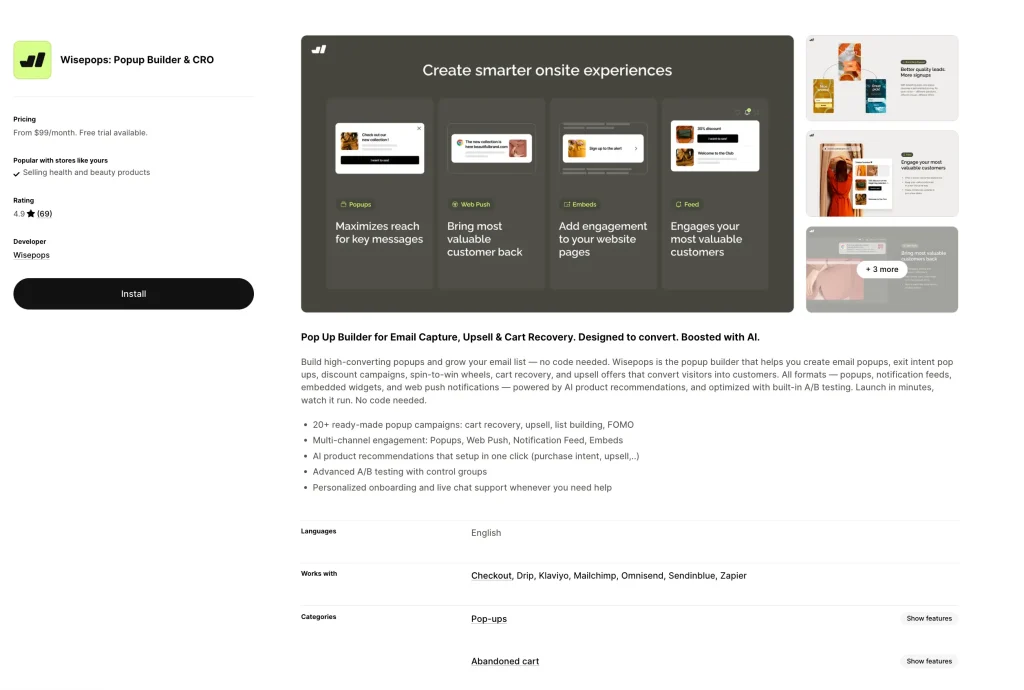
AI exit detection predicts when a shopper will leave, then fires a targeted popup offering a discount or free shipping for an email.
Pros: Detection works on both desktop and mobile — rare, since most tools only track cursor movement. 30+ targeting rules by cart value, traffic source, and device. A/B testing and web push are included in the plan. Wisepops claims it catches 5 to 10% more carts than standard exit-intent tools (vendor claim).
Cons: The App Store lists a single $299/mo plan with no cheaper public tier, versus the $49 entry that rival guides still quote. Only 71 Shopify reviews. Needs an email app alongside it.
Verdict: Now a tool for stores doing $50K+/month with real traffic. Everyone else gets most of the mechanism from Adoric at 2% of the price.
3. Adoric (Best Budget Popup Tool)
Best for: Small and mid-size stores wanting exit-intent without Wisepops pricing. Rating: 4.9★ (259 reviews) | Price: From $4.99/mo (free plan to 20 orders/mo) | View on the App Store
Combines exit-intent popups, email capture, spin-to-win, and product recommendation widgets, triggered by scroll depth, time on page, or click events.
Pros: Order-volume pricing from $4.99/mo (0–100 orders) with a genuinely free plan below 20 orders; its listing also includes free shipping bars and cart abandonment tools. Recommendation widgets add cross-sell value beyond capture. Drag-and-drop builder, no developer needed.
Cons: The free plan stops at 20 orders a month. Popups only work while the shopper is on site and it has no follow-up channel of its own, so pair it with an email or push tool. We have not verified how its mobile exit intent behaves.
Verdict: The value pick for popups at almost any revenue level now that Wisepops starts at $299.
PART 2: Best Shopify Abandoned Cart Recovery Apps
Recovery works on abandoned checkouts — shoppers who left contact details. Per the benchmark table above, vendors report 3 to 5% from a typical email flow, 10 to 15% tuned, and a 15 to 20% ceiling with email plus SMS (not independently audited).
4. Klaviyo (Best Abandoned Cart Flow Marketing Automation)
Best for: Stores with a marketing team or agency needing deep segmentation. Rating: 4.7★ (3,351 reviews) | Price: Email from $20/mo, SMS from $15/mo (free to 250 profiles) | View on the App Store
Klaviyo is the default automation platform for serious Shopify and Plus stores: pre-built abandoned cart flows, real-time Shopify sync, predictive analytics, best-in-class segmentation.
Pros: Slice audiences by 50+ data points and send different messages to a first-time $30 cart vs a repeat buyer with a $500 cart. Klaviyo's own benchmark for abandoned cart flows is a 3.33% placed-order rate and about $3.65 per recipient. Email and SMS branch inside one flow, its listing now adds WhatsApp, and it advertises multi-channel A/B testing. Agencies know it cold.
Cons: More to configure than Omnisend, and 8% of its App Store reviews are 1-star (263 of 3,351). Pricing scales fast: $20/mo at 251–500 profiles on the listing, and trackers of its calculator show roughly $100 at 5,000 profiles and $400 at 25,000. It bills on active profiles (contacts who may receive your emails), so a large imported list costs money even if you rarely mail it.
Verdict: Right if you have a marketing team; solo founders should look at Omnisend or Recapture. More on structuring the underlying list in our email list segmentation guide.
5. Omnisend (Best Klaviyo Alternative)
Best for: Growing stores wanting multi-channel without Klaviyo complexity. Rating: 4.7★ (3,184 reviews) | Price: Standard $16/mo; free plan for 250 contacts and 500 emails/month | View on the App Store
Email, SMS, and web push in one platform, with a builder that pulls products straight from your catalog.
Pros: 89% of its Shopify ratings are 5-star. The free plan includes the abandoned cart flow, popups and forms, capped at 250 contacts and 500 emails a month, and 24/7 live support is listed even on Free. Standard adds unlimited web push, and SMS is billed per message from $0.007. A strong EU footprint makes it a sensible European pick (more alternatives in our email marketing apps guide).
Cons: 5% of its App Store reviews are 1-star (163 of 3,184). Segmentation is shallower than Klaviyo's. The $16/mo entry covers 500 contacts and rises as the list grows; SMS is a separate per-message cost.
Verdict: Our default pick for stores between roughly $10K and $100K/month: one tool for email, SMS and push, a real free plan, and a lower price than Klaviyo at scale.
Klaviyo vs Omnisend: which should you pick?
The most-asked head-to-head in this category. We sell neither, and the figures below come from each app's live listing on 5 October 2026:
| Klaviyo | Omnisend | |
|---|---|---|
| App Store rating | 4.7★ (3,351 reviews); 8% are 1-star | 4.7★ (3,184 reviews); 5% are 1-star |
| Free plan | 250 profiles, 500 emails/month, 150 SMS credits | 250 contacts, 500 emails/month; abandoned cart flow and popups included |
| Paid entry | Email $20/mo (251–500 profiles); SMS $15/mo (1,250 credits) | Standard $16/mo (500 contacts, 6,000 emails, unlimited web push); Pro $59/mo; SMS from $0.007/message |
| Price at scale | Calculator is interactive; trackers show about $150 at 10,000 profiles and $720 at 50,000 | Trackers disagree (about $130 at 10,000 contacts, $330 to $410 at 50,000); cheaper at comparable volumes in every source we saw |
| Channels | Email, SMS and WhatsApp in one platform; push and forms listed | Email, SMS and web push in one builder |
| Segmentation & flows | Predictive analytics, send-time optimisation, multi-channel flows and A/B testing on the listing | Covers the common recovery segments; Pro adds product-recommender AI and dynamic content |
| Billing basis | Active profiles (contacts who may receive emails) | Contacts stored |
| Pick it if | You have a marketing team, high AOV, or complex segments | You are founder-run, EU-based, or want multi-channel on a budget |
Our read: Klaviyo rewards someone who will keep tuning it; Omnisend rewards a founder who will not. That is a judgement, not a measured result.
6. Recapture (Best for Founder-Run Stores)
Best for: Founder-run stores that want recovery running on autopilot. Rating: 5.0★ (45 reviews) | Price: Free until $500 recovered, then $39/mo (15-day free trial, no credit card) | View on the App Store
Purpose-built for abandoned cart and post-purchase recovery rather than a full marketing suite. Recapture says it has helped stores recover over $340 million since 2015 (vendor claim); SMS reminders and email broadcasts are paid add-ons.
Pros: Built for fast setup: the listing says AI drafts store-specific recovery emails in under 60 seconds and most stores are live within 5 minutes. Pricing is outcome-linked (free until the first $500 recovered), so the downside is small. Covers both abandoned carts and abandoned checkouts in one campaign.
Cons: Only 45 reviews, so the 5.0★ comes with a small sample. Fewer segmentation rules than Klaviyo. No native push.
Verdict: If you do not have an email marketer and do not want to become one, this is the pick.
7. Retainful (Best Budget Email Recovery)
Best for: Small stores wanting recovery emails plus repeat-purchase coupons. Rating: 4.4★ (28 reviews) | Price: Pro $14/mo (free plan, 500 emails/mo, abandoned cart flow included) | View on the App Store
Multi-step abandoned cart emails plus automatic next-order coupon generation to drive the second purchase.
Pros: A free 500-email tier that already includes the abandoned cart flow, and Pro at $14/mo with unlimited contacts (sends capped at 10x your list, then $4 per extra 500 contacts). Next-order coupon automation is a genuine differentiator most recovery apps skip. Pre-built workflows, popups and live chat support are listed on the free plan.
Cons: The current listing shows 4.4★ across just 28 reviews — the weakest rating of any mainstream recovery app in this guide, on a thin sample. SMS is listed on the app but email is the core product, and there is no web push.
Verdict: The budget pick if next-order coupons matter; otherwise Omnisend's free tier or Recapture's free-until-$500 model carries less risk.
8. Postscript (Best US SMS Recovery)
Best for: US stores selling impulse products. Rating: 4.7★ (1,206 reviews) | Price: Free to install; $49/mo minimum spend at $0.009/SMS plus carrier fees ($100 credit in the first 30 days). Growth $100/mo ($0.008/SMS), Professional $500/mo ($0.007/SMS) | View on the App Store
SMS earns its place on speed and click-through, not on the "98% open rate" that several lists quote — that number has no primary source and SMS has no read receipt to produce one. The defensible case: Klaviyo's published benchmarks put SMS flow click rates near 10% (top performers above 16%). Speed and click-through are the draw, and you should budget for SMS as a paid channel, because every message costs money whether it converts or not.
Pros: Native Shopify integration, unlimited segments, campaigns and automations on every plan, and a unique toll-free number on Starter. The minimum-spend model means you pay for messages, not seats.
Cons: US-focused — international SMS is not properly supported, so EU stores should use WhatsApp, or trial CartBoss cautiously given its 3.1★ rating. The $49/mo minimum spend is a floor you pay regardless of use, which is why SMS belongs above the $200k/year revenue line. Requires phone capture.
Verdict: For US stores with impulse products, layering Postscript on a tuned email flow moves you toward the vendor-reported 15 to 20% ceiling.
9. TxtCart AI (Best AI Conversational SMS)
Best for: US stores wanting two-way AI text conversations. Rating: 4.9★ (540 reviews) | Price: Free to install; $29/mo minimum spend plus SMS/MMS and carrier fees ($500 trial credits). Growth $79/mo (to 2,000 avg orders), Pro $399/mo (to 5,000). AI agent $0.99 per resolution | View on the App Store
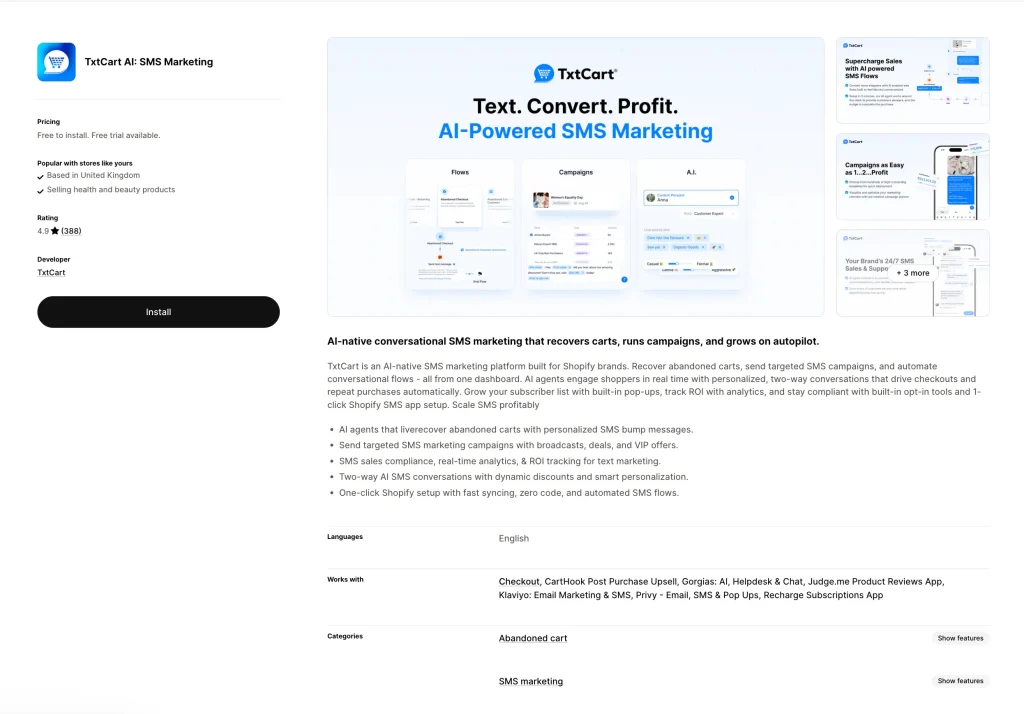
TxtCart AI: SMS Marketing (rebranded from TxtCart this year) uses AI agents to hold conversational SMS exchanges with shoppers who abandon — answering questions, offering dynamic discounts, and handling objections rather than firing one-way reminders.
Pros: The AI agent answers questions and recommends products over two-way text, and the app lists campaigns to 18+ countries, popups, keywords and QR codes for list growth. TxtCart claims a 20% recovery rate on abandoned cart revenue and 29 to 42% reply rates (vendor figures — treat the benchmark table above as the neutral reference). The $29/mo minimum spend is the lowest entry point among the dedicated SMS apps here.
Cons: SMS only, so you need a separate email app. Per-message and per-resolution costs accumulate past the minimum, and the same consent, 10DLC and quiet-hours rules apply as for any SMS tool. We have no independent data on how its AI replies perform, so test with a small segment first.
Verdict: The pick for conversational SMS at the lowest minimum spend. Pair with email for full coverage.
10. CartBoss (Pay-Per-SMS for Europe)
Best for: EU and UK stores wanting SMS recovery with no monthly commitment. Rating: 3.1★ (9 reviews: six 5-star, three 1-star) | Price: Pay per SMS, no monthly fee | View on the App Store
Sends pre-written recovery texts with automatic language detection, so the message arrives in the shopper's language.
Pros: Automatic language detection and multilingual templates address a real problem for EU multi-market stores, and the listing highlights GDPR compliance and auto-filled checkout forms. Zero monthly fee means little risk at low volume.
Cons: Nine reviews is far too thin a base to trust, and three of them are 1-star. Less customisation than Postscript, and SMS only. You are trusting the product rather than social proof.
Verdict: The no-fee, pay-per-SMS model makes it cheap to trial for Europe, but trial it consciously, not as a proven incumbent; WhatsApp tools have far more reviews behind them.
11. PushOwl by Brevo (Best Browser Push Recovery)
Best for: Reaching shoppers who never gave an email or phone number. Rating: 4.8★ (2,279 reviews) | Price: Plus Bundle $19/mo includes cart recovery automation; free Basic bundle has 500 pushes/mo but no cart automation; Power $79/mo | View on the App Store
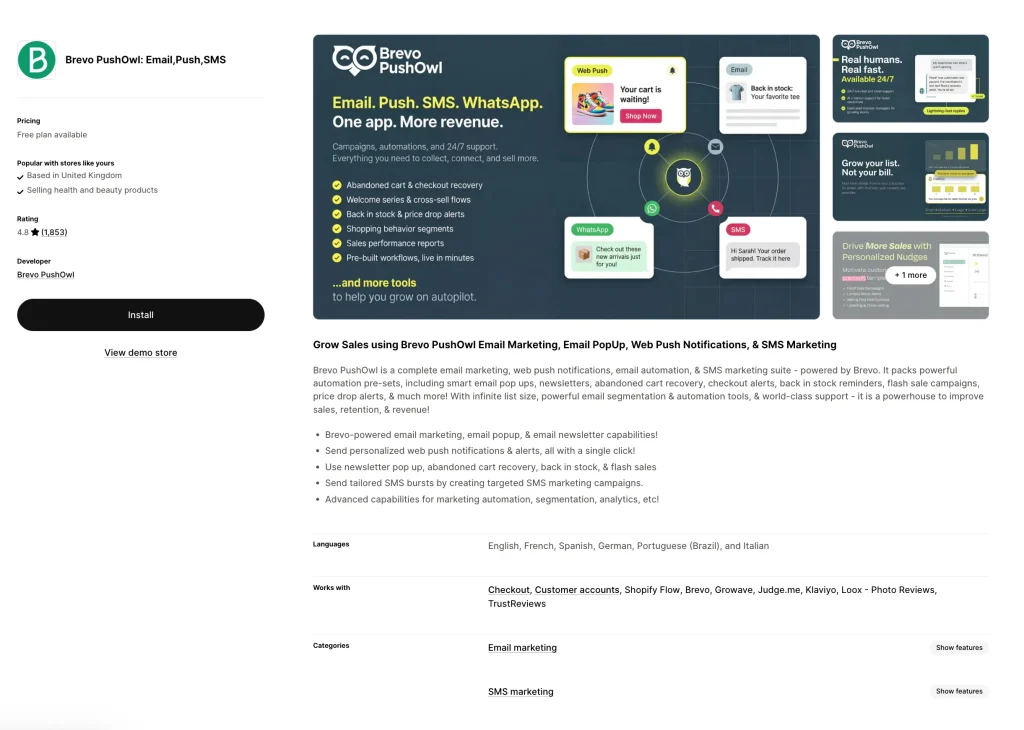
PushOwl (now part of Brevo) sends a browser notification to abandoners. No email or phone number needed, just a one-click permission popup — the lowest-friction recovery channel in the ecosystem.
Pros: Reaches shoppers who never gave you contact info. Plans scale by monthly push volume (500, 10k and 25k pushes on the three bundles) rather than by subscriber count. Since the Brevo acquisition it also bundles email and SMS, though push remains the standout. With 2,279 reviews at 4.8★ it has the deepest review base of any push tool here.
Cons: Push notifications are short by nature — no room to build trust like email. The free bundle does not include abandoned cart recovery automation, so the channel only becomes a recovery tool from the $19 Plus bundle. Web push also needs the shopper to click Allow first, and on iPhone it needs the site added to the Home Screen (per WebKit's iOS 16.4 announcement).
Verdict: An add-on channel on top of email, not a replacement. The free bundle is useful for newsletters and back-in-stock alerts, but plan on $19/mo for cart recovery; if you want push for free, Cartly's free plan includes unlimited push.
12. CK: Abandoned cart on WhatsApp (Best Low-Cost WhatsApp)
Best for: Selling into Europe, India, MENA, LATAM, and Southeast Asia. Rating: 5.0★ (298 reviews) | Built for Shopify badge | Price: Free Forever plan (100 manual messages), VIP $9.99/mo, Advanced $29/mo; automated messages from $0.02 each (varies by country) | View on the App Store
CK: Abandoned cart on WhatsApp, by Carthike, runs automated WhatsApp recovery via the WhatsApp Business API, plus order confirmations, shipping updates, review requests and COD verification.
Pros: The $9.99/mo VIP tier is the lowest-cost automated WhatsApp recovery here, and the Free Forever plan covers 100 manual messages. It holds a 5.0★ rating across 298 reviews and carries the Built for Shopify badge. The Advanced plan adds multiple automated abandoned-cart messages and a team inbox.
Cons: Only valuable if customers use WhatsApp, and Meta's US marketing-template pause makes it a non-US tool. Per-message fees (from $0.02 each) sit on top of the plan, and there is no email recovery.
Verdict: The budget WhatsApp pick, and a strong one.
13. BiteSpeed (Best WhatsApp AI Flows)
Best for: Higher-volume stores in India and the UAE. Rating: 4.6★ (403 reviews, now listed as "B: WhatsApp, Voice, SMS & Chat") | Price: Free to install, usage-based charges | View on the App Store
WhatsApp abandoned cart recovery, broadcasts and chatbots, plus AI voice agents that phone shoppers about abandoned carts and COD orders, and a shared support inbox.
Pros: Broader than CK: chatbot campaigns that collect customer data, COD-to-prepaid conversion, an omnichannel inbox and the AI voice channel, which almost no other app here offers. Handles broadcasts as well as recovery.
Cons: Usage-based costs land well above CK's $9.99 tier at volume. Its rating is a little lower than CK's (4.6★ vs 5.0★). Likely overkill for a small store, and value is concentrated in WhatsApp-dominant markets. We could not find a public price for the voice agents.
Verdict: Choose over CK once WhatsApp is your primary channel and you need campaigns plus recovery in one platform.
14. Tidio (Best Live Chat and AI Agent Recovery)
Best for: Considered purchases (furniture, electronics, jewelry, B2B). Rating: 4.8★ (1,350 reviews) | Price: Customer Service and Flows from $29/mo; Lyro AI agent $39/mo for 200 conversations (free plan available) | View on the App Store
Helpdesk, live chat and Lyro, an AI agent that answers questions, can start conversations on product pages, compare products and add to cart. It is a pre-purchase tool more than a recovery tool.
Pros: Two-way conversation beats one-way email for high-ticket items where an unanswered question blocks the sale. Lyro acts inside Shopify (order status, refunds, order edits) as well as answering, and the live visitors list shows who is on site now. AI usage is capped at your plan limit so bills do not surprise you.
Cons: On impulse buys the chat friction slows checkout. The AI agent is a separate $39/mo plan. Needs training or staffing to be more than a widget.
Verdict: Worth adding for furniture, electronics, jewelry, and B2B, where chat prevents the silent abandonment email and SMS cannot catch.
15. Shopify Messaging (formerly Shopify Email — Best Free Starter)
Best for: Brand new stores under $5K/month. Rating: 4.8★ (4,591 reviews) | Price: First 10,000 emails/month free, then $1 per 1,000; SMS and WhatsApp priced per message | View on the App Store
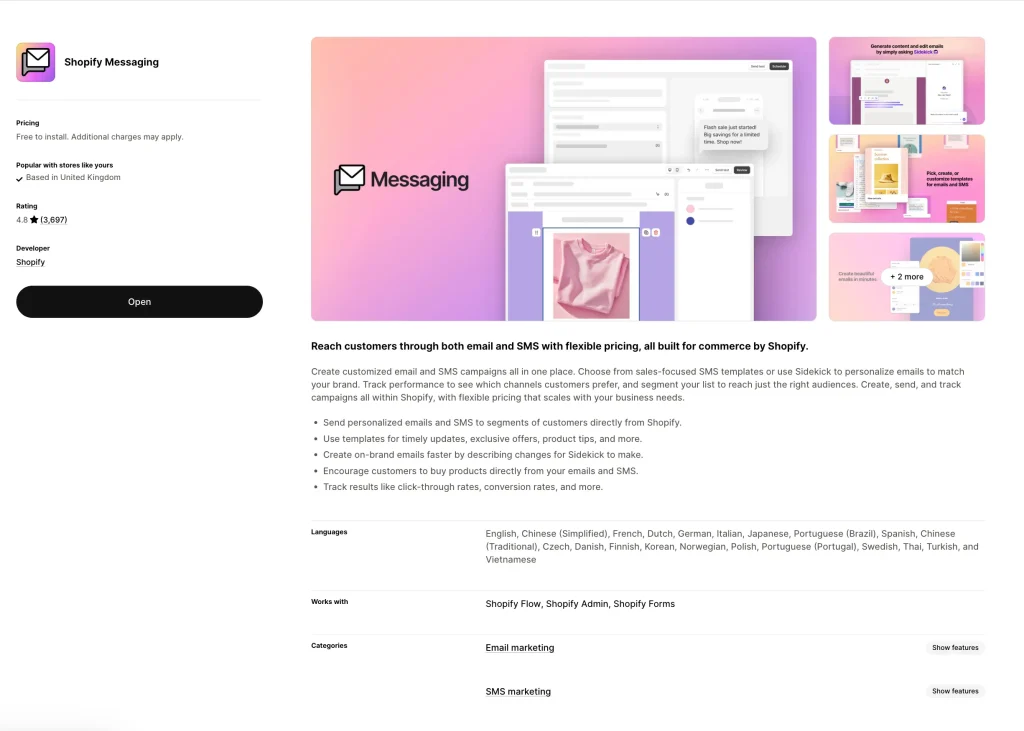
Shopify's own marketing app (renamed from Shopify Email) now handles email, SMS and WhatsApp campaigns. For recovery, Shopify's help center lists three automation templates under Apps → Messaging → Automations: Recover abandoned checkout (started checkout, did not pay), Recover abandoned cart (added to cart, did not start checkout) and Convert abandoned product browse, each available on email and SMS.
Pros: Unbeatable price for email, native Shopify data sync, and the automation sits where your orders already are. A second abandoned checkout automation can be added (it defaults to a 10-hour wait) and the workflow can be edited in Shopify Flow, so multi-step sequences are possible, though less turnkey than a dedicated app.
Cons: The new automation sends only to customers subscribed to marketing by default (you can change the To: field to All customers). Per Shopify's help center, no email goes out when the checkout was abandoned in the Shop app, when Shopify Payments blocked it as high risk, or when a more recent checkout is still inside its wait window; the legacy emails also skip phone-only checkouts and payment errors. Switching from the legacy abandoned checkout emails to the new automation is permanent. Abandoned checkouts older than three months are deleted from the admin. Template flexibility and A/B testing are narrower than Klaviyo or Omnisend.
Verdict: Start here if you have no recovery at all — it is free and takes minutes to enable. Move to Omnisend, Klaviyo or Recapture once you want richer sequences or segmentation.
16. Cartly, formerly CareCart (Best Free Tier for Email plus Push)
Best for: Small stores that want email and web push recovery on one free plan. Rating: 4.8★ (252 reviews) | Price: Free plan (100 recovery emails/month, unlimited push); Pro $14.99/mo | View on the App Store
CareCart and Cartly are the same app (the listing lives at the old care-cart handle), so lists that print only one name are not comparing two products. It bundles multi-step abandoned cart email, web push (which reaches shoppers who never gave an email address), an email-capture popup, and a spin-to-win discount wheel.
Pros: The free plan is usable rather than a 14-day tease: 100 recovery emails a month, unlimited push, unlimited email subscribers and thank-you and win-back emails, which makes it the cheapest way to run email and push together. 252 reviews at 4.8★ is a stronger evidence base than Recapture's 45 or CartBoss's 9. Setup is light.
Cons: The free plan caps recovery emails at 100 a month, and Pro ($14.99/mo) is what removes the cap. Segmentation is shallow next to Klaviyo — you get sequences, not conditional logic on cart value or lifetime value. The spin-to-win wheel trains discount-seeking behaviour and is the wrong tool for a considered-purchase or premium brand. No SMS or WhatsApp.
Verdict: The best free starting point for a store that wants more than Shopify's native email, because push covers the group email cannot reach. Plan to outgrow it as sends rise past the free cap.
17. Dondy (Best-Evidenced WhatsApp Recovery)
Best for: Stores whose customers live on WhatsApp — Europe, India, MENA, LATAM, SEA. Rating: 4.9★ (820 reviews) | Built for Shopify badge | Price: Free chat-button plan; Pro $6.99/mo (manual recovery); Power Automation $79.99/mo (automated recovery); Elite $159.99/mo (AI chatbot) | View on the App Store
Dondy runs WhatsApp cart recovery, broadcast campaigns, a shared inbox and, on the top plan, an AI chatbot for sales and support, from one dashboard.
Pros: 820 reviews at 4.9★ plus the Built for Shopify badge is the strongest evidence base in the WhatsApp category, nearly 3x CK's review count and about 2x BiteSpeed's. Power Automation includes 1,000 free one-click messages every 30 days, and it uses the official WhatsApp API.
Cons: The cheap plans do not automate cart recovery. The free plan is only a chat button and Pro ($6.99) covers manual abandoned cart recovery; automated recovery starts at $79.99/mo, with Meta's per-message fees on top. WhatsApp marketing templates to US numbers are paused by Meta, so this is a geography decision before it is a product decision. Templates need Meta approval (up to 24 hours).
Verdict: If WhatsApp is where your customers are and you can fund $79.99/mo, this is the default pick on evidence. CK wins on absolute cost at low volume ($9.99/mo automated); Dondy wins on review base, badge and AI tier.
18. Recart (SMS List Growth, Not Cart Recovery First)
Best for: Established stores building an SMS list as an owned channel. Rating: 4.7★ (487 reviews) | Price: Starter $299/mo (free-to-install onboarding tier) | View on the App Store
Recart is an SMS list-growth platform that also does cart recovery, rather than a cart recovery tool that happens to send SMS. Its listing leads with fully managed SMS, opt-in popups for text and email capture, click-only attribution and a dedicated customer success manager.
Pros: Opt-in is the real bottleneck in SMS recovery — you cannot text a number you never captured — and Recart's popups and managed strategy target exactly that. Click-only attribution and showing costs in dollars before sending make its numbers easier to trust. International texting is included on the Starter plan.
Cons: The $299/mo Starter price is the highest in this guide; as a rule of thumb (ours), it needs a store doing well above $50K/month to make sense. If you already run Klaviyo or Postscript, the overlap is substantial and you would be paying twice for the same job.
Verdict: If your problem is "my recovery flow underperforms," buy Postscript or TxtCart AI. If your problem is "almost nobody opts into SMS in the first place," Recart is the specialist.
19. Kanal (WhatsApp Flows With an AI Tier)
Best for: Stores outside the US that want WhatsApp recovery with an AI agent and Klaviyo integration. Rating: 5.0★ (124 reviews) | Price: Free demo plan; Pro $89/mo; Scale $149/mo (AI conversational) | View on the App Store
Kanal builds visual flows on the official WhatsApp Business API: abandoned cart recovery, welcome and order messages, shipping updates and back-in-stock alerts, plus a shared inbox. The Scale plan adds an AI agent that the listing says answers questions in 96+ languages, with Klaviyo, Gorgias and Recharge integrations.
Pros: Unlimited contacts and campaigns on Pro, a perfect 5.0★ rating, and the AI conversational tier is part of the $149/mo Scale plan.
Cons: It is a newer listing than Dondy (124 reviews against 820) and does not carry the Built for Shopify badge. Pro is $89/mo before Meta's per-message fees. Kanal also publishes its own abandoned cart roundup that ranks Kanal first, which is a reason to read vendor-written lists, ours included, with care. WhatsApp marketing to US numbers is paused.
Verdict: A credible alternative to Dondy in the same $79 to $89 band; choose on which dashboard and which AI tier suits you.
Also on rival lists, but not ranked here
Three apps appear in competing roundups and are checked but not recommended yet, because of thin evidence. Privy has a deep review base (4.5★, 4,208 reviews) with popups from $24/mo, email from $30/mo (1,500 contacts) and email plus SMS from $45/mo, so it is a reasonable all-in-one if you want popups and email together. Markopolo AI (4.8★, 6 reviews) lists a free plan, $13.70/mo Standard and $49.99/mo Pro with SMS, WhatsApp, push and AI voice as add-ons; its feature list is broad but six reviews cannot support a recommendation. Getgabs (4.4★, 16 reviews) offers WhatsApp recovery from $11/mo. We will revisit Markopolo and Getgabs when their review counts grow.
Bonus: Shop Pay (Free, Built In, Highest ROI)
Shopify's current Shop Pay page says it delivers as much as 50% better conversion than guest checkout, outpaces other accelerated checkouts by at least 10%, and that its mere presence drives a 5% lift in lower-funnel conversion (an external study Shopify cites from 2023). It is the one change on this page that costs nothing. Older guides quote different multipliers; we use only the figure on Shopify's live page, and it is a vendor claim about an accelerated-checkout study, not a promise for your store. Enable it under Settings → Payments.
Free Shopify Abandoned Cart Apps: What Each Free Plan Really Includes
"Free" ranges from a full recovery flow to a chat button. Verified on the live listings on 5 October 2026:
- Shopify Messaging — first 10,000 emails a month free, with abandoned checkout, abandoned cart and browse automations.
- Omnisend — 250 contacts and 500 emails a month, with the abandoned cart flow and popups included.
- Retainful — 500 emails a month with abandoned cart recovery, flows and exit popups.
- Cartly — 100 recovery emails a month plus unlimited push notifications.
- Recapture — free until the first $500 recovered, then $39/mo.
- Klaviyo — 250 profiles and 500 emails a month, plus 150 SMS credits.
- Adoric — free to 20 orders a month; popups, free shipping bars and cart abandonment tools.
- CK: Abandoned cart on WhatsApp — 100 manual WhatsApp recovery messages on the Free Forever plan.
Not free for cart recovery: PushOwl's free bundle (cart recovery automation starts at $19/mo) and Dondy's free plan (a WhatsApp chat button only). Running Shopify Messaging, Cartly's push and Omnisend together costs nothing but setup time, as long as you stagger the sends (see the conflicts section below).
The 2026 Platform Deadline That Affects Recovery Apps
Platform deadlines: Shopify Scripts have ended
Per Shopify's developer changelog, editing and publishing Shopify Scripts ended on 15 April 2026 and Scripts stopped executing on 30 June 2026. Scripts were a Shopify Plus feature, so this mainly hits Plus stores whose discount, shipping or payment rules were written in Ruby: those rules are no longer running, and the replacement is Shopify Functions (or an app that uses them). Checkout-page tracking has its own deadline — see the tracking box in the conflicts section below.
Why Two Apps Will Both Claim They Recovered the Same Order
Install a recovery app, open its dashboard after a month, and it will show you a recovered-revenue figure. Vendor dashboards credit every order they touched, so that figure is usually larger than the revenue the app actually caused. Understanding why is the difference between a sound decision and an expensive one.
Recovery apps attribute on a click-and-window basis. A shopper abandons, gets your email, ignores it, gets an SMS an hour later, clicks that, and buys. Configure both apps with a 7-day attribution window and both will count the order. Add Klaviyo's own attribution and Shopify's native abandoned checkout email and you can have three tools claiming one $80 order. Your dashboards will show $240 recovered.
Three specific traps:
- The default window is too long. Most apps default to 7 days, some to 30. A shopper who was always going to come back and buy on day 6 gets counted as recovered. A 24 to 72-hour window is far closer to genuine causation for cart recovery, since real recovery happens fast or not at all.
- View-through attribution inflates everything. Some platforms credit an order if the recipient merely opened the email. Given that Apple Mail Privacy Protection auto-opens messages, this manufactures conversions from nothing. Turn view-through off and judge on click-through only.
- Nobody nets out the baseline. Some percentage of abandoners return and buy with zero prompting. That is your organic return rate, and it is the number your app's recovery figure should be measured against, not credited with.
How to get an honest number: before installing anything, record 30 days of baseline — abandoned checkouts, and how many converted with no recovery running. Then install one app, set the window to 72 hours, disable view-through, and compare against that baseline. If you run email and SMS together, set different UTM sources and trust Shopify's order-level source data over either vendor dashboard. As a rule of thumb (our estimate, not a published benchmark), expect the honest figure to land well below what the dashboard reports. That is normal, and an app that recovers a fraction of a large number is still worth paying for — you just need to know which number you are budgeting against.
Which Abandoned Cart Apps Conflict With Each Other
The "install a stack" advice every list gives, including ours, has a failure mode worth planning for: some of these apps collide. The classic symptom is a shopper receiving several near-identical recovery emails in an hour, which is the fastest way to turn a recoverable cart into an unsubscribe.
| Combination | What goes wrong | Fix |
|---|---|---|
| Shopify's native abandoned checkout email + any recovery app | Duplicate emails. If you ever switched Shopify's own abandoned checkout automation on, it keeps sending after you install a third-party app. | Open Apps → Messaging → Automations and turn off Shopify's abandoned checkout automation (and the cart and browse ones, if enabled) the moment a recovery app goes live. |
| Two popup apps (e.g. Wisepops + Adoric + a theme popup) | Popups stack or fight for the same trigger; shoppers see two overlays at once. Directly increases abandonment. | Run exactly one popup tool. Audit theme app embeds for a forgotten second one. |
| Email app + SMS app, both with cart triggers | Email and text arrive within minutes of each other, reading as spam rather than a sequence. | Stagger deliberately: email at 30–60 min, SMS at 4–6 hours, second email at 24 h. Never same-window. |
| Two apps injecting cart-drawer or cart-page scripts | Race conditions on /cart/change.js; quantities revert, discounts drop off. | One app owns the cart surface. Check Online Store → Themes → Customize → App embeds for duplicates. |
| Any recovery app + a checkout.liquid script tag | Script tags on the Thank you and Order status pages stopped working for non-Plus stores on 26 August 2026 — see below. | Migrate to Web Pixels. |
A 2026 deadline that can silently break recovery tracking
Shopify's developer documentation states that script tags on the Thank you and Order status pages were sunset for non-Plus stores on 26 August 2026 (Plus stores: 28 August 2025), and that checkout.liquid and Additional Scripts on those pages were sunset on 28 August 2025. Recovery apps and analytics tools often placed conversion-tracking snippets there, so if an app's recovered-order numbers went strangely quiet in late August or September 2026, check this first — the app may still be sending but can no longer see the conversions it caused.
The replacement is checkout extensions and web pixels (the latter under Settings → Customer events). Any app still asking you to paste a script into Additional Scripts is out of date.
Compliance: What You Must Get Right Before Sending
Half the apps in this guide send SMS or WhatsApp, and none of the competing roundups mention that these are regulated channels with real penalties. Recovery messages are marketing messages, not transactional ones, and that distinction is what the rules turn on.
- US SMS — TCPA and 10DLC. You need express written consent to text marketing; a checkbox pre-ticked at checkout does not qualify, and a phone number collected for delivery updates is not consent to send recovery texts. TCPA statutory damages are $500 per message, rising to $1,500 if the violation is found willful, which turns a mistake into a class action rather than a fine. You must also register your brand and campaign (A2P 10DLC) or carriers will filter your texts. SMS apps handle the registration paperwork; they do not write your consent language for you. This is general information, not legal advice.
- EU/UK — GDPR and PECR. Consent must be freely given, specific and unbundled — one tick for "email me offers," not buried in terms acceptance. You need a lawful basis recorded, an easy opt-out in every message, and a retention policy. The soft opt-in for existing customers is narrower than most merchants assume and does not cover people who never completed a purchase, which is precisely who abandoned cart messaging targets.
- WhatsApp — Meta template approval and the US pause. Business-initiated messages must use a template approved by Meta; Meta's documentation says review can take up to 24 hours, though it is often faster. Cart reminders are marketing-category templates, and since 1 April 2025 Meta has paused marketing templates to US phone numbers. HubSpot, ManyChat, HighLevel and Kanal all relayed the notice, and a July 2026 vendor article still reported no end date — re-check before you build a US WhatsApp flow. Replies inside a customer-initiated 24-hour window are still allowed, and since 1 July 2025 Meta bills per delivered message by category and country.
- Everywhere — quiet hours. The TCPA bars automated marketing texts before 8am or after 9pm in the recipient's local time, and some US states set tighter windows. "Send 30 minutes after abandonment" plus a shopper in another timezone is how stores accidentally text people at 2am. Enable timezone-aware quiet hours in whichever tool you pick.
None of this is a reason to avoid SMS or WhatsApp. It is a reason to capture consent explicitly at the point of collection, keep the record, and let the platform handle registration.
The Abandoned Cart App Stacks We Recommend
Every stack starts with the same prevention layer: a cart drawer with a free shipping bar (ours is Oxify, from $9.99/mo; alternatives in our cart drawer comparison) plus free Shop Pay. Then add recovery by stage and market (monthly costs are our estimates from the plans above, before message fees):
| Stack | Add on top of cart drawer + Shop Pay | Total cost /mo |
|---|---|---|
| 1. New store (under $5K/mo) | Shopify Messaging (free to 10K emails) | ~$10 |
| 2. Growing ($5K–$100K/mo) | Omnisend or Retainful (email) + Adoric popups + Cartly's free push | $30–$120 |
| 3. Scaling ($100K+/mo) | Klaviyo (about $100–$400 at 5k–25k profiles) + Postscript or TxtCart AI (US SMS) or BiteSpeed (WhatsApp) + PushOwl Plus ($19) | $250–$700 incl. SMS minimums |
| 4. European / UK multi-market | Omnisend + CK ($9.99) or Dondy ($79.99) or Kanal ($89) on WhatsApp; Klarna/Clearpay as payment methods | $30–$250 depending on the WhatsApp tool |
| 5. WhatsApp-first (India, MENA, LATAM, SEA) | CK: Abandoned cart on WhatsApp ($9.99) or BiteSpeed (recovery + COD confirmation) + Shopify Messaging free backup | $20–$100 plus per-message fees |
5 Mistakes That Increase Cart Abandonment
- Showing 6+ upsells in the drawer. Decision fatigue. Stick to 2 or 3 (our rule of thumb, not a published benchmark).
- Setting free shipping at $50 when AOV is $48. Set it 20 to 30% above current AOV (again our rule of thumb; the $75 median above is not a target). See our free shipping bar guide.
- Skipping the free shipping bar. It addresses the 40% of abandoners who cite extra costs in Baymard's data.
- Sending one recovery email. A 3-email sequence recovered 2 to 3x more revenue in Recapture's own data (vendor-reported; see the benchmark section).
- Fake countdown timers. Timers resetting every visit destroy trust. Use them only for real sales.
How to Measure if Your Apps Are Working
Track four numbers in Shopify Analytics → Reports → Online Store Conversion Rate: cart-to-checkout rate (a cart drawer should move it; merchants report gains, but measure your own), checkout completion rate, average order value (upsells and a free shipping bar should lift it), and recovery rate measured on a 72-hour click window against your pre-install baseline (see the attribution section). Compare it with the vendor-reported ranges in the benchmark table, and trust your own baseline over any of them.
Frequently Asked Questions
What is the best Shopify abandoned cart app in 2026?
What is the best Shopify app for abandoned cart recovery with email and SMS?
Is Klaviyo or Omnisend better for abandoned cart recovery?
Does Shopify have built-in abandoned cart recovery, and is it free?
Why isn't my Shopify abandoned cart email sending?
Does WhatsApp cart recovery work in the US?
What is a good abandoned cart recovery rate?
What is the difference between an abandoned cart and an abandoned checkout?
How many abandoned cart emails should I send?
Are abandoned cart recovery apps worth the cost?
What happened to CareCart? Is it still available?
care-cart handle). It holds 4.8★ across 252 reviews with a free plan (100 recovery emails a month, unlimited push) and Pro at $14.99/mo.Is abandoned cart software different from a Shopify abandoned cart app?
The Bottom Line
Most "best Shopify abandoned cart app" lists are rosters of recovery tools. They miss the structural point: prevention beats recovery on math, because prevention works on 100% of your visitors while recovery only reaches the minority who left contact details.
Install one cart drawer. Add one recovery channel matched to your market (Klaviyo or Omnisend in the US and UK, Dondy, Kanal or CK on WhatsApp across Europe, Dondy or BiteSpeed in India and MENA). Turn on Shop Pay. Track the four metrics above. That is the whole playbook; everything else in this guide is detail on which tool fits which store.
Ready to fix the biggest leak in your funnel? Start your free 14-day trial of Oxify Cart Drawer & Upsells → Setup takes under 2 minutes, no credit card required.
About the author: Aditya Singh is the founder of Oxify, maker of Oxify Cart Drawer & Upsells (4.9★, 40 reviews, Built for Shopify badge) and a suite of Shopify AOV apps used by stores across the US, UK, and EU. Every rating, review count and plan price in this guide was re-checked against the live Shopify App Store listings on 5 October 2026, and every app name links to its listing so you can check the figures yourself.