 Oxify
Gift With Purchase Promotion Strategy: 10 Ideas That Don't Kill Margin
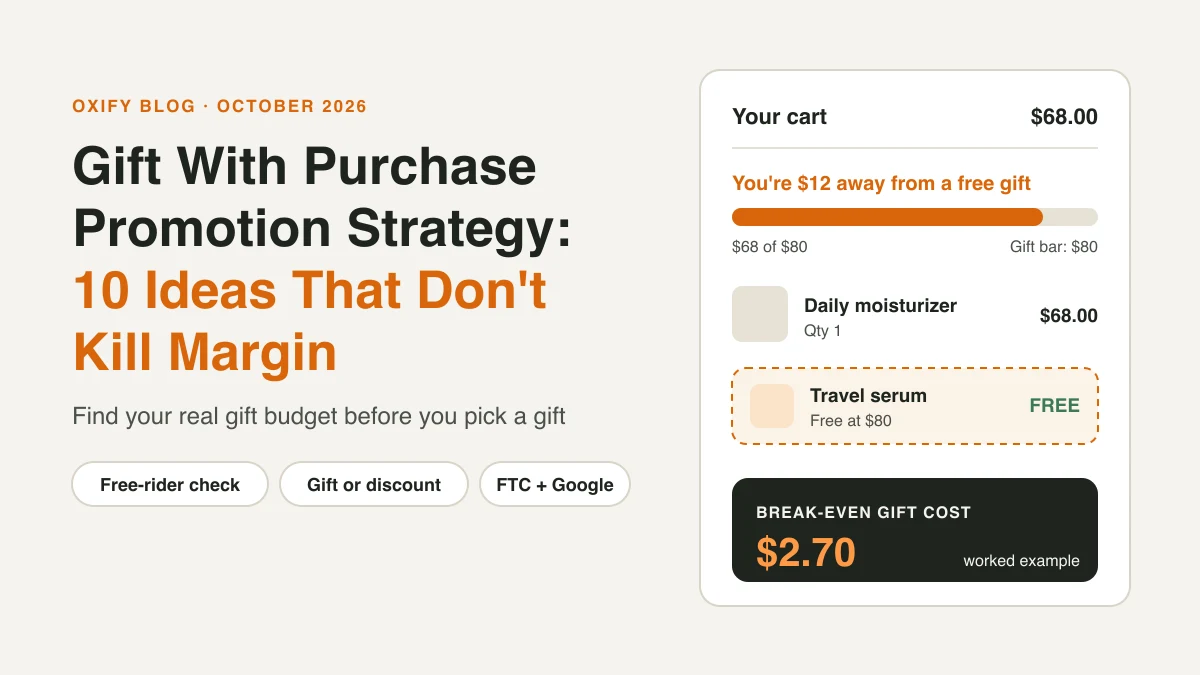
A gift with purchase promotion gives shoppers a free item when they spend a set amount or buy a set product. It keeps your margin safe only when the gift costs less than the new profit it creates. A common shortcut misses one thing: shoppers who would have spent that much anyway get the gift too. In our example, that cuts the gift budget from $6.30 to $2.70.
Below you get the math in three steps, 10 ideas that fit it, and the Shopify, Google and FTC rules that trip up stores. Every number is a worked example, so swap in your own.
Short answer: your gift can cost up to this much before the offer loses money: new profit from shoppers who stretched ÷ all gifts given. In the example below that is $945 ÷ 350 = $2.70. That is a break-even ceiling, so aim well under it, such as half.
I'm Aditya, co-founder of Oxify. We make a Shopify gift app, but the math below works in a spreadsheet without it.
Key facts (verified October 31, 2026)
- Shopify's Buy X get Y discount can start at a Minimum purchase amount. It counts product prices only. Shipping and taxes never count (Shopify Help).
- Shopify never adds the free item to the cart for the shopper. The shopper adds it, or an app does.
- The FTC's guide on "free" offers says you should not pay for the gift by raising the price of what the shopper must buy (16 CFR 251.1).
- Google Merchant Center needs a free-gift promotion title to name the gift. "Free gift with purchase" alone is not allowed (Google Merchant Center Help).
What Is a Gift With Purchase Promotion?
A gift with purchase (GWP) promotion gives shoppers a free item after they meet a rule. You pay for the gift. You hope the shopper buys more than they planned.
Three rules, called triggers, cover most offers:
- Spend: "Spend $80, get a free travel serum."
- Product: "Buy the espresso machine, get a milk jug."
- Item count: "Add 3 items, get a free pouch."
People mix GWP up with other offers. Here is the difference:
| Offer | What the shopper gets | Your cost |
|---|---|---|
| Gift with purchase | A free item | The gift |
| Purchase with purchase | An add-on at a special price | The discount on the add-on |
| Buy one, get one (BOGO) | A free or cheaper copy of the same product | The free unit |
| Discount | Money off | A share of every order it touches |
The Gift Budget: Do This Math First
Your gift can cost up to the new profit it creates, divided by every gift you give. Most gift promos lose money because nobody set that budget first.
The worst case is famous. In 1992, Hoover's UK arm offered two free round-trip flights, worth about £600, to anyone who bought £100 of its products. It expected about 50,000 applications and got about 300,000. The offer was cancelled, and lawsuits and job losses followed (Wikipedia). The gift had no cap and the forecast was far too low.
Meet the free rider
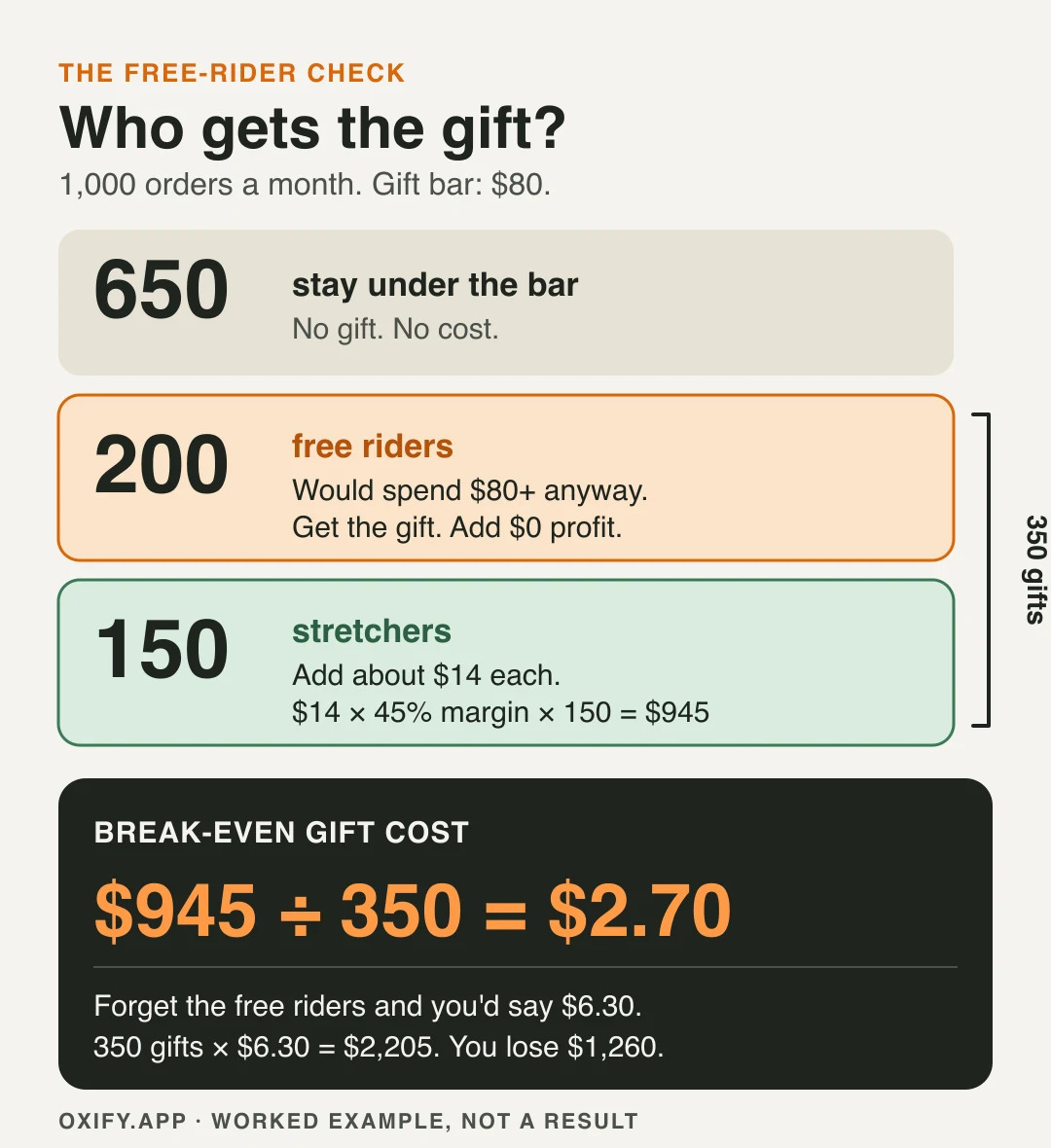
Say your gift bar is $80. Three kinds of shoppers see it:
- Under the bar, stay under. No gift. No cost.
- Already over the bar. They planned to spend $80 or more anyway. They get the gift. You gain nothing. I call these free riders.
- Stretchers. They add one more item to reach the bar. They are the only ones who bring new profit.
Free riders and stretchers both get a gift. So the profit from the stretchers has to pay for both groups. Brandmovers makes the same point in words. Here it is with numbers.
A worked example
Here are the assumptions. They are made up, so replace them with yours.
- 1,000 orders a month
- Average order: $60
- Gift bar: $80 (about 1.3 times the average order)
- Margin: 45% (what you keep from a sale after product, shipping and payment costs)
- Orders over $80 today: 200
- Orders over $80 after the offer: 350, so 150 shoppers stretched
- Each stretcher adds about $14
Now the three steps:
- New profit: 150 stretchers × $14 × 45% = $945.
- Gifts given: 200 free riders + 150 stretchers = 350.
- Break-even gift cost: $945 ÷ 350 = $2.70.
The shortcut that costs you money
Some guides, such as Growth Suite's, say the gift must cost less than the profit on the extra spend. That is $14 × 45% = $6.30. It counts only the 150 stretchers.
- Pick a $6.30 gift.
- 350 gifts × $6.30 = $2,205.
- You earned $945.
- You lose $1,260 a month, and your average order value looks great.
Copy this into a sheet:
profit = stretchers × extra × margin
gifts  = orders over the bar, after
max    = profit ÷ gifts
The ceiling moves with how well the offer works:
| What happens | Orders over the bar (before → after) | Break-even gift cost |
|---|---|---|
| The offer barely moves people | 200 → 250 | $1.26 |
| It works okay (our example) | 200 → 350 | $2.70 |
| It works great | 200 → 500 | $3.78 |
Everything else stays the same: $14 extra spend and 45% margin. A gift under $1.26 can't lose money even when the offer barely works. A gift between $1.26 and $2.70 wins only if the offer does its job.
Count the real cost of the gift
A gift costs more than its price tag. Add up the item delivered to your door, its bag or box, pick and pack time, and extra postage for the added weight. Give the gift product a cost per item in Shopify, so your profit reports count it.
Example: $0.75 + $0.15 + $0.25 + $0.20 = $1.35. That is half of the $2.70 ceiling, which leaves a cushion. In the middle row it earns $945 − 350 × $1.35 = about $473 a month. In the first row it loses about $23.
Find your own numbers
- Pick a bar. Start near 1.3 times your average order. Check the median order too, because a few big orders can pull the average up. See the cart goals guide.
- Count orders above it. Export your last 90 days of orders (Orders, then Export). In a sheet, count how many have a subtotal above your bar. That is your "before."
- Count the near misses. These are orders between your bar minus a typical add-on price and the bar, such as $66 to $80. Stretchers come from this group, so it is the most that can stretch. Use a fraction of it for your low, middle and high rows.
- Run the formula, using the price of your cheapest popular add-on as the extra spend. If your gift costs more than the answer, pick a cheaper gift, raise the bar, or lock the offer to higher-margin products.
Why the guides disagree on the bar
- Afterpay quotes a retail consultant who says 10 to 20 percent above your average order.
- Growth Suite says 25 to 35 percent.
- Retainful says 30 to 50 percent.
None of them shows data for its range. The right bar depends on how your order values are spread, not only on the average. Use the free-rider math, then test.
Two ways to widen the budget
- Raise the bar. Fewer free riders, and a bigger stretch. Say the bar is $100, only 80 orders clear it today, and the same 150 shoppers stretch by $22 each. The ceiling becomes 150 × $22 × 45% ÷ 230 = $6.46. With only 100 stretchers it falls to $5.50. A higher bar is harder to reach, so test it.
- Lock the gift to high-margin products. The same offer at 65% margin gives $3.90. This is illustrative, since a narrower collection also changes how many people stretch. See idea 2.
Two limits. This math ignores extra orders the gift may win, which is upside you must prove in a test. And we have no published before-and-after for a gift offer yet. These are worked examples, not results.
Gift or Discount? A Like-for-Like Test
A gift usually needs far less extra spend to pay for itself than a discount does. Here is the check. For a gift, extra spend to break even = gift cost ÷ margin. A discount also comes off the extra items, so it needs more: extra spend = discount × order ÷ (margin − discount).
| Offer on an $80 order (45% margin) | Cost per order | Extra spend to break even |
|---|---|---|
| 10% off | $8.00 | $22.86 |
| 15% off | $12.00 | $40.00 |
| A gift that costs $1.35 | $1.35 | $3.00 |
- One small add-on can pay for the gift. A 15% discount needs a $40 jump.
- These rows assume every shopper who gets the offer adds the extra spend.
- Free riders raise every number. In our example, 350 gifts go out and only 150 shoppers stretch, so each stretcher must add $7.00 for the $1.35 gift to break even.
Does a free gift make a product look cheap?
Two studies point in different directions:
- Priya Raghubir (Journal of Product & Brand Management, 2005) found that people valued a product less on its own after it had been offered free. The effect was stronger when the offer did not show the item's price.
- Mauricio Palmeira and Joydeep Srivastava (Journal of Consumer Research, 2013) found that shoppers were willing to pay more for a product after it had been free than after it had been discounted.
We read both abstracts. The full papers are paywalled. What to take from them: if you must give a product away, free looks safer than a deep discount. Show the price anyway, and if you write "$18 value," use the price you really charge. Don't give away your hero product. Give a sample, or an item you don't sell alone.
10 Gift With Purchase Ideas That Protect Margin
Pick the idea that fits your goal. Each one has a guardrail and a test for when to skip it.
| Idea | Goal it serves | Watch out for |
|---|---|---|
| 1. Spend-bar gift | Raise order value | Free riders |
| 2. Collection-locked gift | Protect margin | A collection too small to reach |
| 3. Starter-kit gift | Sell a hero product | Gifting an accessory you already sell |
| 4. Sample-size gift | Win reorders | One-time products |
| 5. Digital or service gift | Add value at near-zero cost | Costs you forget to count |
| 6. Pick-one gift | Please varied tastes | Choices with different costs |
| 7. Two-rung ladder | Grow bigger baskets | Rung 2 not paying for itself |
| 8. Overstock or limited-run gift | Clear stock | A gift nobody wants |
| 9. First-order or next-order gift | Win or keep customers | Codes leaking |
| 10. Country gift | Sell in many markets | Shipping and duty costs |
What I'd do first. I'd start with idea 2, or ideas 1 and 2 together. It fixes the margin problem before anything else. Then I'd add idea 4 if my customers reorder. I'd wait on the pick-one gift and the ladder until the first offer had run for a few weeks and I knew my numbers.
1. The spend-bar gift
Spend $80, get a free item. It is the base version. The others are twists on it.
- Why it protects margin: the bar sits above what most shoppers spend, so they must add something to reach it.
- Guardrail: run the budget math. Then check what share of orders already clear the bar.
- On Shopify: create a Buy X get Y discount. Under Customer buys, choose Minimum purchase amount. Under Any items from, you must still pick specific products or collections, so use a collection that holds everything for a store-wide bar. Set the gift to Free. Tick "Set the maximum number of uses per order" and enter 1.
- Skip it if: a large share of orders already clear the bar.
Shopify won't put the gift in the cart for you. An app can. See how to add a free gift automatically, or compare the four ways to set it up.
2. The collection-locked gift
Only products from your best-margin collections count toward the bar.
- Why it protects margin: your margin number goes up. Clearance and thin-margin items never earn a gift.
- Guardrail: check the margin of each collection first. Don't lock the offer to a collection so small that few shoppers can reach the bar.
- On Shopify: under Customer buys, choose Specific collections. Shopify says that only those products count toward the minimum.
- Skip it if: your margins are about the same across products.
3. The starter-kit gift
Buy the espresso machine, get a milk jug. The gift comes with one product, not a spend level.
- Why it protects margin: it pushes a high-margin hero product without cutting its price.
- Guardrail: check how many hero buyers already buy the accessory. If 25 of every 100 buy a $12 jug today, you now give away 100 jugs and lose 25 sales. Gift a different item, or one few people buy today.
- On Shopify: under Customer buys, pick the hero product. Under Customer gets, pick the gift and set it to Free. Shopify's example gives one free hat per order, or one per T-shirt. Choose the one you can afford.
- Skip it if: the accessory is a big profit line for you.
4. The sample-size gift
A mini of something you want them to buy again.
- Why it protects margin: the unit cost is small next to the full-size price.
- Guardrail: sample a high-margin product that people reorder. Use one clear discount name per offer, such as GWP-2026-11, so you can filter those orders later. Compare their reorders after 60 to 90 days with similar buyers who got no gift.
- Skip it if: shoppers buy your product once. Think furniture or one-time gear.
5. The digital or service gift
A styling guide, a recipe pack, early access to a launch, or free engraving.
- Why it protects margin: once it exists, a digital gift costs close to nothing to deliver.
- Guardrail: count what it really costs. A guide costs the hours you spend making it once. Engraving costs minutes of labor on every order. Don't offer a service you can't deliver at a known cost.
- How: send it by email after the order, or link it on the thank-you page.
- Skip it if: you already give it away free on your blog. Shoppers won't see it as worth more.
6. The pick-one gift
Shoppers choose one of two or three gifts.
- Guardrail: keep every choice within about $1 of the others in cost. Then the pick never changes your budget math.
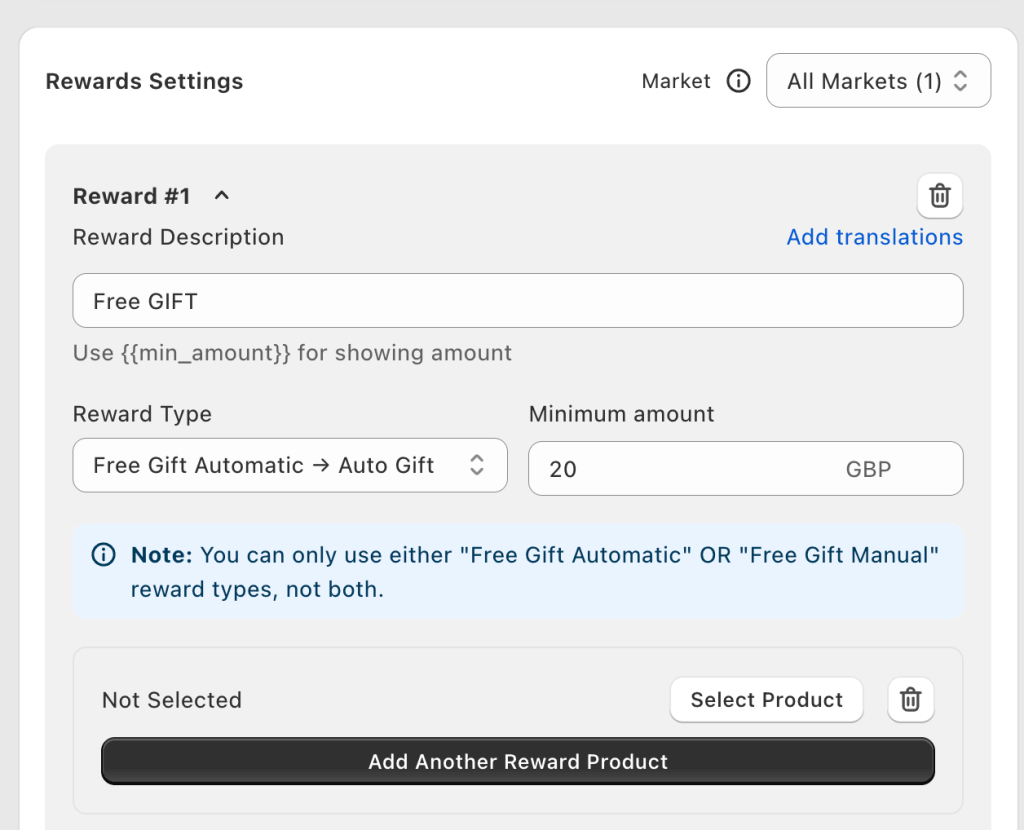
- How: a gift picker in the cart needs an app. Natively, you can point the gift at a collection and the shopper adds one by hand. In Oxify's reward settings, a note says to use either the automatic or the manual gift type, not both. See manual gift selection.
- Skip it if: the gifts come in sizes or scents. Extra choices slow shoppers down.
7. The two-rung ladder
A small gift at the first bar. A better gift at a higher bar.
- Guardrail: gift cost grows with the basket, but every rung needs its own budget test. A rung can fail while the first one passes. A starting point we use is 1.3 and 1.8 times your average order. With a $60 average, that is about $80 and $110.
- A real ladder: Crossword, a bookstore chain in India, used free shipping, then an extra 5% off, then an extra 10% off. Crossword reports a 20% lift in additional revenue against its pre-Oxify baseline. That is their own figure, and the rungs were discounts, not gifts. Copy the shape (a next goal always in reach), not the percentages. Read the case study.
- On Shopify: you can run one Buy X get Y discount per rung. But shoppers add each gift by hand, there is no progress bar, and nothing removes a gift when the cart shrinks. An app fixes that.
- Skip it if: you sell very few products. Two bars can confuse shoppers.
More on this in tiered cart rewards.
8. The overstock or limited-run gift
Turn slow stock into a reason to buy. Or run the gift for the first 300 orders only. You can call it a "mystery gift" if the item is a surprise.
- Why it protects margin: a cap limits the loss. At 300 gifts and $1.35 each, the most it can cost is $405.
- Guardrail: make the gift its own product. Track its inventory and set the stock to the number of gifts you can afford. When it reaches zero, Shopify shows the gift as sold out and the offer stops. Count the gift's cost as what you would get otherwise, such as a clearance price. Not $0.
- Test: would a shopper pay $5 for it? If not, it is clutter, and it cheapens the offer.
- Skip it if: the item is damaged, expired or close to expiring.
9. The first-order or next-order gift
Aim the gift at one moment in the customer's life.
First-order version: a welcome gift.
- Why it protects margin: compare it with your welcome code. A 10% code on a $60 first order costs $6. A $1.35 gift costs less than a quarter of that.
- On Shopify: under Eligibility, choose Customer segments. "Limit to one per customer" on a discount code stops repeat use by the same email or phone number. It does not make the code new-customer-only. Test it as a brand-new shopper and as a returning one before you launch.
- Heads up: Google rejects promotions limited to first-time customers, so you can't list this one in Merchant Center.
Next-order version: "Order again in 30 days and get a free mini on orders over $50."
- Why it protects margin: you pay nothing unless the shopper comes back and spends.
- On Shopify: make a Buy X get Y discount code with a minimum purchase amount, an end date and one use per customer. Shopify's own help page describes this pattern: a code that makes a hat free when the cart total passes a set value. Put the code on an insert card, in the confirmation email or on the thank-you page. See the order confirmation page guide and thank-you page upsells.
- Watch: if the code shows up on coupon sites in week one, end it.
Skip both if: most sales come from repeat buyers (first-order) or shoppers buy once (next-order).
10. The country-specific gift
A different bar or gift for each market.
- Why it protects margin: shipping and duty costs change by country. A gift that is fine at home can lose money far away.
- Guardrail: raise the bar in far markets, pick a light gift, or skip the gift where shipping is high.
- On Shopify: under Eligibility, choose Markets. Oxify follows Shopify Markets, so thresholds can differ by country.
- Skip it if: you ship to one country.
Duty rules change. See Shopify free gift by country.
Gift picks to test, by store type
These are ideas to test, not data. Run each through the budget math first.
| Store type | Gift to test | Check first |
|---|---|---|
| Beauty and skincare | A mini of a bestseller | Do people reorder the full size? |
| Coffee and tea | A sample bag or a small scoop | Does it push postage up a band? |
| Pet | A small treat pack or toy | Is it safe for every pet that gets it? |
| Clothing and accessories | A branded pouch, sock or tote | Is it useful enough to keep? |
Word the Offer and Follow the Rules
Name the gift, say what counts, add a limit and an end date, and put it next to the offer. This is not legal advice. It is what the sources say, as of October 31, 2026. Ask a lawyer about your case, and check local rules if you sell outside the US. Ask your accountant how to book the gift's cost and how sales tax treats it where you sell.
Copy you can adapt
- Cart bar: You're $12 away from a free Travel Serum.
- Banner: Free Travel Serum with orders over $80. Ends November 30.
- Terms, right under the offer: Free Travel Serum with $80 or more in products. Shipping and tax don't count. One per order. Sale items don't count. While supplies last. Ends November 30, 2026. If a return drops your order under $80, the gift's value comes off your refund.
Only promise what your setup does. "Sale items don't count" works if you lock the bar to full-price collections (idea 2). The refund line is your own policy, so decide it first and check your local consumer law.
FTC guide on "free" offers (US)
The guide is 16 CFR 251.1. It is a guide, not a statute. The FTC uses it to judge whether an offer is deceptive.
- "Free" means the shopper pays nothing for the gift and no more than the regular price for the item they must buy. Calling it a "gift" or a "bonus" doesn't change that.
- The "regular price" is the price the item openly sold at over the last 30 days. If prices moved, it is the lowest price with real sales. Don't raise the price just before the gift starts.
- You should not pay for the gift by raising the price of the required item or by swapping in a lower-quality one.
- State the conditions clearly, near the offer. A footnote with an asterisk doesn't count.
- There is a frequency limit. A "free" offer on the same size of a product should not run more than 6 months in any 12, with at least 30 days between offers and no more than three a year in one trade area. Sales of that size in the area should also stay under half of the product's sales. You sell online, so ask a lawyer how "trade area" fits you.
Google Merchant Center promotions
You can tell Google about your gift. It may then show as a "special offer" link next to your products. The rules are on Google's promotions page.
- Free gifts are an allowed promotion type. It is open in 13 countries, including the US, UK and Canada.
- The title must name the gift by product type or brand. "Free gift with purchase" alone is rejected. "GWP" in a title is also not allowed, and neither are short month names such as "Nov". Write "November".
- A promotion must end within 6 months (183 days).
- Promotions limited to a group, such as first-time customers, get disapproved.
- It is not open to accounts connected to a marketplace, apart from a small beta.
5 Ways a Gift Promo Quietly Loses Money
- Sale items. Shopify doesn't count an item toward the bar if another product discount that can combine is already on it. A sale price you set on the product is a different case, so test a cart with a sale item.
- Coupon stacking. It depends on the Combinations boxes on both discounts. On Shopify's non-Plus plans, a product in a Buy X get Y discount can't also take another product discount, so a product code can cancel the gift (Shopify's page isn't fully clear on which one wins). Place a test order. See can you stack discounts on Shopify.
- A gift that stays after the cart shrinks. The shopper removes the item that earned it. The gift should leave too. Gifts that auto-add must auto-remove.
- Two bars that disagree. A free-shipping bar and a gift bar with different numbers confuse shoppers. Keep one bar, or match the numbers. See the free shipping bar guide.
- Returns and endless offers. A shopper returns the item and keeps the gift, so write the rule in your return policy. And set an end date, because shoppers learn to wait for a gift that never ends.
When a Discount Is the Better Call
- Your shoppers compare price first, as with plain commodity items.
- You can't find a gift that is cheap and still wanted.
- Your margin is thin. If the budget math gives you under a dollar, skip the gift.
- One marketer in a Reddit thread says shoppers assume a "free" gift is built into the price. That is one person's view. It is also the worry behind the FTC guide.
How to Tell If It Worked
Judge it on profit per order after the gift, not on average order value. Track four numbers:
- Share of orders over the bar, before and after.
- Gift cost per gift, with all the extras.
- Profit per order after the gift. This is the number that decides.
- Repeat orders from gift winners in 60 to 90 days, against similar buyers.
- The best test runs the offer for some shoppers and not for others. If your app can't split visitors, alternate weeks on and off. A plain before-and-after can mislead, because seasons change.
- Set a stop rule before you start. If profit per order after the gift is lower than before for two weeks in a row, raise the bar or end the offer.
More in how to measure cart upsell performance.
Use This Before Black Friday
Black Friday 2026 is Friday, November 27. Start one gift offer now, with a stock cap, and read the numbers before the big weekend. Early-November buyers act differently from Black Friday buyers, so treat the test as a rough guide. On the big weekend, consider a gift on your best-margin collection instead of a deeper site-wide discount. Planning bundles too? See the Black Friday bundle playbook.
Frequently Asked Questions
What does gift with purchase (GWP) mean?
How does a gift with purchase work?
How much should a gift with purchase cost?
Is a gift with purchase better than a discount?
Is a "free" gift really free? Do FTC rules apply?
How do I write gift with purchase terms and wording?
Can I run a gift with purchase on Shopify without an app?
About This Guide
- Who: published by Oxify, which makes Shopify upsell apps. We say so wherever our own app or data appears.
- What we read: Shopify's Buy X get Y help page, the FTC's "free" guide (16 CFR 251.1), Google's Merchant Center promotions page and Wikipedia's Hoover page, all on October 31, 2026. We read the abstracts of two research papers (the full text is paywalled), and the top guides on this topic.
- What we did not do: we did not run every Shopify path in a live store, so click through each one in your own admin first. We have no published before-and-after for a gift offer. The budget numbers are made up to show the math. Crossword's 20% is the figure Crossword reported.
Put the Gift Where Shoppers See It
A gift nobody sees is just a cost. Oxify Cart Drawer & Upsells adds the gift to the cart, shows how far the shopper is from it, and takes it out if the cart shrinks. You can set the bar by cart total or item count, stack rewards, and set different bars by market.
Start a 14-day free trial on the Shopify App Store and build your first gift offer.
My promise: put Oxify Cart Drawer & Upsells live with at least one offer for 30 days. If your average order value hasn't gone up, email us and we'll refund 100% of what you paid. That guarantee tracks average order value. Judge the gift itself on profit per order, as above. See pricing.