 Oxify
Upselling vs Cross-Selling: Definitions, Examples and When to Use Each
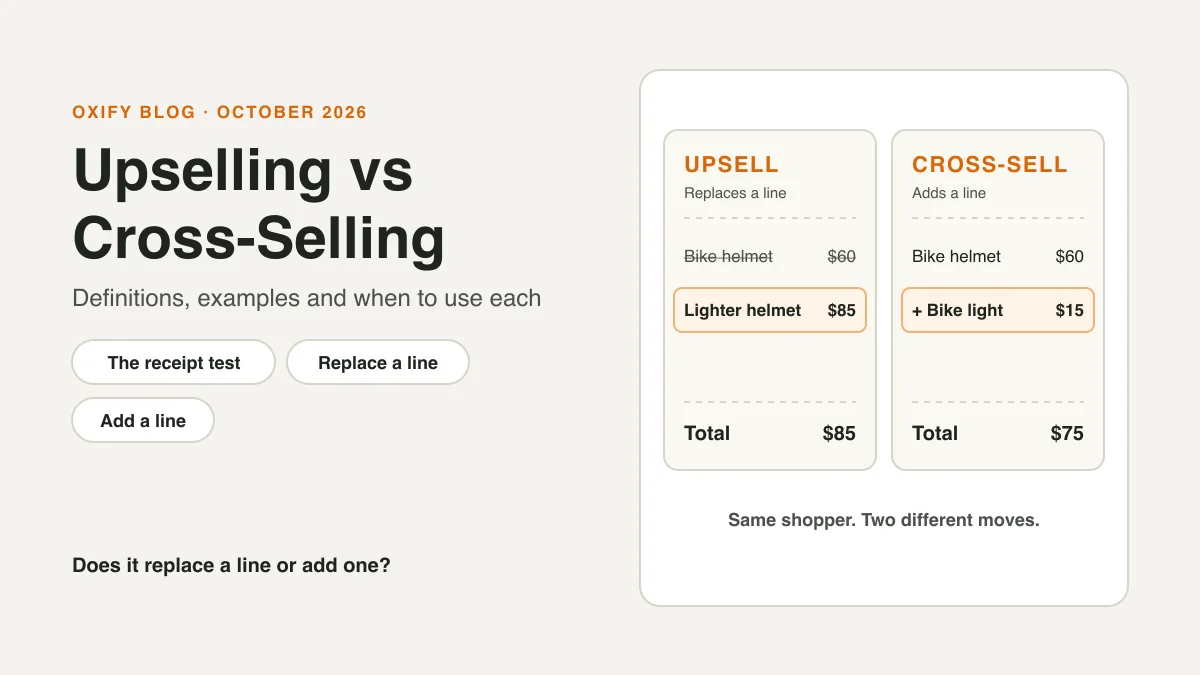
Upselling means offering a better or bigger version of the item a shopper is already buying. Cross-selling means offering a related item that goes with it.
The key difference: an upsell replaces the choice, and a cross-sell adds to it. Picture the receipt. If the new item replaces a line, it's an upsell. If it adds a line, it's a cross-sell.
I'm Aditya, co-founder of Oxify, a Shopify upsell app. Below are plain definitions, examples, how to pick what to offer, and what I've seen work in real stores.
Jump to: the receipt test · upselling · cross-selling · side by side · what to offer · when to use each · is it legal? · FAQ
Quick Answer (For Skim Readers)
| Compare | Upsell | Cross-sell |
|---|---|---|
| What it does | Swaps in a better or bigger version | Adds a related item |
| Receipt test | Replaces a line | Adds a line |
| Example | A $60 helmet becomes the $85 one | A helmet plus a bike light |
| Raises order value by | A pricier choice, or more of the same item | More items per order |
| Main risk | Price shock | Clutter, or an item that doesn't fit |
Everyday Examples
The idea is the same everywhere. These are the classics.
| Setting | Upsell | Cross-sell |
|---|---|---|
| Phone shop | A phone with more storage | A case and a screen protector |
| Fast food | "Make it a large" | "Add fries?" |
| Software | The Pro plan instead of Basic | A training session |
| Hotel | A room with a view | Breakfast or airport pickup |
| Online store | The 3-pack instead of one | The matching conditioner |
The Receipt Test
When you're not sure which one you're looking at, picture the receipt.
| Offer | What changes on the receipt | Type |
|---|---|---|
| $40 shirt becomes the $52 organic-cotton one | One line, new price | Upsell |
| $40 shirt plus a $15 belt | New line added | Cross-sell |
| Single notebook becomes a 3-pack | Same line, more units | Upsell |
| Tent plus a ground sheet | New line added | Cross-sell |
| $30 monthly box becomes a $300 yearly plan | One line, new plan | Upsell |
| $3 gift wrap | New line added | Cross-sell |
Some offers do both. A "starter kit" that replaces a single item and adds two extras is an upsell and a cross-sell in one. Don't worry about the label. Ask what the shopper gets.
Offers People Argue About
Guides don't agree on these. The receipt test breaks the tie.
| Offer | On the receipt | Our call |
|---|---|---|
| Extended warranty | Adds a line | Cross-sell (many guides call it an upsell) |
| Bundle | Depends | Upsell if it swaps one item for a bigger set. Cross-sell if it adds partners. |
| Quantity break ("buy 3, save 10%") | Same line, more units | Upsell |
| Subscribe and save | One-time line becomes a plan | Upsell |
What Is Upselling?
Upselling is offering a higher-value version of the item a shopper is already considering. The shopper still buys one thing. It just costs more, and it should be worth more to them.
Four common ways to upsell in a store:
- A better model. Good, better, best. A $60 helmet next to an $85 lighter one.
- A bigger size or pack. A 6-pack becomes a 12-pack. One candle becomes a set of three.
- A longer plan. Monthly becomes yearly. One delivery becomes a subscription.
- A premium touch. Leather instead of canvas. A longer guarantee.
Where it fits best: the product page, while the shopper is still choosing. Once they've added the item to the cart, a big upgrade feels like reopening the decision.
What Is Cross-Selling?
Cross-selling is suggesting a related item that goes with what the shopper is buying. They keep their first choice and add to it.
Five common ways to cross-sell:
- A natural partner. Shampoo and its conditioner.
- An accessory. A dog bed and a washable cover.
- A care item. Leather boots and a waterproof spray.
- A refill or consumable. A pen and a pack of refills.
- Protection. A repair kit or an extended warranty.
Where it fits best: the cart, where small add-ons are an easy yes, and the moment after payment. Our guide to in-cart upsells shows how to keep these offers small and on topic.
A Cross-Sell We Built: Replenhair
When we set up Replenhair's cart drawer, the cross-sell was easy to spot. Replenhair is a UK brand that sells hair care for textured hair. Almost every product has a partner: a shampoo wants its conditioner, a growth oil wants a scalp serum.
The hard part was the price. The store already ran promotions of 20% to 50%, so a full-price add-on had little pull. We gave the add-on row its own 10% saving. That gave shoppers a reason to say yes now, on this order.
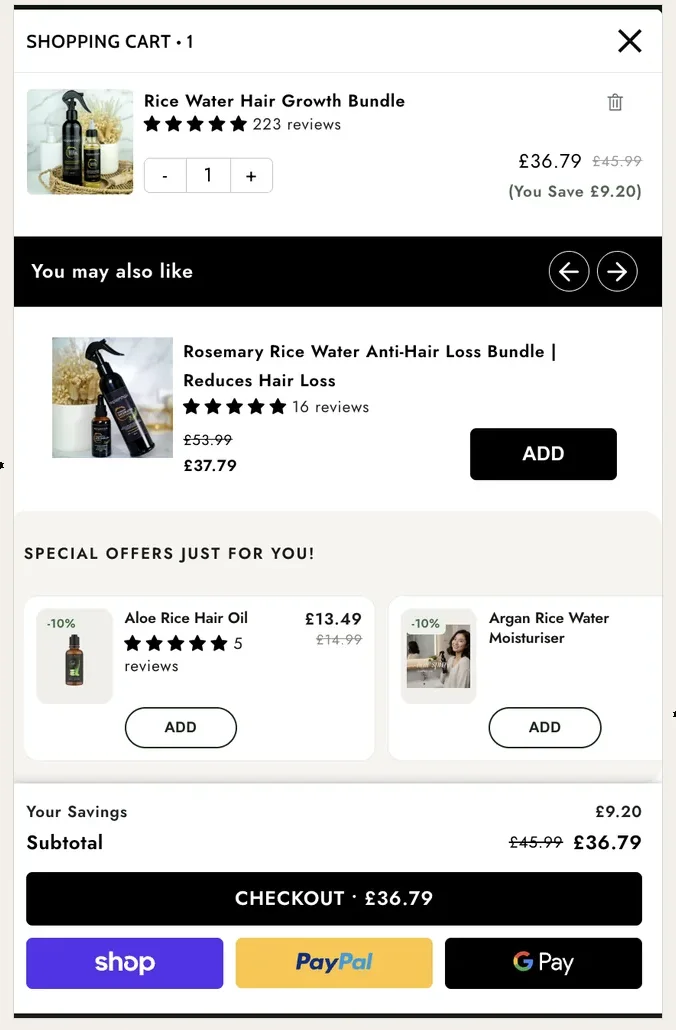
In our dashboard, that cart drawer earned £8,742, about 57% of the store's £15,451 in app-attributed revenue (read 31 July 2026). That is our own data, not a controlled test.
Replenhair's own review of our app on the Shopify App Store says: "we have seen the AOV has increased." The full story is in the Replenhair case study.
Upselling vs Cross-Selling, Side by Side
| Question | Upselling | Cross-selling |
|---|---|---|
| What is the goal? | A higher-value choice | More items per order |
| What does the shopper do? | Swaps their choice | Keeps it and adds |
| How big is the ask? | Bigger. It changes the main purchase. | Smaller. It's an extra. |
| Best moment | While choosing | When ready to pay, or just after |
| What can go wrong? | The price jump scares them off | The item doesn't fit, or there are too many |
| What to watch | Average order value | Items per order |
Both raise average order value (AOV), which is the average amount each order brings in. Here is a simple example:
| Move | Order total | Gain |
|---|---|---|
| Starting order: one $30 item | $30 | |
| Upsell: swap for the $42 version | $42 | +$12 |
| Cross-sell: add a $10 item | $40 | +$10 |
| Both | $52 | +$22 |
Pros and Cons
| Upselling | Cross-selling | |
|---|---|---|
| Pros | More revenue from the same shopper. Often more margin per sale. Usually no extra item to pack. | Small asks are easy to accept. Can build a routine. Raises items per order. |
| Cons | A big jump can scare people off. An upgrade that disappoints can bring returns. | Random items feel like clutter. Each add-on needs stock, packing and shipping. |
How to Choose What to Offer
The label matters less than the pick. Here is how I'd choose.
- Ask what the item needs to be used. A camera needs a memory card. A plant needs a pot.
- Look at your past orders. Which items keep showing up together? Those pairs are already proven.
- Put big asks early and small asks late. Show upgrades on the product page, while the shopper is choosing. Save small add-ons for the cart.
- Use your free-shipping line. If a cart is $6 short of free shipping, a $6 to $10 add-on solves a real problem for the shopper.
- Set the pairs by hand where it matters. Shopify's free Search & Discovery app lets you pick up to 10 complementary products for each product.
| Main item | Good offer | Poor offer |
|---|---|---|
| Running shoes | Running socks | A winter coat (a different trip) |
| Shampoo | The matching conditioner | A hair dryer at 3 times the cart |
| Dog bed | A washable cover | A cat toy |
| Leather boots | Waterproof spray | A second pair of boots |
| Coffee beans | The bigger bag, or a subscription | A tea set |
My rule of thumb for cart add-ons: about 10% to 25% of the cart total. That comes from practice, not from a Shopify rule, so test it.
Where Each One Fits on Shopify
Each spot in your store suits one tactic more than the other. This map is our rule of thumb, not data.
| Spot | Upsell | Cross-sell |
|---|---|---|
| Product page | Best: a bigger pack or a better version | Good: a "bought together" pair |
| Variant picker | Good: tag the 3-pack "best value" | Rarely |
| Cart drawer | Light: swap to a bigger pack | Best: one small add-on |
| Checkout (Plus) | Rarely | Good: a small checkbox add-on |
| After payment | Good: a pack deal | Best: one matching item |
| Follow-up email | Good: "subscribe and save" | Good: "goes with your order" |
Want the set-up steps for each spot, with and without an app? Follow how to upsell on Shopify, step by step.
When to Use Each
Watch what the shopper is doing, then pick.
| What the shopper is doing | Use | Why |
|---|---|---|
| Comparing sizes or versions | Upsell | They're already choosing. Show the better option. |
| In the cart, ready to pay | Cross-sell | Don't reopen the decision. Add something small. |
| Just paid | Cross-sell or pack deal | The first order is already safe. |
| Buying a refill again | Upsell | A bigger pack or "subscribe and save" fits a repeat buyer. |
| Buying one high-priced item | Cross-sell | A care kit or protection feels fairer than a pricier model. |
One naming trap: a "post-purchase upsell" is a spot, not a tactic. The offer inside it can be a cross-sell, like a matching item, or a pack deal that acts like an upsell. We explain the spot in what is a post-purchase upsell, and compare all the spots in pre-purchase vs in-cart vs post-purchase upsells.
When to Skip an Offer
- The add-on can't ship with the order. A backordered extra can delay the whole parcel.
- The price jump is big. A $60 offer on a $25 cart feels like a second purchase.
- The item doesn't match. Dog food shoppers don't want a cat toy.
- The shopper is in a hurry. A gift with a deadline needs a fast, clean checkout.
- You already show three offers. Shopify's own guidance for post-purchase pages caps it at three offers in a row.
How fast does interest drop? Growth Suite, which makes a rival upsell app, measured 20 million sessions in its own stores (January to June 2026).
Shoppers said yes to 5% of the first offer they saw, 8% of the second, 6% of the third and 1% of the fourth. Our post on whether upsells hurt conversion rate has a simple break-even test.
Is Upselling Ethical? Is It Legal?
Upselling itself is normal and legal. Misleading shoppers is not. Keep to these:
- Never pre-tick an add-on. In the UK, an extra payment needs the shopper's express consent, and a pre-ticked box doesn't count. If you charge for one anyway, you must refund it.
- Show the full price. UK guidance from the regulator says the total price, including mandatory fees, must be shown upfront.
- Use real "was" prices. In the US, the FTC's pricing guides say a former price must be one you really offered, not one inflated to fake a discount.
- No fake deadlines. UK rules, updated in April 2025, ban falsely saying an offer is only available for a limited time. The guidance names a countdown clock that restarts as an example.
- Make "no" easy. Shopify's UX rules for post-purchase offers ask for clear options to accept or refuse, without pressuring customers.
- Be clear about subscriptions. If a "subscribe and save" offer renews, say so, and show how to cancel.
Rules differ by country and state, and this is not legal advice. Ask a lawyer to check your offers.
What to Measure
- Take rate: offers accepted ÷ offers shown.
- Attach rate: orders with an add-on ÷ all orders. It's the best check for cross-sells.
- Average order value: total sales ÷ number of orders. The best check for upsells.
- Revenue per visitor: total sales ÷ visitors. This is the judge. If it rises, keep the offer.
- Profit per order: revenue minus product cost, shipping and fees. A big add-on with thin margins can lose money.
Related Terms in Plain Words
| Term | What it means |
|---|---|
| Downsell | A cheaper offer shown after someone says no to the first one. See the upsell and downsell funnel. |
| Suggestive selling | A sales term for suggesting something extra, like "want fries with that?" People use it for both upsells and cross-sells. |
| Order bump | A small checkbox offer on the payment step, like "add gift wrap for $3." The box should start unticked. |
| Bundle | Two or more items sold together at one price. |
| Frequently bought together | A block that shows items other people bought with this one. It's a cross-sell. See FBT vs cross-sell vs related products. |
| Quantity break | A deal like "buy 3, save 10%." It's an upsell to more units. See quantity break strategies. |
Need help picking an app? We compare them in best Shopify upsell apps and best Shopify cross-sell apps. We make Oxify, which is on both lists, so read them with that in mind.
Frequently Asked Questions
What is the difference between upselling and cross-selling?
What is the difference between upsell, cross-sell and downsell?
Which is better for an online store, upselling or cross-selling?
Is a bundle an upsell or a cross-sell?
Is an extended warranty an upsell or a cross-sell?
Is a post-purchase upsell an upsell or a cross-sell?
Is upselling illegal?
Are upselling and cross-selling annoying to customers?
About This Guide
Written by Aditya Singh, co-founder of Oxify, which makes Shopify upsell apps. Offer data comes from Growth Suite's 2026 numbers, rules from Shopify's docs and UK and US law, and store figures from Oxify dashboards, all read on October 29, 2026.
Put Both to Work in Your Store
Oxify Cart Drawer & Upsells lets you show upgrades and add-ons in the cart drawer, on the product page and right after payment, with one dashboard for all three.
Start a 14-day free trial on the Shopify App Store, then begin with one offer that passes the receipt test.
My promise: put Oxify Cart Drawer live with at least one offer for 30 days. If your average order value hasn't gone up, email us and we'll refund 100% of what you paid. See pricing.